
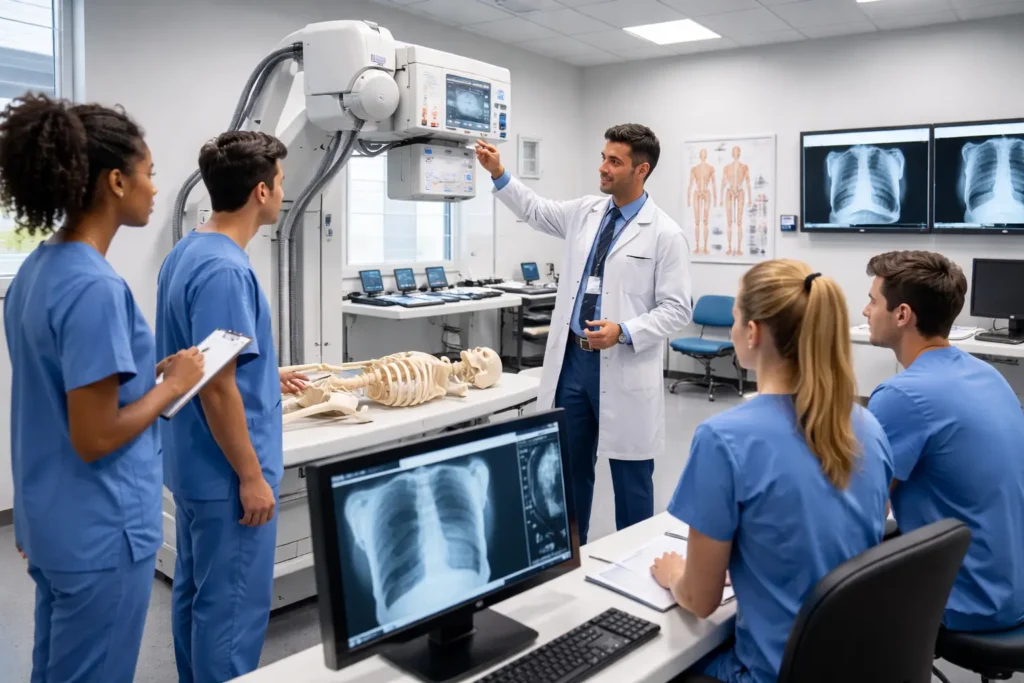
If you’ve been searching for an x-ray technology school, you’ve likely encountered a frustrating maze: school websites that pitch their programs, government sites that list regulatory requirements, and certification bodies that explain credentialing standards — but nothing that brings all of it together. That’s exactly what this guide does.
Whether you’re just starting to explore radiologic technology as a career or you’re ready to apply to a program next month, this resource covers every step of the journey: what you’ll study, how long it takes, how much it costs, which accreditation to look for, how to verify a school is legitimate, and what your career will look like after graduation.
According to the Bureau of Labor Statistics (BLS), radiologic technologists earn a median annual salary of $75,250, with job growth projected at 6% through 2032 — faster than the average for all occupations. The field is stable, rewarding, and in demand. Let’s make sure you choose the right school to get there.
What to Expect from an X-Ray Technology School
Before comparing programs, it’s important to understand what x-ray school actually involves. This isn’t a certification course you can complete in a weekend. Accredited programs are comprehensive, combining classroom instruction, laboratory practice, and real-world clinical experience in healthcare settings.
Many prospective students underestimate the academic rigor. Radiologic technology programs exist at the intersection of health sciences, physics, and patient care — three demanding disciplines that must be mastered simultaneously.
Core Curriculum: It’s More Than Just “Taking Pictures”
A common misconception is that x-ray technicians simply operate a machine. In reality, the curriculum is medically sophisticated and technically demanding. Here’s what you’ll cover in a standard accredited program:
- Anatomy and Physiology — Deep understanding of the human skeletal system, organ systems, and body cavities is essential for proper patient positioning and image interpretation.
- Radiographic Physics — How X-ray beams are produced, interact with tissue, and form diagnostic images. This includes kilovoltage, milliamperage, exposure settings, and digital imaging systems.
- Radiation Safety and Protection — How to protect patients, yourself, and colleagues from unnecessary radiation exposure using shielding, distance, and time principles.
- Medical Terminology — The language of healthcare. You’ll need to communicate effectively with physicians, nurses, and other clinical staff.
- Image Production and Quality — How to produce diagnostically useful images and troubleshoot poor-quality exposures.
- Patient Positioning — Over 200 standard positioning techniques, including how to work with injured, elderly, pediatric, or non-cooperative patients.
- Radiographic Pharmacology — Basics of contrast media, including barium and iodinated contrast agents used in fluoroscopic and specialized procedures.
- Radiobiology — How ionizing radiation affects human tissue at the cellular level and why radiation dose management matters.
Is it hard? Yes — and that’s a straightforward answer. The physics and anatomy components are genuinely challenging, and the clinical hours require mental endurance. However, thousands of students complete these programs every year with dedication and the right support. Study groups, anatomy apps, and hands-on lab practice are the most effective tools for getting through the tough content.
The Clinical Externship: Your Hands-On Training
Every accredited x-ray technology program includes a mandatory clinical externship — typically 1,200 or more hours of supervised, hands-on practice in a real healthcare setting. This is not optional or replaceable with simulations; it is a core requirement for ARRT exam eligibility.
During clinicals, you’ll rotate through hospital departments, outpatient imaging centers, and specialty areas like fluoroscopy suites, operating rooms, and emergency departments. You’ll perform actual X-rays on actual patients under the direct supervision of credentialed radiologic technologists.
One of the biggest unspoken anxieties prospective students have is: “Will I have to find my own clinical site?” The answer varies by program. The majority of JRCERT-accredited programs have established partnerships with local hospitals and clinics and will arrange your clinical placement for you. However, most programs cannot guarantee you’ll be placed at a location within a specific zip code, and some hybrid/online programs may require you to identify an affiliated site in your area. Always ask programs directly about their clinical placement process before enrolling.
Types of X-Ray Programs: Degrees, Certificates & Delivery Methods
Not all radiologic technology programs are created equal — and the type of program you choose will directly affect your career options, the time you invest, and the cost. Here’s a breakdown of every pathway available to you.
| Program Type | Duration | Typical Cost | ARRT Eligible | Best For |
| Certificate / Limited Permit | 9–18 months | $3,000–$12,000 | Limited (state-specific) | Quick entry, limited-scope work |
| Associate Degree (AAS/AS) | 20–24 months | $7,000–$18,000 | Yes (full ARRT) | Most students, standard career path |
| Bachelor’s Degree (BS/BSRT) | 3.5–4 years | $18,000–$50,000+ | Yes (full ARRT) | Management, teaching, specializations |
| Online/Hybrid (AAS) | 20–24 months | $10,000–$22,000 | Yes (full ARRT) | Working adults, flexible schedules |
Certificate & Limited Permit Programs (The Fast-Track Entry Point)
Certificate programs — sometimes called Limited Permit X-ray Technician (XT) programs — are the fastest way to enter the field and are available in many states, including California, Texas, and Florida. These programs typically run 9 to 18 months and train students to perform a defined, limited scope of imaging procedures, such as chest X-rays, extremity imaging, and spine films.
Limited permit technicians cannot perform fluoroscopy, trauma imaging, or pediatric care in most states without additional credentialing. Their scope of practice is legally defined by state health departments. They are not eligible to sit for the full ARRT certification exam unless they complete a full associate degree program.
This pathway makes sense for career changers who want affordable entry into healthcare imaging, or for people who are certain they’ll work in a specific, limited-scope setting like a chiropractic office or occupational health clinic.
Associate Degree in Radiologic Technology — The Standard Path
The Associate of Applied Science (AAS) or Associate of Science (AS) in Radiologic Technology is the most common and most recommended pathway for aspiring X-ray techs. These programs typically take 20 to 24 months to complete (excluding any prerequisite coursework), and upon graduation, you are eligible to sit for the ARRT’s nationally recognized certification examination.
Associate degree programs are offered at community colleges, vocational schools, and some four-year universities. Community college programs are typically the most affordable option, with total tuition often ranging from $7,000 to $15,000. Programs must hold JRCERT accreditation to be recognized by the ARRT.
This is the degree level required to work in hospitals, imaging centers, urgent care facilities, and most clinical settings across the United States.
Bachelor’s Degree — Advancing Your Career
A Bachelor of Science in Radiologic Technology (BSRT or BS) typically takes 3.5 to 4 years and is designed for technologists who want to move into leadership, education, or specialized modalities. Many bachelor’s programs are completion programs — meaning they accept graduates of associate degree programs and allow them to complete a bachelor’s degree in 1 to 2 additional years.
This degree opens doors to department management, radiologic technology education (teaching at the program level requires a bachelor’s degree at minimum), and cross-training into advanced imaging modalities like MRI, CT, mammography, and interventional radiology.
If you’re entering radiologic technology as a long-term career with ambitions beyond the technologist role, planning for a bachelor’s completion makes strategic sense even if you start with an associate degree.
Online X-Ray Technology Schools — Hybrid Learning Explained
“Online x-ray school” is one of the most searched phrases in this field — and one of the most misunderstood. Here’s the reality you need to understand before you commit to an online program:
Important: There is no such thing as a 100% online x-ray technology program. The JRCERT and ARRT both require in-person clinical hours. Any program claiming to be fully online and ARRT-eligible should be verified carefully — or avoided entirely.
What legitimate online programs offer is a hybrid model: didactic (classroom) coursework is completed online through a learning management system, while clinical hours are completed in person at an affiliated healthcare facility near you. This model works well for adult learners who are already working in healthcare or who have strong time management skills.
When evaluating a hybrid program, always ask:
- Is the program JRCERT-accredited? (Non-negotiable — verify at jrcert.org)
- Does the program have established clinical affiliates in my geographic area?
- Will the program assist with clinical placement, or am I responsible for finding my own site?
- Are all clinical hours required to be completed before graduation? (They should be)
The #1 Factor: Accreditation and State Approval — Don’t Skip This
Of all the decisions you’ll make when choosing an x-ray technology school, accreditation is the single most important factor. Enrolling in a non-accredited program can result in graduating with a credential that no employer will accept and that no state licensing board will recognize. It can mean wasting tens of thousands of dollars and years of your life.
There are two separate layers of accreditation you must verify for any program you’re considering.
Layer 1: JRCERT — Program-Level Accreditation
The Joint Review Committee on Education in Radiologic Technology (JRCERT) is the accrediting body recognized by both the U.S. Department of Education and the ARRT specifically for radiologic technology programs. JRCERT accreditation means the program has been rigorously evaluated for curriculum quality, clinical training standards, faculty credentials, student outcomes, and pass rates on the ARRT exam.
JRCERT accreditation is the gold standard — and it’s non-negotiable if your goal is to become a credentialed radiologic technologist. Without JRCERT accreditation, a program’s graduates are generally ineligible to sit for the ARRT certification examination.
You can verify any program’s JRCERT status directly at jrcert.org using their “Find a Program” search tool. Always do this before enrolling.
Layer 2: Regional Accreditation — School-Level Credibility
In addition to JRCERT program accreditation, the institution itself should hold regional accreditation from one of the recognized regional accrediting bodies (such as the Higher Learning Commission, SACSCOC, or WASC). Regional accreditation is required for students to be eligible for federal financial aid and ensures the institution meets baseline educational standards.
If a school is not regionally accredited, credits earned there generally cannot be transferred to other institutions, and the degree may not be recognized by employers or licensing boards. Always verify institutional accreditation at the U.S. Department of Education’s database at ope.ed.gov.
Layer 3: State Approval and Licensure Requirements
Beyond accreditation, most states require radiologic technologists to obtain a state license to practice — in addition to ARRT certification. State requirements vary significantly, and some states are more stringent than others.
For example, California requires radiologic technologists to hold a Radiologic Technology Certification Certificate (RTCC) issued by the California Department of Public Health (CDPH), in addition to ARRT certification. California also maintains a separate category for Limited Permit X-ray Technicians with its own approved school list.
Before enrolling in any program, visit your state health department’s website and look up the specific requirements for radiologic technology licensure in your state. Do not assume that ARRT certification alone is sufficient to work legally in every state.
How to Verify a School — Step-by-Step
Use this checklist every time you’re evaluating a program:
| 1 | Go to jrcert.org → click “Find a Program” → search by state or school name. Confirm the program is listed as ‘Accredited’ (not provisional or on warning). |
| 2 | Go to the U.S. Department of Education database (ope.ed.gov/accreditation) → confirm the institution holds regional accreditation from a recognized body. |
| 3 | Visit your state health department’s radiologic technology page → look for a list of approved programs or state-specific licensure requirements. |
| 4 | Go to arrt.org → review the eligibility requirements for the certification exam, including the primary eligibility pathway and ethics requirements. |
| 5 | Contact the program directly and ask: What is your ARRT first-time pass rate? Where do your graduates work? What is your clinical placement process? |
The True Cost of X-Ray School and Financial Aid
The cost of an x-ray technology school depends heavily on the type of institution, your state residency, and whether you’re pursuing a certificate, associate, or bachelor’s degree. Here are realistic cost ranges based on national data:
- Community College Associate Degree Programs: $7,000 – $15,000 total tuition (in-state). These are the most affordable and often the highest-quality pathways.
- Vocational/Technical School Certificate Programs: $8,000 – $18,000. Costs vary widely based on program length and facility quality.
- Private College Associate or Bachelor’s Programs: $20,000 – $50,000+. Higher tuition, but may offer more scheduling flexibility and student support services.
- Online/Hybrid Associate Programs: $10,000 – $22,000. Watch for programs that charge higher per-credit rates than their on-campus counterparts.
Remember that tuition is not the only cost. Budget for application fees, background checks and drug screening, clinical uniform and equipment (stethoscope, radiation dosimeter, etc.), textbooks and online learning platforms, liability insurance (sometimes required for clinicals), and the ARRT exam fee ($225 as of recent data).
Financial Aid for X-Ray Technology Students
If you enroll in a regionally accredited institution, you are generally eligible to apply for federal financial aid through the FAFSA. This can include Pell Grants (which do not need to be repaid), subsidized and unsubsidized federal student loans, and work-study programs.
Many states also offer healthcare workforce scholarships and grants specifically for students entering allied health fields. Additionally, some hospital systems offer tuition assistance or loan forgiveness programs for employees who enroll in radiologic technology programs — check with local hospital HR departments if you’re already working in healthcare.
Important: Only students at regionally accredited institutions qualify for federal financial aid. If a program is not regionally accredited, you will be paying entirely out of pocket. This is a major financial risk to avoid.
Your Career After Graduation: Salary, Settings, and Growth
Radiologic technologists enjoy a stable, well-compensated career with real variety in work settings. According to the Bureau of Labor Statistics (BLS) Occupational Outlook Handbook, radiologic technologists and technicians earn a median annual salary of $75,250, with the top 10% earning over $100,000. Job growth is projected at 6% from 2022 to 2032, adding approximately 14,400 new positions nationally.
| Work Setting | Typical Environment | Salary Range |
| Hospitals | High-volume, emergency imaging, inpatient care | $60,000–$90,000+ |
| Outpatient Clinics | Routine imaging, scheduled appointments | $55,000–$78,000 |
| Diagnostic Imaging Centers | Specialized imaging, MRI, CT, X-ray | $58,000–$82,000 |
| Urgent Care / Orthopedics | Injury imaging, fast-paced, diverse cases | $52,000–$72,000 |
| Mobile Imaging Units | Travel-based, nursing homes, remote facilities | $55,000–$80,000 |
| Government / VA | Federal benefits, steady hours, veteran care | $62,000–$92,000 |
Specialization Opportunities
One of the most valuable aspects of a career in radiologic technology is the ability to cross-train into advanced imaging modalities. Many techs begin in general X-ray and then pursue additional certification in:
- Computed Tomography (CT) — High-demand specialty with premium pay in most markets.
- Magnetic Resonance Imaging (MRI) — Requires additional training and ARRT MRI certification.
- Mammography — Requires ARRT mammography certification; dedicated field with strong demand.
- Fluoroscopy — Real-time imaging used in gastrointestinal and interventional procedures.
- Bone Densitometry (DEXA) — Evaluation of bone density, often added to general X-ray positions.
- Medical Dosimetry — Advanced specialty in radiation therapy planning (requires additional education).
Each specialty requires continuing education credits and typically a separate ARRT certification examination. This career ladder keeps radiologic technology financially and professionally dynamic throughout your working life.
faqs
How long is x-ray technician school?
It depends on the program type. Certificate or limited permit programs run 9 to 18 months. Associate degree programs — the standard pathway — take 20 to 24 months. Bachelor’s degree programs take 3.5 to 4 years, though many are designed as completion programs for those who already hold an associate degree.
Is x-ray technician school hard?
Yes, genuinely. The coursework in radiographic physics, anatomy and physiology, and radiation biology is medically and scientifically rigorous. The clinical rotations are physically demanding and emotionally challenging. However, students who prepare with consistent study habits, use anatomy visualization tools, and engage actively in their clinical rotations consistently succeed. The difficulty is manageable — but don’t underestimate it going in.
Can you become an x-ray tech online?
Partially. You can complete the didactic (classroom) portion of a program online through a hybrid model. However, there is no accredited, ARRT-eligible program that is 100% online. All legitimate programs require in-person clinical hours — typically 1,200 or more hours — at an affiliated healthcare facility. Be extremely skeptical of any program that claims to be fully online and ARRT-eligible.
Do you need a degree to be an x-ray tech?
For full-scope radiologic technologist certification through the ARRT, you need at minimum an associate degree from a JRCERT-accredited program. In some states, limited permit X-ray technicians can work with a certificate-level credential, but their scope of practice is legally restricted and they cannot sit for full ARRT certification. If you want a full, unrestricted career in diagnostic imaging, plan for the associate degree.
How much does x-ray tech school cost?
Total program costs range from approximately $7,000 at community colleges (for in-state students in associate degree programs) to $25,000 or more at private vocational schools or colleges. Online/hybrid programs often fall in the $10,000–$22,000 range. Factor in additional costs for uniforms, equipment, books, exam fees, and background checks. If you attend a regionally accredited institution, federal financial aid — including Pell Grants — may be available.
What accreditation should an x-ray school have?
Two types: (1) The program itself must hold JRCERT accreditation — the only accreditation recognized by the ARRT for radiologic technology program graduates. Verify at jrcert.org. (2) The institution should hold regional accreditation from a recognized regional accrediting body, which is required for federal financial aid eligibility and ensures credit transferability. Verify at ope.ed.gov.
What is the difference between ARRT and state licensure?
ARRT certification is a national, voluntary credential issued by the American Registry of Radiologic Technologists. It demonstrates that you’ve passed a rigorous examination and met educational standards. State licensure is a legal requirement in most states that allows you to practice within that state’s borders. Most states require both: ARRT certification plus a separate state license or registration. Requirements vary; always check your specific state’s health department website.
Can I get financial aid for x-ray tech school?
Yes, if you attend a regionally accredited institution and meet FAFSA eligibility requirements. Federal aid options include Pell Grants, subsidized loans, and work-study. Some states offer allied health scholarships. Some hospital systems offer tuition assistance for employees pursuing radiologic technology credentials. Research local healthcare employers and state workforce development programs for additional funding opportunities.
How to Choose the Right X-Ray Technology School for You
With everything you’ve now learned, here’s how to apply it in your school search. Prioritize these factors in order:
1. JRCERT Accreditation — Non-Negotiable
Before anything else, verify JRCERT accreditation at jrcert.org. If a program isn’t on that list, move on. No exceptions.
2. ARRT First-Time Pass Rate
This is the single best proxy for program quality. JRCERT-accredited programs are required to report this data. Ask the program directly or look up their published outcomes. National average is approximately 88–90%. Programs below 80% are a red flag.
3. Cost vs. Value
Community college programs are almost always the best value if you’re seeking an associate degree. Private programs may offer conveniences like smaller class sizes or more flexible scheduling, but verify the value against the higher price tag. Calculate the total cost, not just per-semester tuition.
4. Clinical Placement Support
Ask every program: “Do you arrange clinical placements for students, and do you have affiliates in my area?” If the answer involves you finding your own site with little support, factor that risk into your decision — especially if you live in a rural area.
5. Schedule and Format
Be realistic about your life. Full-time traditional programs move fast and leave little room for outside work. Part-time and evening/weekend tracks exist in some programs and allow working adults to manage obligations. Online/hybrid programs work best for self-directed learners who are already working in healthcare settings.
6. Graduate Employment Data
Ask the program where their graduates work. A program with strong regional employer relationships will have answers ready. Vague responses or refusals to provide this data are warning signs.
Disclaimer: Program availability, costs, and state licensing requirements vary and change over time. The data referenced in this guide draws from the Bureau of Labor Statistics, JRCERT, and ARRT publications. Always verify accreditation status directly with JRCERT (jrcert.org) and confirm state-specific requirements with your state health department before enrolling in any program.
Your Path to a Career in Radiologic Technology Starts with the Right School
Verify accreditation at jrcert.org | Check state requirements at your state health department | Review ARRT eligibility at arrt.org

Adrian Cole is a technology researcher and AI content specialist with more than seven years of experience studying automation, machine learning models, and digital innovation. He has worked with multiple tech startups as a consultant, helping them adopt smarter tools and build data-driven systems. Adrian writes simple, clear, and practical explanations of complex tech topics so readers can easily understand the future of AI.