
If you’ve ever sat in a leadership meeting, scanned a corporate dashboard, or heard someone say, “Let’s review this in the MBR,” you might have paused and wondered: what does MBR stand for in business—and why does it seem so important?
You’re not alone.
MBR is one of those acronyms that shows up everywhere—from startups to Fortune 500 boardrooms—but rarely gets explained clearly. And yet, understanding it can dramatically improve how you track performance, align teams, and make smarter decisions.
In this guide, we’ll go far beyond a basic definition. You’ll learn:
- What MBR really means in different business contexts
- How companies actually use it in real life
- Why it’s critical for growth, accountability, and strategy
- A step-by-step process to run an effective MBR
- Tools, mistakes to avoid, and expert insights
By the end, you won’t just know what MBR stands for—you’ll know how to use it like a pro.
What Does MBR Stand for in Business?
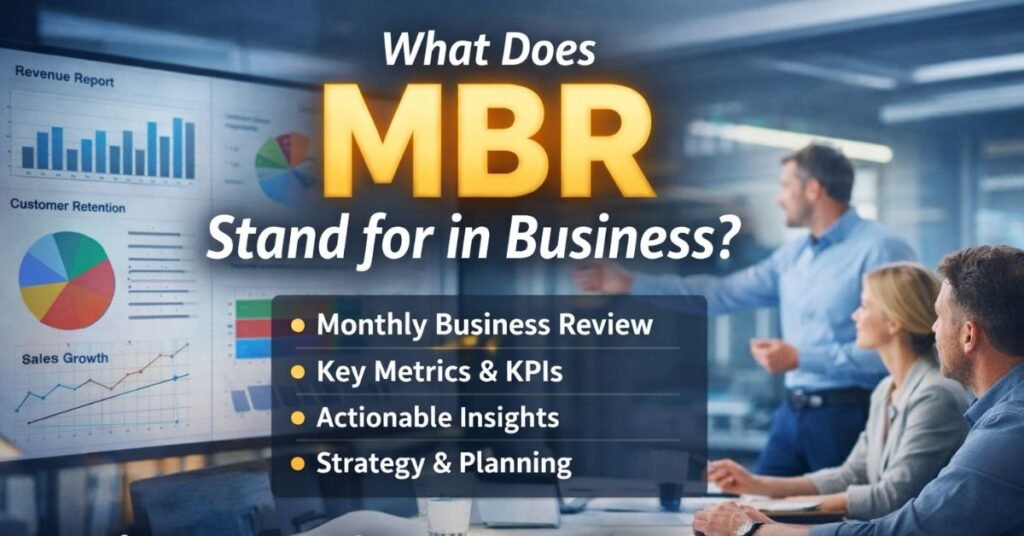
MBR most commonly stands for Monthly Business Review.
At its core, a Monthly Business Review is a structured meeting where teams evaluate performance over the past month, analyze key metrics, and make decisions for the future.
But here’s where it gets interesting.
Depending on the context, MBR can also stand for:
- Monthly Business Report – a document summarizing performance
- Management Business Review – a leadership-level strategic review
- Merchant Business Review – used in eCommerce and vendor relationships
- Marketing Business Review – focused on campaign and growth metrics
Still, in most modern organizations, when someone says “MBR,” they’re referring to a Monthly Business Review meeting or process.
Think of it like this:
If your business were a car, the MBR is your monthly dashboard check—fuel levels, engine health, speed, direction, and whether you’re still heading toward your destination.
Without it, you’re driving blind.
Why MBR Matters More Than Most People Realize
Many businesses operate reactively—fixing problems only when they become urgent. The MBR flips that approach.
Instead of reacting, you anticipate, analyze, and align.
Here’s why MBRs are essential:
1. They Create Accountability
When teams know their performance will be reviewed monthly, something powerful happens: ownership increases.
Sales teams track revenue more carefully. Marketing teams measure campaign impact more precisely. Operations teams focus on efficiency.
MBRs create a rhythm of accountability that’s hard to replicate elsewhere.
2. They Turn Data Into Decisions
Data alone is useless without interpretation.
An MBR forces teams to answer questions like:
- Why did revenue drop this month?
- Which campaign actually drove conversions?
- Where are we losing customers?
It’s not just about reporting numbers—it’s about understanding them.
3. They Align Teams Around Goals
One of the biggest challenges in business isn’t strategy—it’s alignment.
Different departments often operate in silos. MBRs bring everyone together, ensuring:
- Sales, marketing, and operations are on the same page
- Leadership communicates priorities clearly
- Teams understand how their work impacts the bigger picture
4. They Help Spot Trends Early
A single bad week might be noise. But a consistent monthly trend? That’s a signal.
MBRs help you identify:
- Declining customer retention
- Rising acquisition costs
- Seasonal patterns
- Emerging opportunities
Catching these early can save (or make) millions.
Breaking Down the Monthly Business Review (MBR)
Let’s make this simple.
A Monthly Business Review typically includes three core components:
1. Performance Review
This is where you look at key metrics from the past month:
- Revenue
- Profit margins
- Customer growth
- Conversion rates
- Operational efficiency
The goal is not just to present numbers—but to interpret them.
2. Insights and Analysis
This is where the real value lies.
Instead of saying:
“Revenue dropped by 10%.”
You ask:
“Why did revenue drop by 10%?”
Possible answers:
- Seasonal slowdown
- Marketing campaign underperformed
- Sales pipeline weakened
This turns data into insight.
3. Action Planning
Every MBR should end with clear next steps:
- What needs to change?
- What should we double down on?
- Who is responsible?
Without action, an MBR is just a meeting.
Real-World Examples of MBR in Action
To truly understand what MBR stands for in business, let’s look at how different industries use it.
SaaS Company
A software company might use MBRs to track:
- Monthly Recurring Revenue (MRR)
- Customer churn rate
- Customer acquisition cost (CAC)
- Product usage metrics
If churn spikes, the team investigates onboarding issues or product bugs.
eCommerce Business
An online store might focus on:
- Sales revenue
- Average order value
- Conversion rate
- Inventory turnover
If conversions drop, they might test new landing pages or pricing strategies.
Marketing Agency
An agency’s MBR might include:
- Client performance metrics
- Campaign ROI
- Lead generation
- Client retention
They may use MBRs to justify strategy changes to clients.
Enterprise Organization
Large companies use MBRs to:
- Align departments
- Review financial performance
- Evaluate strategic initiatives
These MBRs often involve senior leadership and can shape company-wide decisions.
Step-by-Step Guide to Running an Effective MBR
Now let’s get practical.
Here’s how to run a Monthly Business Review that actually delivers results.
Step 1: Define Clear Objectives
Before scheduling an MBR, ask:
- What do we want to achieve?
- What decisions need to be made?
Without clarity, the meeting becomes unfocused.
Step 2: Choose the Right Metrics
Focus on metrics that matter—not vanity metrics.
Good examples:
- Revenue growth
- Customer retention
- Profit margins
- Sales pipeline health
Avoid cluttering the review with unnecessary data.
Step 3: Prepare Data in Advance
Never walk into an MBR unprepared.
Create:
- Dashboards
- Reports
- Visual summaries
This allows the meeting to focus on discussion—not data gathering.
Step 4: Structure the Meeting
A strong MBR agenda might look like this:
- Overview of key metrics
- Department updates
- Deep dive into issues
- Opportunities and wins
- Action items
Keep it structured but flexible.
Step 5: Encourage Honest Discussion
MBRs should be safe spaces for truth—not blame.
Encourage:
- Open communication
- Constructive feedback
- Problem-solving mindset
The goal is improvement, not finger-pointing.
Step 6: Document Decisions and Actions
Every MBR should produce:
- Clear action items
- Assigned responsibilities
- Deadlines
If it’s not documented, it won’t get done.
Step 7: Follow Up
The next MBR should begin with:
- Reviewing previous action items
- Measuring progress
This creates continuity and accountability.
Tools to Power Your MBR (Free vs Paid)
The right tools can make or break your MBR process.
Free Tools
Great for startups and small teams:
- Google Sheets – simple reporting and dashboards
- Google Data Studio (Looker Studio) – visual dashboards
- Trello / Notion – tracking action items
Pros:
- Low cost
- Easy to use
- Flexible
Cons:
- Limited automation
- Can become messy at scale
Paid Tools
Ideal for growing or enterprise businesses:
- Tableau – advanced data visualization
- Power BI – powerful analytics and reporting
- HubSpot – integrated marketing and sales reporting
- Salesforce dashboards – enterprise-level insights
Pros:
- Automation
- Real-time data
- Scalability
Cons:
- Cost
- Learning curve
Expert Tip
Start simple.
Many businesses overcomplicate MBRs with fancy tools when a clean spreadsheet would work better. Upgrade only when necessary.
Comparing MBR with QBR and WBR
You might also hear terms like QBR or WBR. Here’s how they differ.
MBR (Monthly Business Review)
- Frequency: Monthly
- Focus: Operational performance
- Use: Tracking short-term progress
QBR (Quarterly Business Review)
- Frequency: Quarterly
- Focus: Strategic direction
- Use: Big-picture planning
WBR (Weekly Business Review)
- Frequency: Weekly
- Focus: Tactical updates
- Use: Day-to-day performance
Think of it like this:
- WBR = heartbeat
- MBR = health check
- QBR = long-term vision
Each serves a different purpose.
Common Mistakes in MBRs (And How to Fix Them)
Even experienced teams get MBRs wrong.
Here are the most common pitfalls.
Mistake 1: Turning It Into a Data Dump
Problem:
Teams present endless charts without insights.
Fix:
Focus on “so what?” after every metric.
Mistake 2: Lack of Preparation
Problem:
Meetings waste time gathering data.
Fix:
Prepare reports in advance and share them beforehand.
Mistake 3: No Clear Outcomes
Problem:
Meetings end without decisions.
Fix:
Always define action items and owners.
Mistake 4: Blame Culture
Problem:
Teams fear being criticized.
Fix:
Promote a culture of learning and improvement.
Mistake 5: Tracking Too Many Metrics
Problem:
Information overload leads to confusion.
Fix:
Focus on a handful of key performance indicators (KPIs).
Best Practices for High-Impact MBRs
If you want your MBR to stand out, follow these principles.
Keep It Focused
Less is more. Prioritize what truly matters.
Use Visual Data
Charts and graphs make insights easier to understand.
Tell a Story
Data should tell a narrative:
- What happened
- Why it happened
- What happens next
Involve the Right People
Include decision-makers—not just presenters.
Continuously Improve the Process
Treat your MBR like a product:
- Gather feedback
- Refine structure
- Optimize over time
Who Should Use MBRs?
The short answer: almost every business.
But here’s a clearer breakdown.
Startups
- Track growth
- Identify early issues
- Stay aligned
Small Businesses
- Improve decision-making
- Monitor finances
- Optimize operations
Agencies
- Report to clients
- Track campaign performance
- Improve retention
Enterprises
- Align departments
- Drive strategic execution
- Monitor large-scale performance
If your business has goals (and it should), you need an MBR.
The Hidden Power of MBR: Culture and Discipline
Here’s something most articles won’t tell you.
MBRs aren’t just about data—they shape company culture.
A strong MBR process creates:
- Discipline
- Transparency
- Accountability
- Continuous improvement
Over time, this becomes part of your company’s DNA.
Teams stop guessing and start measuring.
Leaders stop reacting and start anticipating.
That’s where real growth happens.
Conclusion
So, what does MBR stand for in business?
At its simplest, it means Monthly Business Review.
But in practice, it’s much more than that.
It’s a system for:
- Tracking performance
- Aligning teams
- Making smarter decisions
- Driving consistent growth
Whether you’re running a startup, managing a team, or scaling a company, implementing a strong MBR process can be a game-changer.
If you haven’t started yet, begin simple:
- Pick your key metrics
- Schedule a monthly review
- Focus on insights and action
And if you already run MBRs, refine them. Make them sharper, clearer, more actionable.
Because in business, what gets reviewed—gets improved.
FAQs
What does MBR stand for in business?
MBR stands for Monthly Business Review. It’s a regular meeting or report used to evaluate performance, analyze metrics, and plan next steps.
What is included in an MBR?
An MBR typically includes performance metrics, insights and analysis, and action plans for improvement.
How is MBR different from QBR?
MBR focuses on monthly operational performance, while QBR (Quarterly Business Review) focuses on long-term strategy.
Who should attend an MBR?
Key stakeholders such as managers, team leads, and decision-makers should attend to ensure alignment and accountability.
How long should an MBR meeting last?
Most MBR meetings last between 60–120 minutes, depending on the size and complexity of the business.

Michael Grant is a business writer with professional experience in small-business consulting and online entrepreneurship. Over the past decade, he has helped brands improve their digital strategy, customer engagement, and revenue planning. Michael simplifies business concepts and gives readers practical insights they can use immediately.