
If you’ve ever waited for a bank transfer, shipping delivery, refund, or job offer, you’ve probably seen the phrase “allow 3–5 business days.” And like most people, you might have paused and wondered: what are business days, exactly—and why do they feel longer than regular days?
This simple phrase shapes how money moves, how packages arrive, how contracts are enforced, and even how customer service promises are measured. Yet many people don’t fully understand what counts as a business day, when the clock actually starts, or why weekends and holidays suddenly seem invisible in official timelines.
Understanding business days isn’t just useful—it’s practical life knowledge. Whether you run an online store, work in finance, ship products, manage payroll, or simply want to know when your refund will show up, this guide will give you complete clarity.
In this in-depth article, you’ll learn:
- The precise meaning of business days in different industries
- How banks, shipping companies, and employers calculate them
- Real-world scenarios that explain confusing timelines
- Step-by-step ways to calculate business days correctly
- Common mistakes people make (and how to avoid them)
- Tools, comparisons, and expert insights to save time and stress
By the end, you’ll never be confused by “3–5 business days” again.
What Are Business Days? A Clear, Beginner-Friendly Explanation
At its simplest, business days are the standard working days used by companies, banks, government offices, and service providers to measure time for operations and deadlines.
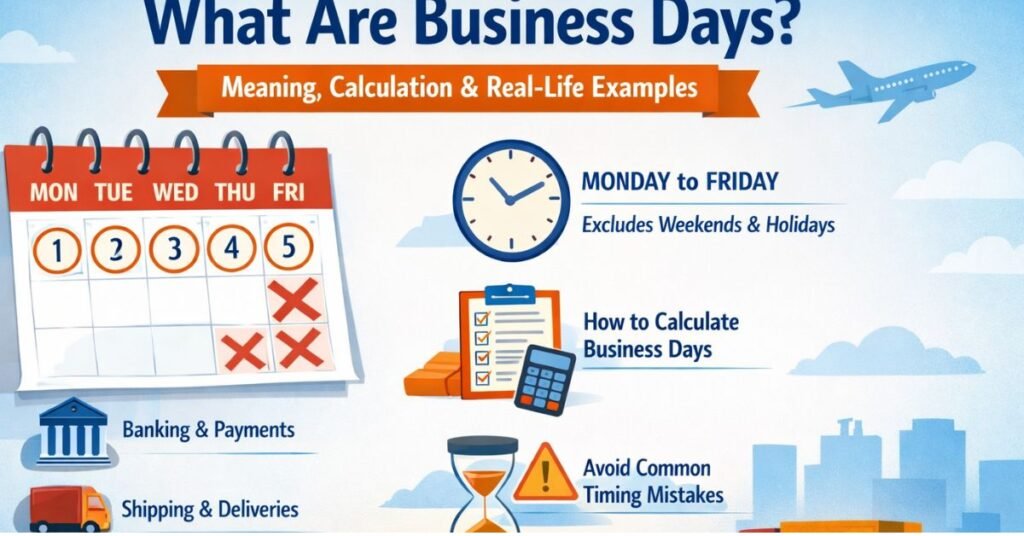
In most countries, a business day typically means:
- Monday through Friday
- Excluding weekends (Saturday and Sunday)
- Excluding public holidays
So if someone says “5 business days,” they usually mean five working weekdays, not five calendar days.
Here’s a quick example:
- You submit a refund request on Friday
- The company promises processing in 3 business days
The count usually goes:
- Monday → Day 1
- Tuesday → Day 2
- Wednesday → Day 3
Your refund would likely process by Wednesday, not Monday.
This difference between calendar days and business days is where most confusion happens.
Think of it like this:
- Calendar days = every day on the calendar
- Business days = only days when offices are open and work actually happens
If a task requires human approval, banking systems, logistics staff, or office processing, it almost always follows business days, not calendar days.
Why Business Days Matter in Everyday Life
Most people only notice business days when they’re waiting for something. But behind the scenes, business days quietly control huge parts of modern life.
They determine:
- When salaries arrive
- When loans are approved
- When legal deadlines expire
- When online orders ship
- When refunds return to your account
Without a shared definition of working time, companies couldn’t set reliable expectations.
Imagine if a bank promised a transfer in “3 days” but counted weekends—while another bank didn’t. Chaos.
Business days create predictability, and predictability creates trust.
Real-World Situations Where Business Days Appear
You’ll commonly see business days used in:
- Banking transfers and check clearing
- Credit card refunds
- Shipping and delivery estimates
- HR hiring timelines
- Legal contracts and notices
- Government processing times
- Customer service response windows
Even digital services—like payment processors or freelance platforms—often rely on business days because money movement still depends on traditional banking infrastructure.
So while the internet runs 24/7, the financial system underneath it still runs on business time.
How Different Industries Define Business Days
Here’s where things get interesting: not all business days are identical.
Different industries adjust the definition slightly based on how they operate.
Banking Business Days
Banks usually define business days as:
- Monday to Friday
- Excluding federal/public holidays
- Limited to official processing hours (often until 5 PM local time)
This means:
- A transfer made Friday night may count as Monday’s transaction
- A holiday can delay processing by an extra full day
That’s why wire transfers, ACH payments, and check deposits often feel slower than expected.
Shipping and Delivery Business Days
Shipping companies also use business days, but with logistics-specific rules:
- Warehouses may operate Saturday, but counting still excludes weekends
- Cut-off times determine when the clock starts
- Weather or customs delays don’t count as business days—but still delay delivery
So “2-day shipping” often means two business days after dispatch, not after purchase.
Government and Legal Business Days
Legal systems rely heavily on business days for fairness.
Courts, tax offices, and regulatory agencies typically:
- Exclude weekends and public holidays
- Extend deadlines if the final day falls on a non-business day
For example:
- If a legal filing deadline lands on Sunday
- The new deadline becomes Monday
This protects people from missing deadlines when offices are closed.
Benefits of Understanding Business Days
Knowing how business days work gives you a surprising advantage in everyday decisions.
Better Financial Planning
You’ll know:
- When payments truly arrive
- How long refunds actually take
- When to schedule transfers before deadlines
This prevents overdraft fees, late penalties, and unnecessary stress.
Smarter Online Shopping
Instead of guessing delivery times, you can:
- Calculate realistic arrival dates
- Choose faster shipping only when needed
- Avoid disappointment during holidays
Improved Professional Communication
When you understand business days, you can:
- Set realistic deadlines at work
- Write clearer contracts
- Manage client expectations professionally
This small detail makes you look organized, reliable, and experienced.
Step-by-Step Guide to Calculating Business Days Correctly
Let’s make this practical.
Here’s the simplest reliable method.
Step 1: Identify the Start Date
Ask:
- Does counting begin today or tomorrow?
- Is there a cut-off time?
Many services start counting the next business day, not the same day.
Step 2: Exclude Weekends
Remove:
- Saturday
- Sunday
Even if work happens internally, they usually don’t count.
Step 3: Check Public Holidays
Look for:
- National holidays
- Bank holidays
- Regional closures
Each holiday adds one extra non-business day.
Step 4: Count Forward Only on Valid Days
Move day-by-day, skipping:
- Weekends
- Holidays
Stop when you reach the promised number.
Quick Example
Promise: 5 business days
Start: Thursday
Count:
- Friday → Day 1
- Monday → Day 2
- Tuesday → Day 3
- Wednesday → Day 4
- Thursday → Day 5
Result: Next Thursday
Tools That Help You Track Business Days
You don’t always have to count manually.
Free Options
Online business day calculators
Pros:
- Fast and simple
- Automatically skip weekends/holidays
- Great for occasional use
Cons:
- Some lack regional holiday accuracy
- Limited customization
Calendar apps
Pros:
- Already on your phone
- Easy visual counting
Cons:
- Manual effort required
Paid or Advanced Tools
Project management software
Examples include timeline-based planning systems.
Pros:
- Automatic deadline calculation
- Team coordination
- Holiday integration
Cons:
- Subscription cost
- Overkill for simple needs
Accounting and payroll platforms
Pros:
- Built-in banking schedules
- Accurate payment timing
Cons:
- Only useful for financial workflows
For most people, a free calculator + awareness of holidays is enough.
Common Mistakes People Make With Business Days
Even experienced professionals get this wrong sometimes.
Mistake 1: Confusing Business Days With Calendar Days
This causes:
- Missed deadlines
- Late fees
- Wrong delivery expectations
Fix:
Always clarify “calendar or business days?”
Mistake 2: Ignoring Cut-Off Times
Submitting after 5 PM may shift everything by one full day.
Fix:
Send important requests early in the day.
Mistake 3: Forgetting Holidays
Public holidays quietly extend timelines.
Fix:
Check a holiday calendar before planning.
Some regions use:
- Sunday–Thursday workweeks
- Friday–Saturday weekends
Fix:
Confirm local business day definitions for international work.
Real-World Examples That Make Business Days Easy to Understand
Example 1: Bank Transfer Before a Weekend
Transfer sent: Friday evening
Processing starts: Monday
Arrival: Tuesday or Wednesday
Even though you waited four calendar days, only two business days passed.
Example 2: Online Store Refund
Refund promised: 7 business days
Includes: one public holiday
Actual wait: 8–9 calendar days
Normal—not a delay.
Example 3: Job Offer Response Deadline
HR says: Respond within 3 business days
You receive email: Thursday
Deadline becomes: Tuesday, not Sunday.
When Business Days Don’t Apply
Some services operate outside traditional rules.
24/7 Digital Systems
Examples:
- Cryptocurrency transfers
- Automated downloads
- AI-based services
These often run on calendar time, not business days.
Emergency or Premium Services
Such as:
- Same-day courier delivery
- Instant wire transfers
- Priority customer support
These bypass standard business timing—usually for extra cost.
Conclusion: Why Understanding Business Days Saves Time, Money, and Stress
Business days may seem like a small technical detail, but they quietly shape how the modern world functions.
They determine when:
- Money moves
- Packages arrive
- contracts expire
- decisions finalize
Once you truly understand what business days are, confusing timelines suddenly make sense.
You stop guessing.
You plan smarter.
You avoid frustration.
And most importantly—you gain control over expectations in both personal life and professional work.
Next time someone says “allow 3–5 business days,” you’ll know exactly what that means—and exactly when to expect results.
If this guide helped clarify things, consider sharing it or bookmarking it for the next time timing really matters.
FAQs
What are business days in simple terms?
Business days are weekdays (Monday–Friday) when companies and banks are open, excluding weekends and public holidays.
Do Saturdays count as business days?
Usually no, unless a specific company states otherwise.
Are business days the same worldwide?
No. Different countries have different weekends and holidays.
How many calendar days are 5 business days?
Typically 7 calendar days, but holidays can make it longer.
Do online payments follow business days?
Many still depend on banking systems, so yes.

Michael Grant is a business writer with professional experience in small-business consulting and online entrepreneurship. Over the past decade, he has helped brands improve their digital strategy, customer engagement, and revenue planning. Michael simplifies business concepts and gives readers practical insights they can use immediately.