
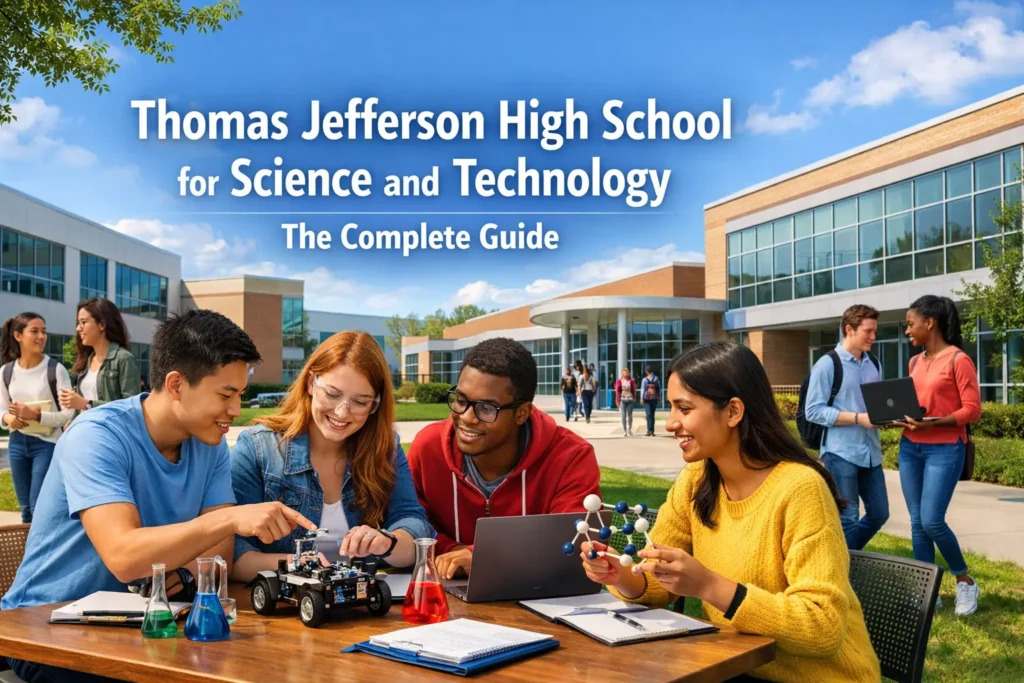
Thomas Jefferson High School for Science and Technology — widely known as TJHSST or simply “TJ” — is one of the most celebrated public high schools in the United States. Consistently ranked among the nation’s best, this STEM-focused magnet school sits in Alexandria, Virginia, and draws elite students from across Northern Virginia with a rigorous curriculum, world-class research labs, and a legacy of producing tomorrow’s scientists, engineers, and innovators.
Whether you’re a prospective student weighing your options, a parent trying to understand the admissions process, or simply curious about what makes this school exceptional, this guide covers everything you need to know — from rankings and research labs to application requirements and student life.
At a Glance: Key Facts & Figures
| Detail | Information |
|---|---|
| Full Name | Thomas Jefferson High School for Science and Technology |
| Common Names | TJHSST, TJ |
| Address | 6560 Braddock Rd, Alexandria, Virginia 22312 |
| Phone | (703) 750-8300 |
| Type | Public Magnet / Virginia Governor’s School |
| District | Fairfax County Public Schools (FCPS) |
| Grades | 9–12 |
| Enrollment | ~2,015 students |
| Student-Teacher Ratio | 17:1 |
| Principal | Michael Mukai |
| Mascot | Colonials |
| US News National Rank | #5 (National), #1 in Virginia |
| Graduation Rate | 100% |
| Website | tjhsst.fcps.edu |
Why TJHSST? A Legacy of Excellence in STEM
National Rankings & Accolades
Thomas Jefferson High School for Science and Technology doesn’t just compete at the top of Virginia’s educational landscape — it competes at the top of the nation’s. Year after year, TJ earns its place among the very best high schools in America.
- US News & World Report: Ranked #5 nationally and #1 in Virginia, with a perfect College Readiness Index score of 100/100.
- Niche.com: Consistently earns an A+ overall grade, placing it among the top STEM schools in the country.
- AP Exam Participation: 100% of students participate in AP exams, with a pass rate exceeding 94%.
- State Assessment Performance: Math proficiency at 99%, Reading at 98%, and Science at 100%.
TJ is also a proud member of the National Consortium for Specialized Secondary Schools of Mathematics, Science and Technology (NCSSSMST), a select group of the country’s premier STEM-focused institutions. Accredited through SACS CASI, the school’s credentials are recognized and respected at the college level nationwide.
Proven Student Outcomes
The numbers speak for themselves. TJHSST maintains a 100% graduation rate, and virtually every graduate pursues higher education at selective colleges and universities. Alumni go on to attend institutions like MIT, Stanford, Harvard, Carnegie Mellon, and the University of Virginia, often pursuing careers in engineering, medicine, computer science, and research.
TJ’s track record of producing nationally recognized Intel Science Talent Search finalists, Siemens Competition winners, and Presidential Scholars underscores the school’s ability to identify and nurture exceptional young minds.
Inside the Classroom: A Rigorous STEM Curriculum
What sets TJ apart academically isn’t just the difficulty of its coursework — it’s the depth and specificity. Students don’t just take generic science and math classes; they dive into highly specialized areas that most undergraduates don’t encounter until their junior or senior year of college.
The IBEST Program for 9th Graders
All incoming freshmen at TJ begin their journey with the Integrated Biology, English, and Science of Technology (IBEST) program. This interdisciplinary course sequence bridges scientific inquiry with writing and communication, establishing a strong foundation for the research-heavy years ahead. IBEST prepares students to think like scientists from day one — forming hypotheses, analyzing data, and presenting findings clearly.
Advanced Placement (AP) Course Offerings
TJ offers an extensive suite of Advanced Placement (AP) courses across every academic discipline, including AP Calculus (AB and BC), AP Physics, AP Chemistry, AP Biology, AP Computer Science, AP Literature, AP U.S. History, and many more. With 100% student participation in AP exams and pass rates well above the national average, TJ students arrive at college with a significant head start.
Unique Course Highlights
Beyond standard AP fare, TJ offers courses you simply won’t find at a typical high school: DNA Science (hands-on molecular biology and genetic engineering), Marine Biology (oceanographic study with lab and field components), Robotics & Engineering (design, build, and program functional robotic systems), Astrophysics (stellar phenomena, cosmology, and space science), Quantum Physics & Optics (modern quantum mechanical principles), Neuroscience (the brain, behavior, and neural systems), Oceanography (Earth’s ocean systems and marine environments), Research Statistics (applied statistical methods for scientific work), and Computer Systems (architecture, operating systems, and low-level programming).
This breadth of specialized coursework allows students to pursue genuine academic passions rather than following a one-size-fits-all track.
The TJHSST Research Experience: Learning Through Discovery
If one feature defines TJ above all others, it’s the school’s commitment to authentic scientific research. This isn’t science fair preparation — it’s serious inquiry conducted in professional-grade facilities alongside real mentors from industry and academia.
The Mandatory Senior Research Project
Every TJ student must complete a Senior Research Project before graduating. This capstone experience requires students to identify an original research question, conduct an independent investigation over the course of their senior year, and present findings to a panel of scientists and engineers. Many students pursue their projects in partnership with mentors from universities like George Mason, George Washington University, or institutions in the broader Washington D.C. metro area, as well as government agencies and private-sector research firms.
The senior research project is not a formality. It produces publishable-quality work, and many TJ students go on to submit findings to prestigious national competitions as a direct result. It is perhaps the single most powerful differentiator between a TJ education and nearly any other high school experience in America.
State-of-the-Art Research Labs
TJ is home to 15+ specialized research laboratories, each equipped with professional-grade instruments and overseen by faculty with real expertise in those fields.
Astronomy Lab — Equipped with telescopes, spectroscopes, and access to remote observing platforms, supporting research in celestial mechanics, stellar classification, and astrophotography.
Biotechnology Lab — One of TJ’s most heavily used facilities, featuring PCR machines, gel electrophoresis equipment, centrifuges, and microscopy stations for genetics, molecular biology, and cell science.
Chemical Analysis Lab — Mass spectrometers, chromatography systems, and precision analytical instruments for chemistry and materials science investigations.
Computer Systems Lab — Home to networking hardware, servers, and programming workstations. Notably, TJ houses a Cray SV1 supercomputer — an extraordinary resource for a high school — enabling computationally intensive research in simulation, modeling, and data science.
Engineering Lab — CAD software, CNC machines, 3D printers, and electronics workbenches for designing and fabricating prototypes across mechanical, electrical, and systems engineering.
Mobile & Web Application Development Lab — Full-stack application development, mobile software, and web platforms using modern industry frameworks.
Neuroscience Lab — EEG equipment, animal behavior analysis tools, and computational neuroscience software for research into brain function, cognition, and behavior.
Oceanography Lab — Aquatic sampling equipment, water quality analyzers, and climate modeling software for marine and environmental research.
Quantum Physics & Optics Lab — Laser systems, interferometers, and photonics hardware for quantum mechanical phenomena and optics experiments at a university-level standard.
Additional labs include facilities for DNA Science, Systems Engineering, and ongoing interdisciplinary projects that cross multiple domains.
Beyond the Classroom: TJ3Sat & TJREVERB
Perhaps no single achievement illustrates TJ’s research culture better than TJ3Sat — the first CubeSat (small satellite) ever designed, built, and launched by high school students. Developed entirely by TJ students under faculty guidance, TJ3Sat was launched into low Earth orbit aboard a NASA rocket, where it successfully transmitted data. The project demonstrated that high school students, given the right environment and support, can contribute meaningfully to the aerospace industry.
TJREVERB is another student-led engineering initiative at TJ, continuing the school’s tradition of tackling ambitious, real-world technical challenges. These projects are not outliers — they reflect a school culture where student ambition is taken seriously and given the resources to flourish.
TJ’s admissions process is competitive, selective, and — in recent years — the subject of significant legal and policy debate. Here’s what you need to know.
Who Can Apply? Eligibility Requirements
TJHSST is a regional magnet school serving a consortium of Northern Virginia jurisdictions. To be eligible to apply, students must be currently enrolled in 8th grade and attend school in one of the participating jurisdictions: Fairfax County, Arlington County, Loudoun County, Prince William County, the City of Falls Church, the City of Fairfax, the City of Manassas, or the City of Manassas Park. Students must also have a cumulative GPA of 3.5 or higher and have completed or be currently enrolled in Algebra 1 (or a higher-level math course). Students with disabilities and English language learners are encouraged to apply and considered under the holistic review process.
Step-by-Step Application Guide
The admissions process has evolved significantly in recent years, moving away from a standardized admissions test toward a holistic review model.
Step 1: Check Eligibility — Confirm the GPA and Algebra 1 requirements are met, and that the current school is in a participating jurisdiction.
Step 2: Complete the Student Portrait Sheet — The core of the TJ application. Students describe their interests, experiences, and motivations in their own words, capturing a full picture beyond grades alone.
Step 3: Write the Problem-Solving Essay — A short essay in response to a prompt that assesses critical thinking, creativity, and the ability to communicate reasoning — skills central to success at TJ.
Step 4: Submit Academic Records — Official transcripts confirming GPA and math coursework.
Step 5: Experience Factors Review — The holistic review considers socioeconomic background, English language learner status, special education history, and other contextual factors.
Step 6: Regional Seat Allocation — A portion of seats are reserved for students from each participating jurisdiction, ensuring geographic diversity.
Typical Application Timeline:
| Milestone | Approximate Date |
|---|---|
| Application Opens | October |
| Application Deadline | November |
| Notifications Sent | March |
| Enrollment Deadline | April |
Always verify on the official FCPS admissions page, as dates may shift.
Understanding the Admissions Statistics
Historically, TJ’s admit rate has hovered around 10–20%, making it one of the most selective public high schools in the nation. In recent years, approximately 480–550 students are offered admission from a pool of several thousand applicants.
In 2021, FCPS eliminated the previous standardized admissions test in favor of the current holistic model, in part to address demographic diversity concerns. This change was challenged in federal court, and courts have upheld FCPS’s authority to design its own admissions criteria. The debate over equity and academic selectivity continues, and families should consult current FCPS guidance for the most up-to-date policy information.
What hasn’t changed is the fundamental standard: TJ is looking for intellectually passionate, academically strong students who are genuinely excited about STEM.
Life at TJ: Beyond Academics
A TJ education extends far beyond the classroom and the lab. The school’s student body is remarkably active, entrepreneurial, and engaged with the world around them.
A Thriving Community: Clubs & Organizations
With over 200 student clubs and organizations, TJ offers something for virtually every interest. Notable examples include Teknos (the award-winning student science journal, where students publish original research), tjTODAY (the student newspaper), Techniques (the yearbook), TJ Orchestra (a highly regarded performing ensemble with regional and national recognition), Swing Dance Club (one of TJ’s most beloved social clubs), the TJSTAR Research Symposium (an annual event where students present research projects to peers and the broader community), Math Team, Science Olympiad, and Robotics (competitive teams that regularly win state and national honors), and Hackathons and Coding Competitions (student-organized tech events that often produce real-world software).
The density and quality of TJ’s extracurricular ecosystem reflects the belief that curiosity, creativity, and community matter as much as grades.
TJHSST Athletics: The Colonials
TJ fields a full complement of varsity and junior varsity sports teams under the banner of the Colonials. While athletics don’t dominate school culture the way they might elsewhere, student-athletes compete with distinction in cross country, swimming, tennis, soccer, basketball, track and field, and other sports. Coaches are known for their commitment to helping student-athletes manage both academic rigor and competitive demands.
A Brief History of TJHSST
Thomas Jefferson High School for Science and Technology was founded in 1985 through a partnership between Fairfax County Public Schools and technology industry sponsors including Hazleton, Honeywell, and AT&T — companies that recognized Northern Virginia’s need for a pipeline of technically skilled graduates.
The school originally occupied a building constructed in 1964 and underwent a transformative $90 million renovation between 2013 and 2017, modernizing every facility, expanding the research labs, and adding the now-iconic Monticello dome to the school’s exterior.
Over four decades, TJ has grown from a bold regional experiment into a nationally recognized institution whose influence on STEM education extends far beyond Virginia’s borders.
faqs
What is Thomas Jefferson High School for Science and Technology known for?
TJHSST is known for its elite STEM curriculum, 15+ specialized research labs, mandatory senior research project, and consistent top-5 national ranking — currently #5 nationally and #1 in Virginia per US News & World Report.
Is TJHSST a public or private school?
TJ is a public magnet school operated by Fairfax County Public Schools and designated as a Virginia Governor’s School. There is no tuition.
What is the acceptance rate for TJHSST?
Approximately 10–20%, with around 480–550 students offered admission annually from several thousand applicants.
What GPA do you need to get into TJHSST?
A minimum cumulative GPA of 3.5 is required to apply. Admitted students typically have significantly higher GPAs.
Where is Thomas Jefferson High School for Science and Technology located?
6560 Braddock Rd, Alexandria, Virginia 22312 — in Fairfax County, in the suburbs of Washington D.C.
What is the TJHSST admissions process?
The process includes a Student Portrait Sheet, a problem-solving essay, academic transcripts, and a holistic review that considers experience factors including socioeconomic background. There is no standardized admissions exam.
What research labs does TJHSST have?
15+ specialized labs including Astronomy, Biotechnology, Chemical Analysis, Computer Systems (with a Cray SV1 supercomputer), Engineering, Neuroscience, Oceanography, Quantum Physics & Optics, and Mobile & Web Application Development.
What is the TJHSST senior research project?
A mandatory independent research project completed in senior year, typically in partnership with a professional mentor, presented to a panel of scientists and engineers.
How does TJHSST rank nationally?
#5 nationally and #1 in Virginia by US News & World Report, with a perfect 100/100 College Readiness Index.
What are the demographics of TJHSST?
The ~2,015-student body includes students identifying as Asian, White, Hispanic, Black, and Two or More Races. The school actively works to expand access for economically disadvantaged and underserved students.
Resources for Prospective Families
Contact Information & Location
Thomas Jefferson High School for Science and Technology 6560 Braddock Rd, Alexandria, Virginia 22312 Phone: (703) 750-8300 Website: tjhsst.fcps.edu
Official Resources
- Official School Website: tjhsst.fcps.edu
- FCPS TJ Admissions Page: fcps.edu/tjadmissions
- Virginia Department of Education: doe.virginia.gov
- US News School Profile: usnews.com/education (search “Thomas Jefferson High School for Science and Technology”)
For the most current admissions timeline, eligibility requirements, and application materials, always consult the official FCPS TJ admissions page directly — policies are updated regularly.
This guide was compiled from publicly available data including US News & World Report, Niche, Fairfax County Public Schools official resources, the Virginia Department of Education, and Wikipedia. For official information, prospective students and families should consult tjhsst.fcps.edu directly.

Adrian Cole is a technology researcher and AI content specialist with more than seven years of experience studying automation, machine learning models, and digital innovation. He has worked with multiple tech startups as a consultant, helping them adopt smarter tools and build data-driven systems. Adrian writes simple, clear, and practical explanations of complex tech topics so readers can easily understand the future of AI.