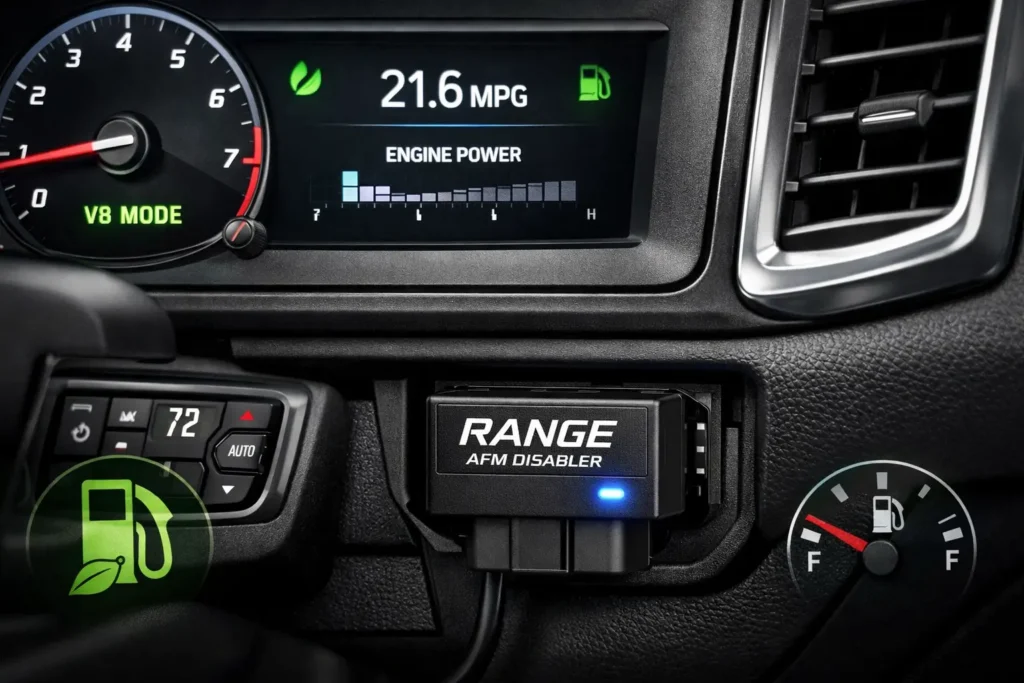
If you own a GM truck or SUV with a V8 engine, chances are you have felt that unsettling shudder when your engine quietly drops from eight cylinders down to four. General Motors calls this Active Fuel Management (AFM). Millions of GM owners call it frustrating — and for good reason. The Range Technology AFM Disabler is a simple plug-and-play OBD2 device engineered to eliminate that problem completely, without voiding your warranty or requiring a single tool.
In this comprehensive review, we cover everything you need to know: what the device does, which vehicles it fits, how to install it, how much fuel it saves, and how it stacks up against competing solutions. Whether you drive a Silverado, Tahoe, Yukon, or Escalade, this guide will help you make a confident, informed decision.
What is Range Technology?
The Problem: Why GM’s Active Fuel Management (AFM) Fails You
GM introduced Active Fuel Management on its V8 engines to improve fuel economy by deactivating four cylinders during light-load driving — turning your V8 into a V4 when maximum power is not needed. In theory, this sounds smart. In practice, it creates a host of problems for everyday drivers.
Under the factory AFM calibration, your engine drops to V4 mode approximately 35% of the time during normal driving. Every transition creates stress — mechanical and otherwise:
- A subtle but persistent vibration or shudder during the V8-to-V4 shift
- Increased oil consumption caused by the AFM lifters cycling repeatedly under load
- Premature AFM lifter failure — a documented and expensive repair costing $2,000 to $5,000 at the dealership
- A droning sound at highway cruising speeds while in V4 mode
- Reduced throttle response when you need to accelerate from V4
According to factory data, the average driver only needs full V8 performance about 10% of the time. Yet AFM constantly cycles the engine in and out of V4 mode even when unnecessary, placing repetitive stress on components that were never designed to handle that cycling frequency for 150,000 or 200,000 miles.
The Solution: How the Range AFM Disabler Works
The Range Technology AFM Disabler is a compact electronic device that plugs into your vehicle’s OBD2 diagnostic port — the same port a mechanic uses to read fault codes. Once connected, it communicates with your engine control module (ECM) in real time and prevents the AFM system from activating cylinder deactivation.
The result: your V8 stays in full V8 mode approximately 90% of the time under normal driving conditions. The device does not flash or reprogram your ECM, does not alter any other vehicle system, and requires zero calibration. Plug it in and drive.
Key Insight: Because Range Technology does not modify your ECM software, it is 100% reversible. Unplug it and your truck instantly returns to factory AFM behavior — no traces, no residual codes, no evidence.
Compatible Vehicles: Full GM Fitment Guide
Supported GM Trucks and SUVs
The Range Technology AFM Disabler is designed exclusively for GM vehicles equipped with V8 engines and the AFM system. It does not work on diesel engines, four-cylinder engines, or non-GM brands. Supported models include:
- Chevrolet Silverado 1500 — V8 models
- Chevrolet Tahoe
- Chevrolet Suburban
- Chevrolet Corvette — AFM-equipped generations
- GMC Sierra 1500 — V8 models
- GMC Yukon and Yukon XL
- Cadillac Escalade and Escalade ESV
Year-by-Year Compatibility: 2007 to 2025
GM introduced AFM on its V8 truck platforms beginning with the 2007 model year. The Range device covers all model years from 2007 through the current 2025 lineup that retain the OBD2-controlled AFM system. If your vehicle was built between 2007 and 2025 and features a 5.3L or 6.2L EcoTec3 V8, the Range device is almost certainly compatible.
Always verify compatibility at rangetechnology.com using your specific year, make, model, and engine size before purchasing.
NOT Compatible With
- Diesel-powered GM vehicles (Duramax and others)
- Four-cylinder or six-cylinder GM engines
- GM trucks equipped exclusively with Dynamic Fuel Management (DFM) — a separate Range product addresses DFM
- Non-GM vehicles including Ford, RAM, Toyota, and others
Key Benefits of Using Range Technology
Increase Fuel Economy — Save 65+ Gallons Per Year
This may seem counterintuitive: if AFM is designed to save fuel by running fewer cylinders, how does disabling it improve fuel economy? The answer lies in driving behavior and engine efficiency.
When AFM is active, it forces V4 operation during highway cruising — a condition where a well-tuned V8 is already running efficiently at low throttle demand. The constant transition between V8 and V4 introduces fuel-wasting events: the engine must re-fire deactivated cylinders repeatedly, and many drivers unconsciously compensate for the V4 shudder by pressing the accelerator harder, burning more fuel.
Range Technology reports that users save an average of 65 gallons of fuel per year — approximately $250 annually at average US gas prices. Over five years of ownership, the device pays for itself multiple times over.
Real-World Numbers: 65 gallons saved per year | ~$250 annual fuel savings | Device cost recovered in approximately 12 months
Prevent AFM-Related Lifter Failure and Oil Consumption
The most financially significant benefit of disabling AFM is protecting your engine from premature lifter failure. AFM lifters use a collapsing mechanism to deactivate individual cylinders. When these lifters cycle thousands of times per drive cycle over years of use, the mechanism wears out — and when it fails, it frequently damages the camshaft as well.
An AFM lifter job at a GM dealership typically costs between $2,000 and $5,000 in parts and labor. Independent shops may charge less, but the repair is invasive and time-consuming regardless. Preventing the failure entirely with a $200 device is straightforward math.
Additionally, AFM operation increases oil consumption in many vehicles, as oil is drawn into cylinders during deactivation events. Keeping the engine in V8 mode reduces this consumption, helping maintain proper oil levels between changes.
Smoother Acceleration and No More V8-to-V4 Shudder
With AFM disabled, your engine delivers consistent V8 power throughout the entire drive cycle. Drivers consistently report the following improvements after installing the Range device:
- Complete elimination of the characteristic V4 drone at highway speeds
- Noticeably smoother throttle response during acceleration
- No hesitation or surge when the engine previously transitioned between modes
- A more confident, linear, and predictable driving experience overall
Installation Guide: Plug In and Drive
What Is in the Box
- Range Technology OBD2 AFM Disabler device (compact, low-profile)
- Quick-start instruction card
- Manufacturer warranty documentation
Step-by-Step Installation (Under 2 Minutes, No Tools Required)
- Locate your OBD2 port. In most GM trucks and SUVs, it is under the driver’s side dashboard, just to the left of the steering column.
- Turn the ignition to the OFF position before connecting any OBD2 device.
- Align the Range device connector with the OBD2 port and press firmly until you feel it click into place.
- Start your engine. The Range device LED will illuminate to confirm it is active and communicating with the ECM.
- Drive normally. The device begins working immediately — no setup menus, no configuration screens, no calibration required.
How to Verify the Device Is Working
- The LED indicator on the Range device will glow solid when properly connected and operational.
- During highway driving at 55 to 65 mph, the V4 shudder and drone you previously experienced should be completely absent.
- Your tachometer may read slightly higher than before at steady speeds, as the engine remains in V8 mode rather than dropping RPM in V4.
Range Technology vs. Competitors: Which Solution Wins?
| Solution | Cost | AFM Disabled? | ECM Modified? | Reversible? | Install Time |
| Range Technology | ~$200 | Yes (90% V8) | No | Yes | 2 minutes |
| Custom Tune (HP Tuners) | $400–$700+ | Yes (fully) | Yes | Complex reflash | Hours + dyno |
| DiabloSport inTune i3 | $350–$450 | Yes | Yes (flash) | Requires reflash | 30–60 min |
| Pulsar LT (Edge Products) | $350–$500 | Yes | No (inline) | Yes | 15 minutes |
| Leave AFM Active | $0 | No | No | N/A | N/A |
Range Technology vs. Custom Tuning
A custom tune using HP Tuners or EFI Live is the gold standard for AFM deletion — but it comes at a significant price. Professional tunes cost $400 to $700 or more, often require a dyno session, and permanently modify your ECM calibration. If you need dealer warranty service, you must first reflash the factory tune. Range Technology avoids all of this complexity while delivering the core benefit most owners want: AFM eliminated, reversibly, for a fraction of the cost.
Range Technology vs. DiabloSport inTune i3
The DiabloSport inTune i3 directly flashes your ECM, which is treated as an ECM modification under GM’s warranty policy. It offers a broader feature set — performance tunes, transmission adjustments — but most AFM-focused buyers do not need those features. For drivers who want AFM deletion without touching the ECM, Range Technology is the simpler, lower-risk choice.
Range Technology vs. Pulsar LT
The Pulsar LT by Edge Products is Range Technology’s closest direct competitor — also an inline OBD2 device that does not flash the ECM. The Pulsar LT offers additional features such as speedometer calibration and shift adjustments. However, it is priced $150 to $300 higher than Range Technology. If AFM deletion is your primary goal and additional tuning features are not needed, Range Technology offers the stronger value.
Potential Drawbacks and How to Address Them
Will It Pass Emissions Testing?
You must unplug the Range device before an OBD2 emissions test. The device occupies the diagnostic port, which emissions testing equipment needs to access directly. Once unplugged, your vehicle returns to factory AFM behavior and reads as completely stock to the emissions tester. Plug it back in after the test. The Range device does not generate any emissions-related fault codes or affect catalytic converters, oxygen sensors, or any other emissions-controlled component.
Battery Drain Concerns
The Range device draws a very small amount of standby power while plugged in. For daily-driven vehicles, this is not a practical concern. If your truck will be parked for more than one week without being started, it is good practice to unplug the device to prevent any parasitic draw — the same precaution recommended with any OBD2 device left permanently in the port.
OBD2 Port Occupied — What If a Mechanic Needs Access?
Simply unplug the Range device temporarily before any service appointment requiring OBD2 port access. Alternatively, a low-profile OBD2 Y-splitter allows a scan tool to connect alongside the Range device without removing it. This is particularly convenient if you use a persistent monitoring device such as a Bluetooth OBD2 reader.
Can It Trigger a Check Engine Light?
In rare cases, some users have reported a P0300 random misfire code during the first few drive cycles after installation. This is typically caused by an initial CAN bus communication handshake event. If a code appears, clear it with any standard OBD2 scan tool. The vast majority of Range Technology users report no check engine lights at all during normal operation.
FAQS
Does Range Technology Really Work?
Yes. The device communicates with your ECM in real time and actively prevents AFM cylinder deactivation commands from executing. Thousands of GM truck and SUV owners across forums including GM-Trucks.com and community groups have reported consistent positive results, including elimination of V4 shudder, reduced oil consumption, and improved highway fuel economy.
Is the Range AFM Disabler Safe for My Engine?
The Range device is broadly considered safe by the automotive aftermarket community. Because it does not reprogram your ECM, there is no risk of corrupted calibration data or software conflicts. It intercepts the CAN bus commands that trigger cylinder deactivation, leaving all other engine functions completely untouched. Many engine builders and powertrain specialists specifically recommend AFM deletion devices for high-mileage GM vehicles as a proactive lifter protection measure.
Can I Leave the Range Device Plugged In All the Time?
Yes, for all practical purposes. Most users leave it permanently installed. The only recommended exceptions are: before an OBD2 emissions test, before a dealer service appointment where technicians need port access, and if the vehicle will be stored or parked without running for more than one week.
Will It Void My GM Warranty?
Because the Range device does not modify or reflash your ECM, it is generally considered warranty-safe under the Magnuson-Moss Warranty Act. Under that law, a manufacturer must prove that an aftermarket part directly caused a failure in order to deny a warranty claim. Since Range Technology does not alter ECM software or any physical engine component, it does not meet that standard. Consult your dealership’s service manager if you have specific warranty questions related to your vehicle.
What Is the Difference Between the RA003 and Newer Range Models?
The RA003 was an earlier Range Technology product designed for a specific subset of model years. Newer Range devices include updated firmware covering the expanded 2007 to 2025 vehicle lineup and provide compatibility with late-model GM ECM versions. Always check rangetechnology.com with your vehicle’s year, make, model, and engine size to confirm the correct product number for your application.
Does Range Technology Work on Both 5.3L and 6.2L Engines?
Yes. The Range AFM Disabler is fully compatible with both the 5.3L EcoTec3 V8 and the 6.2L EcoTec3 V8 found in GM trucks and SUVs. Both engines use the same OBD2-controlled AFM architecture that the Range device communicates with.
How Do I Reset the Range Device?
To reset the device — for example, after a check engine light event — unplug it from the OBD2 port, wait 30 seconds, and plug it back in. The device resets automatically on each power cycle. No additional steps are required.
Can I Use a Splitter to Connect Both Range and a Scan Tool?
Yes. An OBD2 Y-splitter or extension cable allows you to keep the Range device connected while simultaneously connecting a separate scan tool, Bluetooth monitor, or data logger. Ensure the splitter supports full CAN bus pass-through for reliable operation with all connected devices.
Does the AFM Disabler Affect Towing Performance?
No. The Range device does not alter your transmission calibration, tow/haul mode behavior, or maximum power output. In fact, many owners report that towing feels smoother with AFM disabled, since the engine stays in full V8 mode throughout the load cycle rather than attempting to deactivate cylinders under trailer weight.
Customer Reviews and Real-World Results
What GM Truck Owners Are Saying
Across major automotive communities — including GM-Trucks.com forums, dedicated Silverado and Sierra Facebook groups, and Reddit’s truck enthusiast communities — the Range Technology AFM Disabler has accumulated strong, consistent positive sentiment. The most common owner-reported outcomes include:
- Elimination of V4 highway drone: Many owners describe the reduction in highway cabin noise as the most immediately noticeable and satisfying improvement.
- Measurable fuel savings: Highway fuel economy improvements of 1 to 3 mpg are frequently reported, consistent with Range Technology’s published 65-gallons-per-year claim.
- Smoother throttle response: Drivers report that throttle delivery feels more direct and linear without the AFM cycling interrupting power delivery.
- Lifter protection peace of mind: High-mileage truck owners specifically cite preventing a future $2,000 to $5,000 lifter repair as their primary motivation for purchasing.
Before and After: A Typical Owner Experience
A representative example from the owner community: a 2018 Silverado 1500 with the 5.3L V8 and 85,000 miles on the odometer. Before the Range device, the owner reported a consistent shudder at approximately 45 mph on the highway as the engine transitioned to V4 mode. After installing the Range AFM Disabler, the shudder disappeared completely. Highway fuel economy improved from 21 mpg to 23 mpg on a consistent commute route. Oil consumption between oil changes also decreased noticeably, reducing the owner’s between-change top-off habit.
Important Note: Individual results vary depending on driving style, route type, vehicle condition, altitude, and ambient temperature. Highway driving consistently yields the most measurable fuel economy improvements with the Range device.
Where to Buy Range Technology
Official Website vs. Amazon vs. Retailers
| Channel | Availability | Price Range | Notes |
| RangeTechnology.com | In stock (typically) | MSRP | Direct from manufacturer; best warranty support |
| Amazon.com | In stock (typically) | MSRP to slight premium | Fast shipping; verify sold/fulfilled by Range Technology |
| AutoAccessoriesGarage.com | In stock (varies) | Competitive | Good for customer reviews and comparison shopping |
| eBay | Used/refurbished available | Below MSRP | Warranty may not apply to secondhand units |
Price, Warranty, and Return Policy
The Range Technology AFM Disabler typically retails between $180 and $230 depending on the retailer and vehicle-specific model. Range Technology offers a one-year limited warranty on all new devices purchased through authorized channels. Return policies vary by retailer — purchasing directly from rangetechnology.com generally provides the most straightforward warranty claims and returns process.
Given that the device recovers its cost in fuel savings within approximately 12 months and offers protection against a potential $2,000 to $5,000 lifter replacement, the value proposition is compelling for any GM V8 owner experiencing AFM-related symptoms.
Final Verdict: Is Range Technology Worth It?
For GM truck and SUV owners who experience AFM shudder, excessive oil consumption, or who simply want to protect their engine from the well-documented long-term risks of AFM cycling, the Range Technology AFM Disabler is one of the most practical and cost-effective solutions on the market today.
It installs in two minutes with no tools. It is fully reversible. It requires no ECM flash and does not involve any mechanical work. It saves an average of 65 gallons of fuel per year. And it protects one of the most expensive mechanical assemblies in your engine — the AFM lifters and camshaft — from premature failure.
Compared to a custom tune, it is dramatically simpler and more affordable. Compared to leaving AFM active and hoping for the best, it is a straightforward investment in engine longevity.

Adrian Cole is a technology researcher and AI content specialist with more than seven years of experience studying automation, machine learning models, and digital innovation. He has worked with multiple tech startups as a consultant, helping them adopt smarter tools and build data-driven systems. Adrian writes simple, clear, and practical explanations of complex tech topics so readers can easily understand the future of AI.