
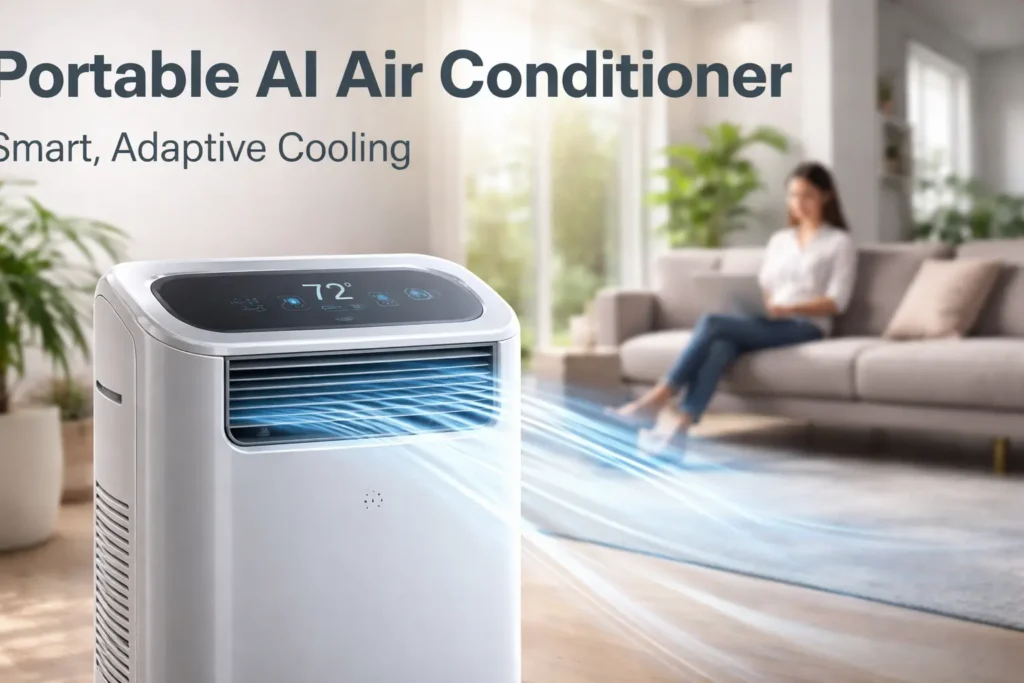
If you’ve ever dragged a bulky portable AC across your apartment, wrestled with a window kit that never quite fit, and still ended up sweating by mid-afternoon, you already understand the problem this article is here to solve.
Cooling used to be simple. You turned a dial. Cold air came out. Your electricity bill quietly spiraled out of control.
Now, the conversation has changed.
The portable AI conditioner isn’t just another iteration of the same old appliance. It’s a response to very real, very modern frustrations: rising energy costs, unpredictable weather, smaller living spaces, remote work, and the desire for comfort without waste.
People aren’t just asking, “Can this cool a room?” anymore. They’re asking:
Will it adapt to my space?
Will it learn my habits?
Will it save energy without sacrificing comfort?
That’s where AI-powered portable cooling steps in.
This guide is written for homeowners, renters, digital nomads, students, and anyone tired of outdated cooling solutions. Whether you’re exploring your first portable unit or deciding if AI-driven climate control is worth the upgrade, you’ll walk away with practical clarity, not marketing hype.
By the end, you’ll understand exactly how portable AI conditioners work, where they shine, where they don’t, and how to choose one that actually improves your day-to-day life.
What Is a Portable AI Conditioner? (Beginner to Expert Breakdown)
At its core, a portable AI conditioner is still a portable air conditioning unit. It cools air, exhausts heat, and lowers indoor temperatures. What changes everything is how it decides when, where, and how to do that.
Traditional portable ACs operate on static logic. You set a temperature. The unit runs until it hits that number. Then it shuts off. Rinse and repeat. It doesn’t care if the sun suddenly hits your window, if five people enter the room, or if humidity spikes at midnight.
AI-based models do care.
Think of it like the difference between cruise control and a self-adjusting driving assistant. One maintains speed blindly. The other responds to hills, traffic, and road conditions.
A portable AI conditioner uses sensors, machine learning algorithms, and adaptive software to monitor variables such as room size, ambient temperature, humidity, occupancy patterns, and even time-of-day usage. Over time, it builds a behavioral profile of your space.
In practical terms, that means the unit learns that your bedroom needs aggressive cooling at night but minimal airflow during the early morning. It knows your home office heats up faster in the afternoon. It anticipates rather than reacts.
For beginners, the benefit is simplicity. You don’t constantly adjust settings. For advanced users, the appeal lies in efficiency optimization, fine-tuned comfort, and measurable energy savings.
AI doesn’t replace cooling hardware. It replaces guesswork.
Why Portable AI Conditioners Matter Right Now
This technology isn’t appearing in a vacuum. It’s answering a convergence of trends.
Living spaces are shrinking, especially in urban areas. People are working from home more than ever. Electricity prices are climbing globally. Climate patterns are becoming more extreme and less predictable.
A fixed central AC system doesn’t make sense for everyone. Window units aren’t always allowed. Portable units offer flexibility, but historically they’ve been inefficient and noisy.
AI changes that equation.
Instead of brute-force cooling, portable AI conditioners focus on targeted comfort. They cool only when needed, only where needed, and only as much as needed. Over a summer season, that difference adds up.
From an environmental perspective, adaptive cooling reduces unnecessary energy consumption. From a lifestyle perspective, it eliminates the constant micro-management that frustrates users.
This isn’t about novelty. It’s about relevance.
Benefits and Real-World Use Cases
The true value of a portable AI conditioner becomes obvious when you see it in context.
For renters, these units offer freedom. You can cool a space effectively without permanent installation or landlord approval. The AI component ensures the unit adapts to varying apartment layouts, poor insulation, and inconsistent sun exposure.
Remote workers benefit from zone-based intelligence. Your home office doesn’t need to be cooled like a living room hosting guests. AI systems recognize usage patterns and adjust airflow accordingly, maintaining comfort without overworking the compressor.
Students in dorms or shared housing experience a different advantage. Instead of fighting over thermostat settings, AI-powered portable units learn individual room behavior. They reduce noise during sleep hours and prioritize cooling during peak activity times.
Small businesses use them strategically. Pop-up shops, clinics, and studios can deploy cooling where it’s needed most without reconfiguring HVAC systems. AI optimization ensures cost-effective operation even during long business hours.
The before-and-after difference is tangible. Before, you manually intervene, accept inefficiency, and tolerate discomfort. After, the system works quietly in the background, responding intelligently to real-world conditions.
How a Portable AI Conditioner Actually Works
Understanding the process helps you make better buying decisions.
First, onboard sensors collect environmental data. Temperature sensors measure heat distribution. Humidity sensors detect moisture levels that affect perceived comfort. Some models include motion sensors to detect occupancy.
Next, the AI engine processes this data. Instead of relying on preset thresholds, it compares current conditions against learned patterns. It asks questions like: Is this room typically occupied at this time? How quickly does it heat up after sunset? What cooling intensity maintains comfort without waste?
Then, the system adjusts operation dynamically. Fan speed, compressor cycles, airflow direction, and cooling intervals all change in real time. Some units integrate with mobile apps, allowing user feedback to refine behavior further.
Over weeks of use, the system becomes increasingly efficient. It doesn’t just cool better. It cools smarter.
This is why early adopters often notice improved performance after the first month. The AI needs data, just like a human learning a routine.
Step-by-Step Guide: Choosing and Using a Portable AI Conditioner
The first step is matching the unit to your space. Room size matters more than marketing claims. An underpowered unit will run constantly. An oversized unit will short-cycle, reducing efficiency.
Measure your room accurately. Consider ceiling height, insulation quality, and sun exposure. AI can optimize performance, but it can’t defy physics.
Next, placement is critical. Position the unit where airflow isn’t obstructed. Avoid corners if possible. Ensure the exhaust hose is as short and straight as you can manage. AI improves efficiency, but poor installation still causes losses.
Once installed, resist the urge to micromanage. Let the system learn. Use the app or control panel to provide basic preferences, but avoid constant manual overrides during the first few weeks.
Pro tip: Many users sabotage AI learning by frequently changing temperatures. Stability helps the system optimize faster.
Finally, maintain it. Clean filters regularly. Ensure sensors aren’t blocked by curtains or furniture. AI relies on accurate data.
Tools, Comparisons, and Expert Recommendations
Not all AI implementations are equal.
Some units use rule-based “smart” logic rather than true machine learning. These can still be useful but won’t adapt deeply over time. Others employ cloud-connected AI that improves with software updates.
Free app-based controls often provide scheduling and remote access. Paid or premium systems usually include predictive algorithms, energy analytics, and deeper automation.
For beginners, entry-level AI models offer noticeable improvements over traditional units without overwhelming complexity. Advanced users may prefer systems with detailed performance dashboards and smart home integration.
Expert advice: prioritize reliability and cooling performance first. AI features should enhance, not compensate for, weak hardware.
Common Mistakes and How to Avoid Them
One of the most common mistakes is assuming AI eliminates all setup requirements. It doesn’t. Poor window sealing, incorrect sizing, and blocked airflow still undermine performance.
Another issue is unrealistic expectations. AI improves efficiency and comfort, but it won’t turn a poorly insulated room into a refrigerator during a heatwave.
Users also forget firmware updates. These updates often refine AI behavior. Ignoring them means missing performance improvements.
Finally, many people disable AI features too early. Give the system time to learn. Initial behavior may feel conservative, but it improves with data.
Energy Efficiency, Cost Savings, and Environmental Impact
Over a full cooling season, portable AI conditioners often consume significantly less energy than traditional portable units. The savings come from reduced runtime, smarter cycling, and humidity-aware cooling.
Lower energy use translates to lower bills. For frequent users, the difference can offset the higher upfront cost within a few years.
From an environmental standpoint, reduced consumption means lower emissions. It’s not a silver bullet, but it’s a meaningful step toward more responsible cooling.
The Future of Portable AI Cooling
We’re still early in this evolution.
Future models will integrate weather forecasts, utility pricing data, and even wearable inputs. Imagine your conditioner adjusting based on your body temperature or upcoming heat spikes.
As AI models improve, expect quieter operation, faster learning, and more personalized comfort profiles.
Portable AI conditioners aren’t a trend. They’re the direction cooling is heading.
Conclusion: Is a Portable AI Conditioner Worth It?
If you value comfort, efficiency, and intelligent automation, the answer is yes.
A portable AI conditioner isn’t about flashy features. It’s about removing friction from daily life. It cools when you need it, conserves energy when you don’t, and adapts to your environment without constant input.
For modern living, that balance matters.
If you’re ready to move beyond outdated cooling methods, this technology offers a practical, future-proof solution.
FAQs
What makes a portable AI conditioner different from a smart AC?
AI models learn and adapt over time rather than following fixed schedules.
Do portable AI conditioners save electricity?
Yes, by optimizing runtime and reducing unnecessary cooling cycles.
Are they difficult to set up?
Setup is similar to traditional portable AC units with added app configuration.
Can AI cooling work in very hot climates?
It improves efficiency but still depends on proper sizing and insulation.
Is internet connectivity required?
Some models use cloud-based AI, while others operate locally.

Adrian Cole is a technology researcher and AI content specialist with more than seven years of experience studying automation, machine learning models, and digital innovation. He has worked with multiple tech startups as a consultant, helping them adopt smarter tools and build data-driven systems. Adrian writes simple, clear, and practical explanations of complex tech topics so readers can easily understand the future of AI.