
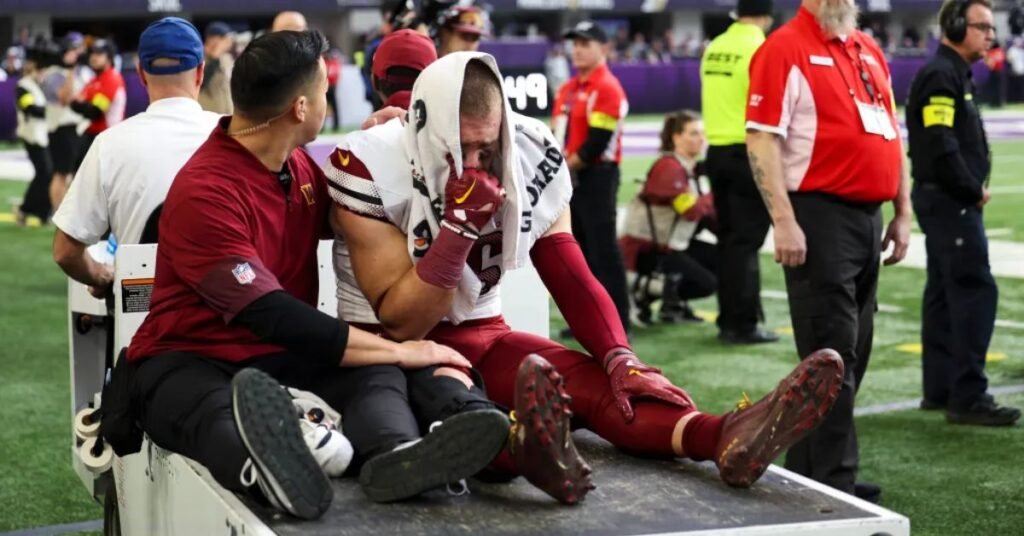
Imagine you’re watching the game — it’s late third quarter, the offense is down, and tension is high. The ball spirals in the air; the veteran tight end jumps, arms outstretched, ready to make the catch. In a heartbeat, everything changes: a violent hit to the knee, a sickening fall, and the stadium goes silent. That’s what fans and teammates witnessed on December 7, 2025, when Zach Ertz went down hard after a play against the Minnesota Vikings — a moment that may mark the end of an era.
If you’re following the NFL or simply care about resilience and recovery, Ertz’s injury is both heartbreaking and instructive. Let’s walk through what happened — and why it matters.
What Happened: The Injury Breakdown
- In the third quarter of the game, Ertz leaped for a high pass on a second-and-11. As he hung in the air, Vikings safety Jay Ward collided with Ertz’s right leg. The hit appeared to lower the helmet right into the knee.
- The impact caused Ertz’s knee to buckle in a way that immediately raised alarming red flags. Medical staff rushed in, placed his leg in a brace, and he was carted off the field — visibly emotional.
- Initial diagnosis: fear of a torn anterior cruciate ligament (ACL) in the right knee, pending an MRI for confirmation. Coach Dan Quinn said “early signals aren’t good.”
Given Ertz’s age (35) and history — including a previous major knee injury and lengthy NFL career — many are wondering if this could be career-ending.

Why It Matters — More Than Just One Player
• Veteran Presence & Leadership
Ertz isn’t just any tight end. He’s been a stalwart in the league since 2013. Over his career he’s amassed huge stats, won a Super Bowl, made multiple Pro Bowls, and been a reliable target for several teams.
Losing him isn’t just losing a pass-catcher — it’s losing experience, leadership, and stability in the locker room.
• Impact on Team Dynamics
With Ertz sidelined, younger or less proven players — such as Ben Sinnott — may be called on to step up. It changes play schemes, red-zone strategies, and even how the offense flows.
• The Human Side of Injuries
Seeing a veteran go down hard — hearing teammates express heartbreak, a moment many called “one of the worst hits” — reminds us: players are humans, too, with physical fragility and emotional stakes.
If You Were “On the Inside” — What’s the Plan
Here’s a simple step-by-step of what happens after such a serious injury (like a suspected ACL tear), and what both players and teams — and even we as fans — often must do:
- Immediate Care & Assessment
- On-field stabilization: knee brace, cart, quick assessment. (That’s what Ertz got right away.)
- Imaging (MRI) ideally within 24–48 hours to confirm the extent of ligament and structural damage.
- Diagnosis & Treatment Decision
- If ACL (or other ligament) tear — orthopedic surgeon and team doctors evaluate whether surgical repair is recommended.
- Consider player’s age, previous injuries, long-term mobility vs. career goals.
- Surgery (if applicable)
- ACL reconstruction — often the standard for severe ACL tears. Requires skilled surgical team, post-op rehabilitation plan.
- Or, in rare cases, non-surgical rehab if tear is partial or player decides to retire.
- Rehabilitation & Recovery
- Early rehab: physical therapy focusing on reducing swelling, restoring range of motion.
- Progressive strengthening: knee stability, leg strength, balance exercises.
- Gradual return: light jogging → agility drills → on-field movements (if continuing in football).
- Mental & Emotional Recovery
- For many, the hardest part isn’t just physical — facing career uncertainty, rehab pain, doubts.
- Support from teammates, family, professionals (therapists/physio/coach) becomes crucial.
Common Mistakes (or Missteps) to Avoid — On & Off the Field
- Rushing the recovery — returning too quickly can lead to re-injury or chronic knee problems.
- Ignoring proper rehab protocol — skipping physical therapy or not following through with exercises.
- Neglecting mental health — underestimating the emotional toll of serious injury and uncertain future.
- Overlooking prevention hygiene — in sports, protecting knee health via strength training, flexibility work, safe tackling techniques.
What This Means — Real-World Takeaways
Whether you’re an athlete, a fan, or just someone who appreciates resilience:
- Injuries like this remind us how unpredictable sports — and life — can be. Even the most experienced players are vulnerable.
- Recovery is rarely just physical; it’s emotional, psychological, and long-term.
- Teams must invest in young talent, but mentoring matters — losing veterans affects more than just the stat sheets.
- For anyone with knee instability or prior injuries: listen to your body, get proper evaluation, and don’t rush healing.
Final Thoughts: Why Zach Ertz’s Injury Matters to All of Us
Zach Ertz’s plight is a stark reminder: in the violent — beautiful — world of football, one moment can shift everything. What matters most isn’t just what happens on that field, but how one responds afterward. Will this be the end of a storied career? Maybe. Or perhaps it becomes a testament to strength, recovery, and resilience. Either way, it’s a story about humanity as much as it is about sport.
ALSO READ: Sam Altman IQ: What We Know About the OpenAI CEO’s Intelligence and Leadership
FAQs
Q: Did Zach Ertz tear his ACL for sure?
A: As of the latest reports, the team fears a torn ACL and scheduled an MRI to confirm the injury.
Q: Could this injury end his career?
A: Given his age (35) and severity of impact — yes, that’s a plausible outcome. Many analysts describe it as “potentially career-ending.”
Q: What happens if he undergoes surgery?
A: He would likely need ACL reconstruction followed by several months of rehab: physical therapy, strength training, gradual return to activity.
Q: Is recovery possible at his age?
A: It is possible, but challenging. Recovery depends on many factors — surgical success, rehab discipline, overall health, motivation, and willingness to adjust expectations.
Q: Why does this matter beyond just one player?
A: Because losing a veteran like Ertz impacts team dynamics, mentorship for younger players, and reminds fans that even elite athletes are human.

Hannah Price is a digital journalist who covers breaking news, global events, and trending stories with accuracy and speed. She has previously contributed to several online magazines and has built a reputation for verifying facts before publishing. Hannah believes in responsible reporting and aims to present stories in a way that readers can trust.