
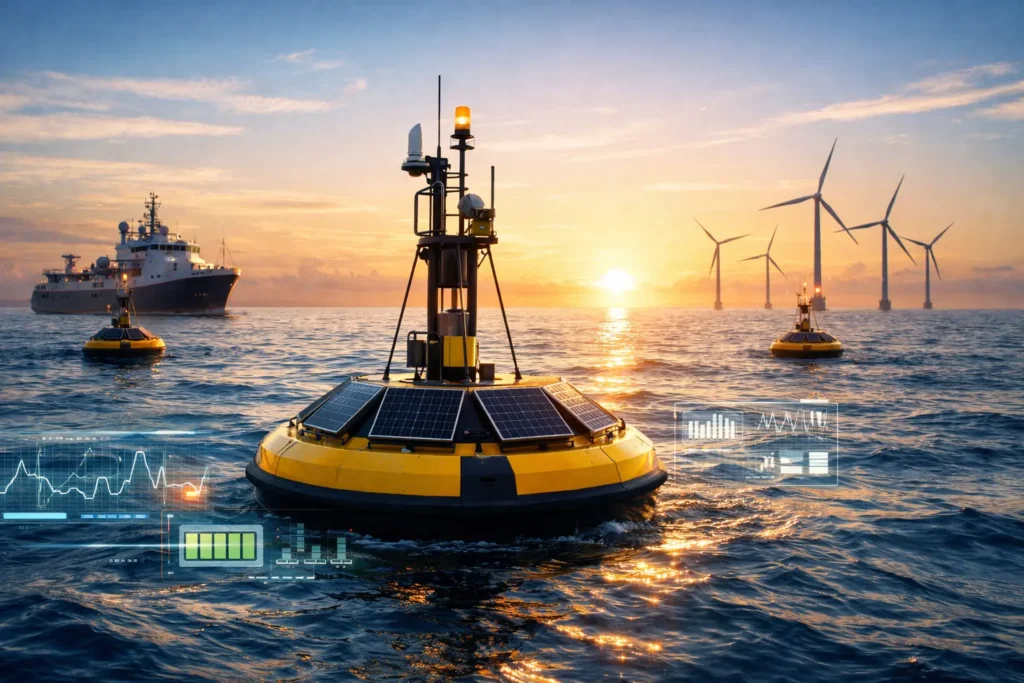
Ocean power technology sits at the intersection of renewable energy and advanced maritime systems. At its core, the field involves harnessing the immense kinetic and potential energy of ocean waves to generate electricity—a clean, persistent, and virtually inexhaustible resource. But in recent years, the definition of ocean power technology has broadened considerably. Today it encompasses far more than wave energy conversion alone; it includes autonomous surface and subsea vehicles, AI-powered data platforms, and integrated systems designed to deliver persistent intelligence from the ocean’s surface to its floor.
The company most closely associated with this field is Ocean Power Technologies (NYSE American: OPTT), a publicly traded firm founded in 1984 and headquartered in Monroe Township, New Jersey. Once focused primarily on grid-connected wave energy projects, OPT has strategically evolved into a provider of autonomous maritime systems, framing its offerings under the umbrella of “Ocean Intelligence.” Understanding this evolution is essential for anyone researching the sector—whether you are an investor tracking OPTT, a defense professional evaluating maritime surveillance solutions, an offshore energy operator seeking remote power, or a researcher exploring autonomous ocean platforms.
This guide covers the full scope of ocean power technology: the physics behind wave energy conversion, OPT’s flagship products (PowerBuoy®, WAM-V®, and Merrows™ software), the industries being transformed, the business models driving adoption, and an honest look at the challenges and future outlook for the sector.
What is Ocean Power Technology and How Does It Work?
The Core Mechanism: Wave Energy Conversion
Ocean waves carry enormous amounts of energy. As wind blows across the water’s surface, it transfers kinetic energy into oscillating wave motion—energy that travels vast distances across the ocean with minimal dissipation. Wave energy converters (WECs) capture this motion and transform it into electricity.
The most commercially developed WEC type is the point absorber—a floating buoy that moves up and down with passing waves. OPT’s PowerBuoy® is a point absorber that uses this vertical heave motion to drive an internal linear generator, producing electricity that can be transferred to a seabed load via a submarine cable. The buoy’s articulating mechanical system efficiently captures energy across a range of sea states, from calm swells to harsh open-ocean conditions.
Other wave energy converter designs include attenuators (long floating structures oriented parallel to wave direction), oscillating water columns (where wave action compresses air to drive a turbine), and overtopping devices (which capture water in elevated reservoirs). Each has distinct advantages depending on deployment depth, distance from shore, and power output requirements. Point absorbers like the PowerBuoy® have proven particularly suited for offshore, stand-alone deployments because of their compact footprint and ability to operate far from the electrical grid.
Beyond Waves: Hybrid & Subsea Power Solutions
Wave energy alone does not always meet the continuous power demands of offshore sensors and autonomous systems. To address this, OPT has developed hybrid configurations that supplement wave energy with solar panel arrays and lithium iron phosphate battery storage. The Hybrid PowerBuoy® integrates these sources to provide uninterrupted power even during periods of low wave activity, ensuring 24/7 connectivity to subsea payloads.
For deeper applications, OPT’s Undersea Substation Pod (USP) serves as a subsea power aggregation node. It accepts energy from surface buoys and distributes it to multiple underwater instruments—AUVs (Autonomous Underwater Vehicles), seabed sensors, and subsea infrastructure—through an umbilical interface. The USP can store up to 132 kWh of energy, providing a reliable resident power solution for extended subsea missions without the cost and environmental impact of support vessels.
Key Applications: Who Uses Ocean Power Technology?
Government & Defense: Ensuring Maritime Security
The defense and government sector represents OPT’s dominant market today. The reasoning is straightforward: modern maritime security requires persistent, unblinking awareness across vast ocean areas—exactly what traditional crewed vessels cannot economically provide. Deploying and maintaining patrol ships around the clock is extraordinarily expensive; autonomous platforms powered by the ocean itself offer a compelling alternative.
OPT’s systems have been deployed in support of U.S. Coast Guard and U.S. Navy requirements, with the PowerBuoy® serving as a force multiplier for maritime domain awareness (MDA). Equipped with radar, AIS (Automatic Identification System) receivers, and electro-optical/infrared (EO/IR) cameras, a PowerBuoy® can monitor vessel traffic, detect anomalies, and transmit real-time intelligence to shore-based command and control (C2) centers—all without a crew member in the field.
OPT has also developed the LEAP (Littoral Expeditionary Autonomous PowerBuoy) program in partnership with the U.S. Navy, designed for rapid deployment in forward operating areas. LEAP units can be transported and launched from standard naval vessels, providing immediate ISR (Intelligence, Surveillance, Reconnaissance) coverage in contested or operationally challenging zones. This positions ocean power technology not as background infrastructure, but as an active component of naval operations.
Offshore Energy: Powering Remote Operations
The offshore oil and gas industry faces a persistent challenge: how to power the growing network of subsea sensors, pipeline monitors, and corrosion-detection instruments that modern operations require. Running submarine power cables from shore or maintaining diesel generator vessels is expensive and environmentally costly. Ocean power technology offers a zero-emission, low-carbon alternative that operates indefinitely without fuel resupply.
The emerging offshore wind sector presents additional opportunities. As wind farms push further offshore into deeper water, their subsea monitoring and maintenance needs grow proportionally. PowerBuoys® can provide persistent power to underwater inspection systems, environmental monitoring instruments, and AUV recharging stations—enabling what the industry calls AUV “residency,” where vehicles remain underwater for extended missions rather than returning to port.
Carbon capture and storage (CCS) projects, which inject CO₂ into subsea geological formations for long-term sequestration, require continuous monitoring of injection sites. Ocean-powered buoys are well-suited to this application, providing the operational efficiency and real-time data needed to verify carbon storage performance without ongoing vessel support.
Science & Research: Unlocking Ocean Intelligence
Oceanographic research has historically depended on research vessels—expensive assets that provide snapshots of ocean conditions during relatively brief cruises. Autonomous platforms powered by wave energy change this model fundamentally, enabling months or years of continuous data collection at a fraction of the cost.
Scientists deploy PowerBuoys® and WAM-V® autonomous surface vehicles (USVs) to conduct hydrographic surveys, monitor water temperature and salinity profiles, track marine mammal activity, and measure ocean acidification—data essential for climate science, fisheries management, and environmental regulation. Replacing a crewed research vessel with a persistent autonomous platform can reduce operational costs by an order of magnitude while dramatically increasing data density.
The Core Technologies: An Integrated Ecosystem
OPT’s competitive advantage lies not in any single product but in the integration of three complementary technologies that collectively deliver a complete Ocean Intelligence solution: persistent offshore power (PowerBuoy®), mobile surface operations (WAM-V®), and AI-capable data management (Merrows™). Understanding each component—and how they work together—is key to evaluating ocean power technology’s capabilities.
PowerBuoy®: The Persistent Power Platform
The PowerBuoy® is OPT’s flagship product and the technology on which the company’s reputation is built. Available in configurations ranging from 2 kW to 40 kW of continuous power output, it serves dual purposes: as a wave energy converter that generates electricity from ocean waves, and as a sensor host platform that can carry payloads including cameras, communications equipment, environmental sensors, and acoustic modems.
Key technical characteristics of the PowerBuoy® include:
- Zero-emission operation with no fuel, no exhaust, and minimal maintenance requirements
- Real-time bidirectional data transfer via satellite, cellular, or RF communications links
- Modular payload bay compatible with third-party sensors and communications systems
- Designed for harsh sea states at open-ocean mooring sites, kilometers from shore
- Proven deployments across North America (New Jersey, Oregon, Hawaii), Europe (Spain, UK, Cornwall), and the Asia-Pacific region
The Mark 3 PowerBuoy® represents the latest generation, incorporating lessons from over a decade of field deployments. Its onboard processing capability enables edge computing—running analytics algorithms directly on the buoy rather than transmitting raw data to shore—reducing bandwidth requirements and enabling faster, more autonomous decision-making.
WAM-V®: The Autonomous Surface Vehicle (USV)
The Wave Adaptive Modular Vessel (WAM-V®) is an autonomous surface vehicle (USV) distinguished by a unique articulating suspension system. Rather than a rigid hull, the WAM-V® uses a flexible pontoon structure that independently adapts to wave motion, maintaining a stable platform for its sensor payload even in challenging conditions. This is not a minor engineering detail—platform stability is critical for sensors like synthetic aperture sonar, high-definition cameras, and precision GPS systems that require a steady base to function accurately.
The WAM-V® is designed for maritime domain awareness missions, including:
- Surveillance and perimeter monitoring of ports, offshore platforms, and critical maritime infrastructure
- Hydrographic survey and bathymetric mapping of shallow coastal and harbor areas
- Environmental monitoring, including water quality sampling and oceanographic data collection
- Search and rescue support, providing eyes-on capability in hazardous conditions without risking crew
The WAM-V® can be operated remotely by a human pilot or run autonomously using pre-programmed mission routes. When integrated with PowerBuoy® infrastructure for communications relay and the Merrows™ software platform for data management, it becomes a mobile node in a broader Ocean Intelligence network—extending situational awareness from fixed buoy positions to dynamic, area-coverage operations.
Merrows™: AI-Capable Ocean Intelligence Software
Merrows™ is the software layer that ties the PowerBuoy® and WAM-V® into a coherent intelligence system. Named after the mythological sea creatures of Celtic legend, Merrows™ serves as the data integration and analytics brain for OPT’s hardware ecosystem.
At a functional level, Merrows™ ingests data streams from multiple sensor types—radar returns, AIS vessel tracking data, EO/IR camera feeds, acoustic sensors, and environmental instruments—and fuses them into a unified operational picture. Its AI-capable architecture enables automated anomaly detection: the system can flag vessels behaving unusually, identify objects of interest in camera feeds, correlate radar contacts with AIS transponder data to detect “dark” vessels operating without identification, and generate alerts for human operators.
For non-technical users, think of Merrows™ as the difference between raw camera footage and a security system that actively watches for threats and only alerts you when something requires attention. Rather than requiring an operator to monitor dozens of sensor feeds simultaneously, Merrows™ handles the routine surveillance workload and elevates only the information that matters—making each operator dramatically more effective and enabling smaller teams to cover larger ocean areas.
The platform is designed to be AI-ready, meaning its data architecture supports integration with customer-specific machine learning models and third-party analytics tools. This open approach makes Merrows™ a foundation that customers can customize for specific mission requirements, rather than a fixed, proprietary black box.
Ocean Power Technologies (OPTT): Company & Market Position
Company Overview & History (NYSE American: OPTT)
Ocean Power Technologies was founded in 1984 in the United Kingdom before relocating its primary operations to the United States. Today the company is headquartered in Monroe Township, New Jersey, and is publicly traded on NYSE American under the ticker symbol OPTT—making it the most prominent publicly listed pure-play ocean power and autonomous maritime systems company in the world.
OPT holds a global patent portfolio covering wave energy conversion technology, buoy designs, subsea power systems, and related innovations accumulated over four decades of R&D. The company has established operational facilities in Coos Bay and Reedsport, Oregon; Portland, Australia; and multiple sites across Europe including Spain, the United Kingdom, and Cornwall. Its strategic partnerships include engagements with Lockheed Martin, Iberdrola, Total, the U.S. Navy, and the U.S. Department of Energy—providing both credibility and access to large-scale deployment opportunities.
Project Spotlight: From Early Trials to Modern Deployments
OPT’s history includes both ambitious early-stage grid-connected wave projects and a frank reckoning with commercial realities. The company’s large-scale wave farm projects in Reedsport and Coos Bay, Oregon, as well as a project in Victoria, Australia, encountered significant permitting, cost, and technical challenges that ultimately led the company to pivot away from utility-scale wave power generation toward smaller, standalone power applications.
This pivot proved prescient. Rather than competing in the crowded large-scale renewables market against well-capitalized offshore wind developers, OPT repositioned its PowerBuoy® as a remote power solution for niche but high-value applications where the cost of alternatives (submarine cables, diesel generators, support vessels) is even higher. This strategy led to tangible commercial successes, including the delivery of multiple PowerBuoys® to the U.S. Coast Guard, a partnership with Mythos AI for AI-enhanced ocean surveillance, and ongoing engagements with government defense agencies in multiple countries.
Understanding this evolution is important context for interpreting OPT’s current product strategy, backlog figures, and investor communications. The company today is fundamentally different from the wave farm developer it was a decade ago—and its prospects need to be evaluated on those terms.
The Business Model: Power, Robotics, and Data as a Service
One of the most significant shifts in OPT’s commercial strategy has been the transition from hardware sales to subscription-based service models. Rather than simply selling PowerBuoys® and WAM-Vs® as capital equipment purchases, OPT now offers its solutions through three complementary service frameworks:
Power as a Service (PaaS): Customers receive persistent offshore power delivery as an ongoing service, with OPT responsible for system installation, maintenance, and performance guarantees. This eliminates large upfront capital expenditures and gives customers predictable operational expenses—a model familiar from cloud computing that is now being applied to ocean infrastructure.
Robotics as a Service (RaaS): Customers access WAM-V® autonomous surface vehicle capabilities without owning the hardware. OPT provides the vehicle, communications infrastructure, maintenance, and operational support. This is particularly attractive for organizations with intermittent maritime survey or surveillance needs who cannot justify owning and operating a dedicated USV fleet.
Data as a Service (DaaS): Through the Merrows™ platform, OPT delivers processed, AI-analyzed ocean intelligence—not raw sensor data. Customers receive actionable insights, anomaly alerts, and situational awareness products rather than having to build their own analytics infrastructure. This is the highest-margin tier of OPT’s service model and represents the long-term direction of the company’s business.
In addition to these service models, OPT continues to offer direct sales, equipment leases, and long-term service agreements to customers who prefer ownership over subscription arrangements. This flexibility allows OPT to serve government procurement processes, which often favor capital acquisition, alongside commercial customers who prefer operational expense structures.
Challenges & Future Outlook for Ocean Power Technology
Honest Assessment: The Challenges Ahead
Any credible analysis of ocean power technology must acknowledge the challenges that have historically limited the sector. Wave energy conversion at utility scale has proven more difficult and more expensive than early projections suggested. The ocean environment is extraordinarily harsh: saltwater corrosion, biofouling, extreme weather events, and the sheer logistical difficulty of offshore maintenance all drive up costs and reduce the economic competitiveness of wave power relative to onshore renewables.
As a small-cap public company, OPT also faces the challenges common to early-stage technology businesses: limited revenue scale, ongoing R&D costs, and the need to demonstrate financial sustainability to investors while simultaneously investing in product development and market expansion. Prospective investors should carefully review OPT’s financial filings, backlog figures, and cash position before drawing conclusions about the company’s commercial trajectory.
The Future: AI, Autonomy, and the Blue Economy
Despite near-term challenges, the long-term outlook for ocean power technology is compelling. Several converging trends favor the sector’s growth:
The expansion of the blue economy—the sustainable use of ocean resources for economic growth—is driving unprecedented investment in offshore energy, aquaculture, subsea mining, and marine transport. Each of these industries creates demand for persistent offshore power and data collection capabilities that ocean power technology is uniquely positioned to provide.
Advances in AI and machine learning are increasing the value of the data collected by autonomous ocean platforms. As Merrows™ and competing software platforms become more sophisticated, the economic case for deploying sensor-equipped buoys and USVs grows stronger—each deployment generates more actionable intelligence than was possible just five years ago.
Green shipping corridors—designated ocean routes where vessels operate on zero-emission fuels—will require monitoring infrastructure to verify emissions performance and ensure compliance. Ocean-powered autonomous monitoring stations are a natural fit for this application, providing cost-effective verification infrastructure across routes thousands of kilometers long.
Finally, the broader deployment of offshore renewable energy—particularly floating wind and tidal energy projects—creates co-location opportunities for ocean power technology. Combining wave energy converters with wind turbine arrays could improve the economics of both technologies while providing the persistent power needed to monitor and maintain offshore assets.
faqs
What is ocean power technology and how does it work?
Ocean power technology refers to systems that harness the kinetic and potential energy of ocean waves to generate electricity, and more broadly, to the suite of autonomous platforms, software, and services used to operate persistently in the ocean environment. At its most basic level, a wave energy converter (WEC) such as the PowerBuoy® uses the up-and-down motion of ocean waves to drive a generator, producing electricity that can power onboard sensors or be transmitted to seabed equipment via submarine cable.
What is Ocean Power Technologies’ (OPTT) stock ticker?
Ocean Power Technologies trades on NYSE American under the ticker symbol OPTT. The company is headquartered in Monroe Township, New Jersey, and is one of the few publicly traded pure-play ocean power and autonomous maritime systems companies in the world.
What is a PowerBuoy® used for?
A PowerBuoy® serves dual purposes: it generates electricity from wave motion to power onboard and subsea equipment, and it hosts a sensor payload that can include cameras, radar, AIS receivers, environmental monitoring instruments, and communications systems. Primary applications include maritime domain awareness for defense and security, remote power for offshore energy infrastructure, and autonomous ocean data collection for scientific research.
What does WAM-V stand for?
WAM-V stands for Wave Adaptive Modular Vessel. It is an autonomous surface vehicle (USV) distinguished by its flexible, articulating hull structure that maintains platform stability in wave-affected conditions—a critical capability for high-precision sensors that require a steady base to function accurately.
How does Merrows™ software enhance maritime security?
Merrows™ fuses data from radar, AIS transponders, EO/IR cameras, and other sensors into a unified operational picture. Its AI-capable analytics layer automates threat detection—flagging vessels behaving anomalously, identifying “dark” ships operating without AIS transponders, and generating real-time alerts for human operators. This dramatically reduces the number of operators required to monitor large ocean areas and increases the speed and reliability of threat identification.
What is the difference between a PowerBuoy® and a WAM-V®?
The PowerBuoy® is a fixed, moored platform that generates power from wave motion and hosts sensors at a specific location. The WAM-V® is a mobile autonomous surface vehicle that travels across the water surface to conduct surveys, surveillance, or monitoring operations over a wide area. The two systems are complementary: PowerBuoys® provide persistent, fixed nodes of power and sensing capability, while WAM-Vs® extend coverage dynamically to areas of interest.
Is wave energy commercially viable?
Large-scale, grid-connected wave energy projects have proven challenging to commercialize competitively against offshore wind and solar. However, wave energy in smaller-scale, standalone applications—providing persistent power to remote offshore assets where grid connection or fuel resupply is impractical—has demonstrated clear commercial viability, as evidenced by OPT’s delivered systems to the U.S. Coast Guard and defense agencies. The technology is best understood today as a remote power solution rather than a bulk electricity generator.
Who are Ocean Power Technologies’ main customers?
OPT’s primary customers are government and defense agencies, particularly U.S. Navy and Coast Guard programs requiring persistent maritime surveillance. Secondary markets include offshore oil and gas operators seeking remote subsea power, offshore wind developers requiring monitoring infrastructure, and scientific research institutions conducting oceanographic studies.
What does ‘Robotics as a Service’ (RaaS) mean?
Robotics as a Service (RaaS) is a subscription-based model in which OPT provides autonomous surface vehicle (WAM-V®) capabilities—including the hardware, communications infrastructure, maintenance, and operational support—as an ongoing service rather than a capital equipment purchase. Customers pay for the capability they use rather than owning and operating the vehicles themselves, reducing upfront costs and shifting maintenance responsibility to OPT.
Where can I find Ocean Power Technologies news and investor relations information?
OPT’s investor relations information, including financial filings, press releases, and presentations, is available through their corporate website and NYSE American’s company page for OPTT. The company’s YouTube channel provides video demonstrations of PowerBuoy® and WAM-V® deployments, and their LinkedIn presence offers updates on partnerships, contracts, and product developments.
Conclusion
Ocean power technology has traveled a long arc—from ambitious wave farm projects meant to power cities, to focused autonomous systems delivering persistent intelligence in the world’s most demanding maritime environments. Today’s leading company in the field, Ocean Power Technologies (NYSE: OPTT), exemplifies this evolution: a business that transformed a fundamental challenge (the ocean’s harshness) into a competitive advantage, building systems specifically designed to thrive where others cannot operate.
Whether you approach this topic as an investor evaluating OPTT’s commercial potential, a defense professional assessing maritime surveillance options, an energy operator seeking remote power solutions, or a researcher tracking the future of ocean science, the core insight is the same: ocean power technology is no longer a speculative future concept. It is a deployed, operational set of capabilities being used today to monitor coastlines, power subsea infrastructure, and gather the ocean intelligence that modern maritime operations demand.
The ocean covers 71% of our planet’s surface. For most of human history, it has been a logistical barrier and an operational blind spot. Ocean power technology is changing that—one buoy, one autonomous vessel, one stream of real-time data at a time.

Adrian Cole is a technology researcher and AI content specialist with more than seven years of experience studying automation, machine learning models, and digital innovation. He has worked with multiple tech startups as a consultant, helping them adopt smarter tools and build data-driven systems. Adrian writes simple, clear, and practical explanations of complex tech topics so readers can easily understand the future of AI.