
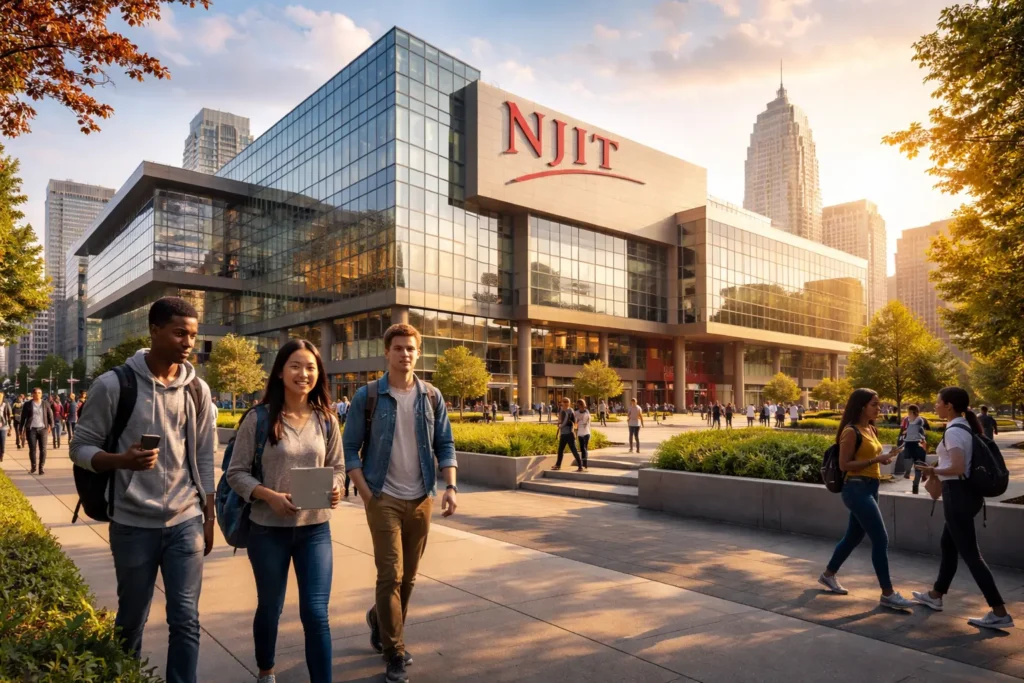
Located in the heart of Newark’s University Heights district, the New Jersey Institute of Technology (NJIT) stands as the state’s premier public polytechnic university and a nationally recognized R1 research institution. Founded in 1881, NJIT has evolved into a powerhouse of innovation, combining cutting-edge STEM education with hands-on learning experiences that prepare students for high-paying careers in technology, engineering, computing, and business. As one of only 32 polytechnic universities in the United States and designated as both a Hispanic-Serving Institution (HSI) and an Asian American Native American Pacific Islander-serving institution (AANAPISI), NJIT serves a remarkably diverse student body of over 12,000 students who benefit from the university’s unique position at the intersection of academic excellence, urban opportunity, and real-world application.
Whether you’re a prospective student exploring your options, a parent researching the best value in higher education, or simply curious about what makes NJIT unique, this comprehensive guide will walk you through everything you need to know—from academic programs and admissions requirements to campus life, career outcomes, and the tangible return on investment that NJIT graduates experience in today’s competitive job market.
Why New Jersey Institute of Technology? A University Built for Innovation and Impact
NJIT distinguishes itself through a unique combination of rigorous academics, practical experience, and proven outcomes. The university’s tagline, “The Edge in Knowledge,” reflects its commitment to giving students a competitive advantage in the rapidly evolving technology landscape.
Academic Excellence and National Recognition
NJIT’s academic reputation continues to rise, as evidenced by its impressive rankings and accreditations. The university is ranked #80 among National Universities by U.S. News & World Report, but more telling is its #19 ranking in the Wall Street Journal’s assessment of colleges, which heavily weights employment outcomes and student satisfaction. These rankings aren’t just numbers—they represent NJIT’s effectiveness in delivering quality education that translates into career success.
As an R1 Doctoral University, New Jersey Institute of Technology belongs to an elite group of institutions characterized by “very high research activity.” This designation means students have access to cutting-edge research opportunities alongside distinguished faculty members who are advancing knowledge in fields like artificial intelligence, cybersecurity, materials science, and sustainable engineering. The university’s research expenditures exceed $170 million annually, funding projects that range from developing next-generation batteries to creating AI systems for healthcare diagnostics.
NJIT’s Martin Tuchman School of Management holds the prestigious AACSB accreditation, a distinction earned by fewer than 6% of business schools worldwide. This accreditation ensures that business students receive education that meets the highest global standards. Additionally, NJIT’s engineering programs are ABET-accredited, providing the credentialing necessary for professional engineering licensure.
The university also carries unique designations as a space-grant and sea-grant institution, opening doors to specialized research funding and partnerships with NASA and NOAA. For students interested in aerospace, oceanography, or environmental science, these affiliations provide unparalleled opportunities to work on federally funded projects addressing national priorities.
From Classroom to Career: The NJIT Advantage
The true measure of any university is what happens to its graduates, and by this metric, NJIT excels. The median early-career salary for NJIT alumni stands at $69,591, significantly higher than the national average for college graduates. This figure jumps to over $120,000 for mid-career professionals, placing NJIT graduates among the top earners in the region.
PayScale consistently ranks New Jersey Institute of Technology among the top 100 colleges nationwide for return on investment (ROI), with graduates recouping their educational investment faster than those from most other institutions. For in-state students paying approximately $21,000 per year in tuition, this ROI is particularly compelling. Even out-of-state students, with tuition around $40,000 annually, find that NJIT’s career outcomes justify the investment.
What drives these impressive outcomes? NJIT’s emphasis on experiential learning. The university’s cooperative education (co-op) program allows students to alternate semesters of academic study with paid, full-time work at companies like Amazon, Goldman Sachs, Bristol Myers Squibb, and JPMorgan Chase. These aren’t just internships—co-op placements typically last six months and provide the depth of experience that transforms a resume. Many students receive full-time job offers from their co-op employers before graduation.
Every NJIT student also completes a senior capstone project, a year-long culminating experience where teams solve real problems for industry partners or conduct original research. Recent capstone projects have included developing autonomous delivery robots, designing sustainable urban infrastructure, creating machine learning models for financial forecasting, and building cybersecurity systems for healthcare applications. These projects give students portfolio-ready work to showcase to employers.
The university’s career services office maintains relationships with over 500 employer partners, hosting career fairs, on-campus interviews, and networking events throughout the year. NJIT’s location in the New York metropolitan area—the nation’s largest job market—provides students with unmatched access to opportunities in finance, technology, pharmaceuticals, telecommunications, and consulting.
Explore NJIT’s Colleges and Cutting-Edge Programs
NJIT’s academic structure consists of six colleges and schools, each offering programs that blend theoretical knowledge with practical application. The university’s STEM focus doesn’t mean it’s narrow—NJIT graduates are as comfortable presenting to executives as they are coding algorithms or designing circuits.
Newark College of Engineering (NCE)
As NJIT’s flagship college, NCE enrolls approximately 35% of the university’s students and offers programs in:
- Biomedical Engineering—combining medicine and technology to develop medical devices, prosthetics, and diagnostic tools
- Chemical Engineering—focusing on sustainable processes, pharmaceutical manufacturing, and materials innovation
- Civil Engineering—addressing infrastructure challenges in transportation, water resources, and structural design
- Electrical and Computer Engineering—spanning power systems, semiconductor design, robotics, and telecommunications
- Engineering Technology—providing hands-on, applied engineering education with immediate industry relevance
- Industrial Engineering—optimizing complex systems in manufacturing, healthcare, and logistics
- Mechanical Engineering—covering everything from aerospace systems to renewable energy and robotics
NCE students benefit from extensive laboratory facilities, including a makerspace equipped with 3D printers, laser cutters, CNC machines, and electronics workbenches. The college’s project-based curriculum means students are building, testing, and iterating from their first year. Faculty members include National Academy of Engineering members and NSF CAREER award winners who bring students into their research labs.
College of Computing Sciences (Ying Wu College of Computing)
Computing is NJIT’s second-largest major, attracting 31% of students. The college offers specialized programs that go beyond traditional computer science:
- Computer Science—covering algorithms, software engineering, systems programming, and theoretical computer science
- Data Science—training students in statistical analysis, machine learning, big data technologies, and data visualization
- Information Technology—focusing on network administration, database management, and IT infrastructure
- Cybersecurity—preparing students to defend against evolving threats through courses in cryptography, network security, digital forensics, and ethical hacking
- Bioinformatics—applying computational methods to biological and medical data
NJIT was one of the first universities to integrate artificial intelligence across its computing curriculum. Every computer science major now takes foundational AI courses, and specialized tracks allow students to deep-dive into areas like computer vision, natural language processing, and reinforcement learning. The university operates an AI Hub that brings together faculty and students working on AI applications in healthcare, finance, urban planning, and cybersecurity.
The college’s unique Business and Information Systems degree combines computing skills with business acumen, while the groundbreaking Business with AI program—among the first of its kind in the nation—prepares students to lead organizations in the age of artificial intelligence. This interdisciplinary approach recognizes that tomorrow’s technology leaders need both technical depth and business sophistication.
Martin Tuchman School of Management
NJIT’s business school takes a distinctly technology-focused approach to management education. All business majors take courses in data analytics, information systems, and quantitative methods, ensuring they can work effectively in tech-driven industries. Programs include:
- Business and Information Systems—combining traditional business disciplines with IT skills
- Finance—with emphasis on fintech, quantitative analysis, and risk management
- Marketing—focusing on digital marketing, analytics, and consumer behavior in technology markets
- Engineering Management—designed for students who want to lead technical teams and projects
The school’s Enterprise Development Center provides students with entrepreneurship education and incubation services. Many New Jersey Institute of Technology students have launched successful startups, and the university’s location in the New York metro area provides access to venture capital, angel investors, and startup accelerators.
College of Architecture and Design, Jordan Hu College of Science and Liberal Arts
The College of Architecture and Design (HCAD) approaches architecture through the lens of technology and sustainability. Students use advanced digital fabrication tools, building information modeling (BIM) software, and computational design methods. The college’s interior design and digital design programs similarly emphasize the integration of technology with creative practice.
The Jordan Hu College of Science and Liberal Arts houses programs in applied mathematics, applied physics, chemistry, biology, and the humanities. Far from being a traditional liberal arts college, it focuses on preparing scientists who can solve real-world problems. Mathematics majors, for example, can specialize in actuarial science, mathematical finance, or applied mathematics with applications in engineering and computing.
The college also offers professional programs in Pre-Medicine, Pre-Dental, and Pre-Law, supporting students who plan to pursue advanced degrees in healthcare or law while building strong quantitative and analytical foundations.
The Albert Dorman Honors College
High-achieving students at NJIT can join the Albert Dorman Honors College, which offers enhanced academic experiences including specialized honors courses, priority registration, dedicated advising, and research opportunities starting in the freshman year. Honors students benefit from smaller class sizes and seminars that encourage deep intellectual exploration.
Through a unique partnership, NJIT honors students can cross-register for courses at Rutgers University-Newark, providing access to an even broader range of academic offerings. The honors program culminates in a thesis or capstone project that demonstrates mastery of the student’s field.
Life as a Highlander: Campus, Community & Newark
NJIT’s 48-acre urban campus in Newark’s University Heights district provides a close-knit college experience within one of the most dynamic cities in the Northeast. While NJIT has historically been known as a commuter school, the university has invested heavily in residential facilities and campus life programming to create a vibrant on-campus community.
A Vibrant and Diverse Community
NJIT’s student body reflects the diversity of the New York metropolitan area and beyond. The university’s demographics show remarkable ethnic and geographic diversity: students come from all 50 states and over 100 countries. This diversity is one of NJIT’s greatest strengths, exposing students to different perspectives and preparing them for global careers.
Gender diversity is improving in STEM fields traditionally dominated by men. While the overall student body is approximately 69% male and 31% female, certain programs like architecture, biology, and business have achieved better gender balance. The university actively works to recruit and support women in STEM through programs, scholarships, and mentoring initiatives.
Students can join over 150 student organizations spanning academic clubs, cultural groups, recreational sports, performing arts, and special interest communities. Popular organizations include the Society of Women Engineers, National Society of Black Engineers, Robotics Club, E-Sports teams, and various entrepreneurship and innovation clubs. The campus hosts hackathons, design competitions, and technical challenges throughout the year.
Greek life at NJIT includes both social and professional fraternities and sororities, offering leadership development, community service opportunities, and social connections. Several engineering and computing fraternities provide academic support and industry networking specific to technical fields.
NJIT competes in NCAA Division I athletics as the Highlanders, with varsity teams in basketball, soccer, volleyball, tennis, swimming and diving, and other sports. The Wellness and Events Center (WEC) serves as the hub for athletics and recreation, featuring a modern fitness center, swimming pool, basketball courts, and multipurpose spaces for everything from yoga classes to large campus events.
Living and Learning in Newark’s University Heights
Approximately 25% of NJIT students live on campus in residence halls and apartments that range from traditional doubles to suite-style and apartment configurations. On-campus housing offers the convenience of living steps from classes, labs, and campus facilities, along with structured community-building through residence life programming.
For commuter students—who make up the majority—NJIT provides extensive support including dedicated lounge spaces, lockers, and programming designed to help commuters connect with campus life. The university’s location makes it accessible via New Jersey Transit rail and bus lines, and many students drive from throughout northern New Jersey.
Newark itself has undergone a remarkable transformation in recent years. The city offers students access to professional sports (the NHL’s New Jersey Devils play at the Prudential Center just blocks from campus), world-class performing arts at the New Jersey Performing Arts Center, diverse dining in neighborhoods like the Ironbound (known for its Portuguese and Spanish restaurants), and cultural institutions including the Newark Museum of Art.
Perhaps most significantly, NJIT’s Newark location provides direct access to New York City via the PATH train, which runs from Newark Penn Station to Manhattan in under 20 minutes. This connectivity allows students to take advantage of internships, cultural attractions, and entertainment options in one of the world’s great cities while paying Newark’s lower cost of living.
Admissions, Tuition, and Financial Aid: Your Roadmap to NJIT
Understanding the admissions process and financial investment is crucial for prospective students and families. NJIT uses a holistic admissions approach that considers academic achievement, extracurricular involvement, and potential for success in a rigorous STEM environment.
Understanding the Admissions Process
NJIT’s acceptance rate of approximately 65% reflects the university’s selective yet accessible approach. The average admitted student has a high school GPA of 3.7 on a 4.0 scale, demonstrating strong academic performance. While this suggests NJIT is within reach for students with solid grades, admitted students typically excel in mathematics and science courses—B+ or higher grades in calculus, physics, and chemistry significantly strengthen an application.
NJIT has adopted a test-optional policy, meaning students can choose whether to submit SAT or ACT scores. For those who do submit scores, the middle 50% of admitted students typically score between 1160-1370 on the SAT (out of 1600) or 25-31 on the ACT. Students with strong test scores should submit them, as high scores can strengthen applications and qualify students for merit scholarships. However, students whose test scores don’t reflect their academic abilities can opt not to submit scores and let their transcripts, essays, and activities speak for themselves.
The university offers two main application deadlines:
- Early Action: November 15 (non-binding, with admissions decisions typically released by January)
- Regular Decision: March 1 (with rolling admissions continuing into the summer for remaining spots)
Early Action applicants often receive priority consideration for merit scholarships and honors college admission, making it the recommended path for students who have NJIT as a top choice.
To strengthen your application, NJIT admissions officers recommend:
- Taking the most rigorous math and science courses available at your school, including AP or IB courses when possible
- Demonstrating interest in STEM through activities like robotics teams, coding clubs, science fairs, or personal projects
- Writing a strong personal essay that shows your problem-solving mindset and passion for technology
- Obtaining recommendation letters from math or science teachers who can speak to your analytical abilities
- Visiting campus if possible or attending virtual information sessions to demonstrate genuine interest
Investing in Your Future: Costs and Financial Support
For the 2025-2026 academic year, NJIT’s tuition and fees break down as follows:
- In-State Students: Approximately $21,000 per year in tuition and fees
- Out-of-State Students: Approximately $40,000 per year in tuition and fees
When factoring in room and board (for on-campus students), books, supplies, and personal expenses, the total estimated cost of attendance is around $39,000 for in-state students living on campus and $58,000 for out-of-state students. Commuter students save significantly on housing costs.
However, very few students pay the full sticker price. NJIT awards over $150 million in financial aid annually through a combination of need-based aid, merit scholarships, and work-study opportunities. The average net price—what students actually pay after grants and scholarships—is significantly lower than the published cost of attendance.
To be considered for financial aid, students must file the Free Application for Federal Student Aid (FAFSA) by the priority deadline. New Jersey residents should also file the New Jersey State Financial Aid application. NJIT’s financial aid office evaluates each student’s financial need and creates an aid package that may include:
- Federal Pell Grants for students with exceptional financial need
- New Jersey TAG grants for eligible state residents
- NJIT institutional grants and scholarships
- Federal student loans (subsidized and unsubsidized)
- Federal Work-Study employment opportunities
Merit scholarships are awarded based on academic achievement and don’t require separate applications—all admitted students are automatically considered. Top scholarships can range from a few thousand dollars per year to full-tuition awards for the most exceptional students. The Albert Dorman Honors College Scholarship, Presidential Scholarship, and Dean’s Scholarship are among the most prestigious merit awards.
NJIT also participates in the Yellow Ribbon Program, providing additional funding for eligible veterans using Post-9/11 GI Bill benefits. Military-connected students should contact the Office of Veterans Affairs to understand their benefits.
Beyond traditional aid, many NJIT students offset costs through paid co-op positions, which can earn students $15,000-$30,000 or more over a six-month placement. Some students graduate with multiple co-op experiences under their belts and thousands of dollars in savings that offset their education costs.
FAQS
What is NJIT best known for?
NJIT is best known for its rigorous STEM education, particularly in engineering and computer science, combined with strong career outcomes. As New Jersey’s public polytechnic university and an R1 research institution, NJIT excels at preparing students for high-paying technology careers through hands-on learning, extensive co-op opportunities, and cutting-edge research in areas like artificial intelligence, cybersecurity, robotics, and sustainable engineering. The university’s designation as a Hispanic-Serving Institution and AANAPISI also reflects its commitment to diversity and access in STEM fields.
Is NJIT a good value for the money?
Yes, NJIT offers exceptional value, particularly for New Jersey residents. With in-state tuition of approximately $21,000 per year and median alumni salaries of $69,591, students typically recoup their educational investment within a few years of graduation. PayScale consistently ranks NJIT among the top 100 colleges nationwide for return on investment. The combination of affordable tuition, generous financial aid (over $150 million awarded annually), co-op earnings that offset costs, and strong job placement makes NJIT one of the best values in higher education for students seeking technology careers. Even for out-of-state students, the career outcomes justify the investment.
What is student life like at NJIT?
Student life at NJIT balances rigorous academics with diverse opportunities for involvement and community building. While NJIT has traditionally been known as a commuter school, the university has made significant investments in residential facilities and campus programming to create a vibrant on-campus experience. Students can choose from over 150 clubs and organizations, compete in NCAA Division I athletics, join Greek life, and attend events at the Wellness and Events Center. The urban Newark location provides access to cultural attractions, professional sports, diverse dining, and—via a quick PATH train ride—all that New York City offers. The student body’s remarkable diversity enriches the experience, exposing students to different perspectives and cultures that prepare them for global careers.
How does NJIT support students in finding jobs?
NJIT’s Career Development Services provides comprehensive support through multiple channels. The university’s cooperative education program allows students to gain six-month paid work experiences at companies like Amazon, Goldman Sachs, and Bristol Myers Squibb, often leading to full-time job offers. Career services maintains partnerships with over 500 employers, hosting multiple career fairs, on-campus interviews, and networking events throughout the year. The office offers resume reviews, mock interviews, LinkedIn optimization, and salary negotiation coaching. Senior capstone projects give students portfolio-ready work to showcase. Additionally, NJIT’s extensive alumni network—including notable graduates like the inventor of Keurig coffee makers and numerous NASA engineers—provides mentoring and industry connections. The university’s location in the New York metropolitan area, the nation’s largest job market, gives students unparalleled access to opportunities in technology, finance, pharmaceuticals, and consulting.
What are the most popular majors at NJIT?
According to U.S. News data, the most popular majors at NJIT are Engineering (35% of students), Computer and Information Sciences (31%), Architecture (9%), Business (7%), and Biology (5%). Within engineering, mechanical engineering, electrical engineering, and civil engineering attract the most students. In computing, computer science and information technology are the top choices. The university’s newer programs in data science, cybersecurity, and artificial intelligence are experiencing rapid growth as student interest in these cutting-edge fields increases. NJIT’s unique Business with AI program—among the first of its kind in the nation—is also gaining popularity among students who want to combine business acumen with artificial intelligence expertise.
The NJIT Advantage: Innovation, Impact, and ROI
Choosing the right university is one of the most important decisions you’ll make, with implications for your career trajectory, earning potential, and personal growth. NJIT offers a unique combination of factors that few institutions can match: rigorous STEM education delivered by an R1 research university, hands-on learning through co-ops and capstone projects, proven career outcomes with median salaries approaching $70,000, exceptional return on investment—particularly for New Jersey residents—and the opportunity to study in the diverse, dynamic New York metropolitan area.
Whether you’re passionate about engineering the next generation of medical devices, developing artificial intelligence systems that transform industries, designing sustainable buildings, launching a tech startup, or pursuing any number of other technology-driven careers, NJIT provides the knowledge, skills, and experiences you need to succeed. The university’s commitment to access and diversity ensures that students from all backgrounds can pursue their aspirations in STEM fields.
As you consider your options, visit NJIT’s campus to experience the energy of University Heights, talk to current students and faculty, tour the labs and makerspaces, and envision yourself as part of the Highlander community. With over 140 years of history preparing leaders in technology and innovation, NJIT continues to deliver on its promise of providing students with “The Edge in Knowledge”—and the competitive advantage to thrive in an increasingly technology-driven world.
For more information about admissions, to schedule a campus tour, or to connect with an admissions counselor who can answer your specific questions, visit NJIT’s website or contact the Office of Admissions directly. Your future in technology starts here.

Adrian Cole is a technology researcher and AI content specialist with more than seven years of experience studying automation, machine learning models, and digital innovation. He has worked with multiple tech startups as a consultant, helping them adopt smarter tools and build data-driven systems. Adrian writes simple, clear, and practical explanations of complex tech topics so readers can easily understand the future of AI.