This isn’t just another news headline. The shooting highlights broader issues that matter — for governments, communities, and everyday people.
Security & Public Safety in Urban Spaces
When military or paramilitary forces are deployed in cities, the expectation is often greater safety. But events like this remind us that deployment alone doesn’t guarantee peace — and may even introduce new risks.
In places declared “hotspots,” patrols may provide deterrence — but the presence of more armed forces doesn’t eliminate the possibility of violence. Sometimes it concentrates it.
Immigration, Resettlement & Vetting Challenges
The suspect was reportedly resettled in the U.S. under a program for Afghans who worked with American forces abroad. His background underscores how complicated and high-stakes immigration and asylum processes can be — especially when security and humanitarian needs collide.
It forces a conversation: how do nations balance compassion for refugees with rigorous safety protocols? And how do societies avoid scapegoating entire communities for the acts of one individual?
The Role of Military Forces in Domestic Policing
Deploying the Guard into civilian areas — especially in a city like DC with legal and constitutional complexities — raises serious civil-liberty questions.
Some residents and experts argue using military troops for domestic law-enforcement blurs lines, undermines trust with citizens, and may escalate tension instead of easing it.

What We — Regular Citizens or Interested Readers — Can Do to Stay Informed & Engaged
While this incident happened far from many of us, its implications ripple globally. Here are some ways you, as a reader, can approach such news with clarity and responsibility:
- Stay informed beyond headlines
- Look for reputable news sources (not just social media).
- Check official reports when available before forming strong opinions.
- Reflect on context, not just emotion
- Violence is tragic — but avoid generalizing or stigmatizing whole groups (immigrants, refugees, etc.) for one person’s actions.
- Consider historical, social, and policy-related factors — why people were resettled, how deployments are authorized, and so on.
- Support balanced public discourse
- Encourage media and community voices that ask tough questions: about security, but also about fairness, civil rights, humanitarian obligations.
- Share informed commentary — help readers understand complexity over sensationalism.
- Advocate for transparency & accountability
- Demand clarity from authorities about investigations, vetting procedures, and deployment justifications.
- Encourage dialogue on how to protect cities without militarizing them.

What Went Wrong — Common Mistakes in Reaction & Discussion
When something like the national guard shot in DC happens, people often react strongly. That’s natural. But there are some pitfalls worth avoiding:
- Reacting too fast — drawing big conclusions (about immigration, refugees, security policy) before all facts are known.
- Painting entire communities with one brush — e.g., blaming all Afghans or immigrants because one person acted violently.
- Accepting simplistic “fixes” — like increased militarization — without considering long-term implications for civil rights, communal trust, or safety.
- Ignoring structural issues — instead of just focusing on the shooter or victims, we must ask: what policies, vetting systems, social supports failed or could be improved?
Real-World Implications & Use Cases of This Event
- Policy reforms: Governments may revisit immigration and asylum vetting processes — especially for individuals who previously worked in war zones or sensitive operations.
- Public safety strategies: Cities deploying military or national guard forces might reconsider when and where to deploy — balancing visibility with respect for civil life, free movement, and community trust.
- Community dialogue & media responsibility: News outlets, commentators, and citizens may shift toward more nuanced, evidence-based reporting of violent events involving immigrants or security forces.
- Advocacy for refugees and immigrants: Civil-society groups may use such events to argue for fair treatment — urging not to scapegoat entire communities while supporting victims and due process.
Takeaway: Why “National Guard Shot in DC” Matters to All of Us
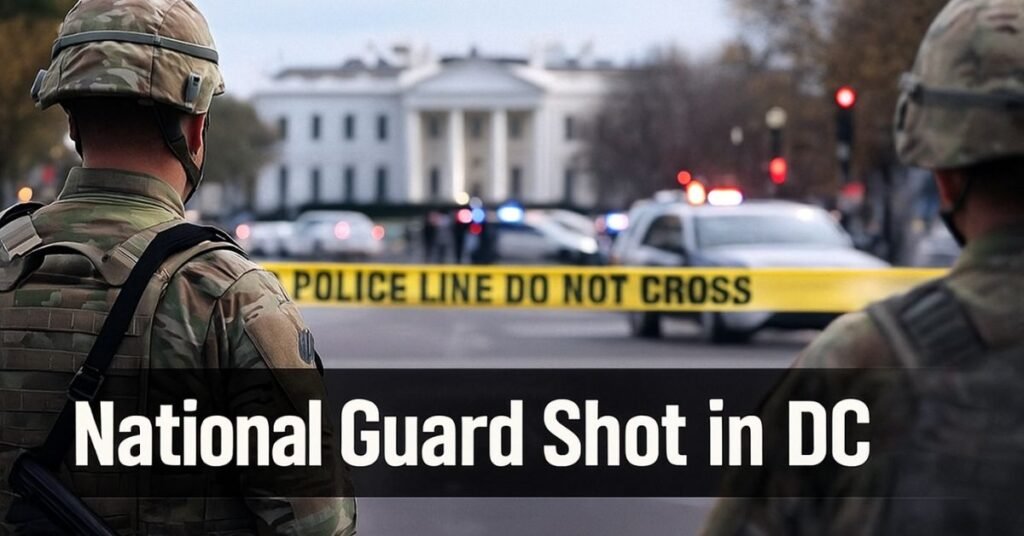
The shooting in Washington — two young guards, a lone suspect, a city in shock — is a stark reminder that security and peace are fragile, even in the world’s most powerful capitals.
It shows that deploying armed forces to protect citizens is not a magic bullet. Real safety demands thoughtful policies, transparent processes, strong social trust, and a willingness to ask difficult questions.
As readers, we have a role: stay curious, demand nuance, resist fear-driven reactions, and advocate for solutions that respect both security and humanity.
Frequently Asked Questions (FAQs)
Q: Who were the victims in the national guard shot in DC?
A: The injured Guard members were identified as Sarah Beckstrom and Andrew Wolfe, both part of the West Virginia National Guard.
Q: Who is the suspect, and what was his background?
A: The suspect is Rahmanullah Lakanwal — a 29-year-old Afghan national who entered the U.S. under a resettlement program in 2021. He reportedly worked with U.S.-backed forces in Afghanistan before coming to the U.S.
Q: Who is the suspect, and what was his background?
A: The suspect is Rahmanullah Lakanwal — a 29-year-old Afghan national who entered the U.S. under a resettlement program in 2021. He reportedly worked with U.S.-backed forces in Afghanistan before coming to the U.S.
Q: Was this a random shooting or a planned attack?
A: Authorities described the incident as a “targeted ambush.” The suspect approached the guards and opened fire, suggesting planning rather than random violence.
Q: Does this event change how governments treat refugees or immigrants?
A: It may influence immigration and vetting policies, especially for individuals who assisted in conflict zones. But it also raises the danger of overly broad responses or blanket stereotyping, which civil-rights advocates warn against.
Q: What can everyday citizens do to respond thoughtfully to such news?
A: Stay informed through credible sources, avoid generalizations, support balanced discussion, and advocate for policies that uphold both safety and dignity.
Final Thoughts & What You Can Do
If you’ve read this far — thank you. It means you care about what happens in places far away, and about how events ripple across borders and communities.
Next time you read a headline like “national guard shot in DC,” remember there’s more behind the words: lives affected, policies under pressure, communities under scrutiny, and deep social questions at stake.
If you want — I can help you track the aftermath of this shooting: legal developments, policy changes, public reactions.
Would you like me to prepare a timeline of events since the shooting (with updates and links)?

Hannah Price is a digital journalist who covers breaking news, global events, and trending stories with accuracy and speed. She has previously contributed to several online magazines and has built a reputation for verifying facts before publishing. Hannah believes in responsible reporting and aims to present stories in a way that readers can trust.