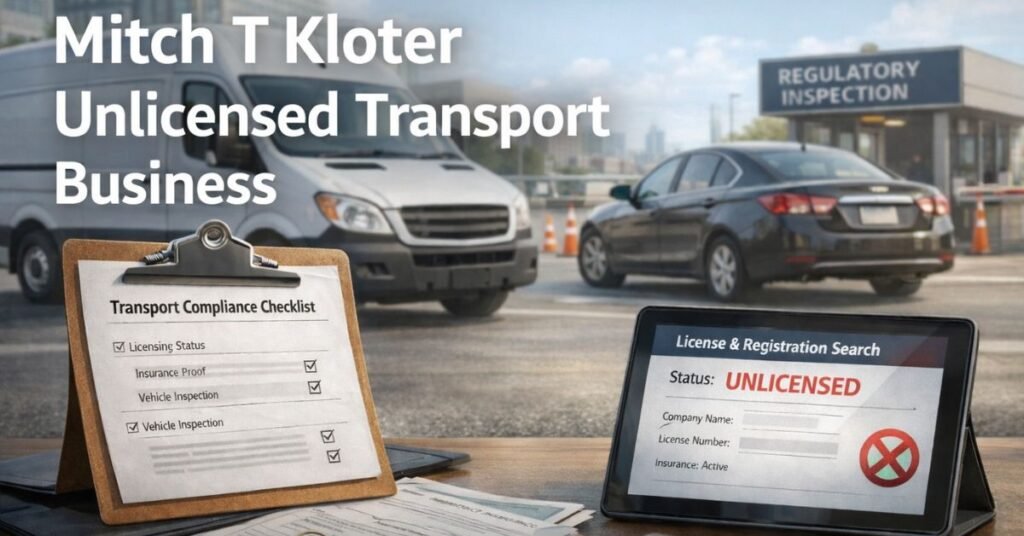
Introduction
If you’ve searched the phrase mitch t kloter unlicensed transport business, chances are you’re trying to make sense of a confusing—and potentially serious—issue. Maybe you’re a consumer who encountered a transport service that didn’t feel quite right. Maybe you’re a small business owner worried about compliance. Or maybe you’re a researcher, journalist, or legal professional trying to understand how unlicensed transport operations actually work in the real world.
Here’s the thing: unlicensed transport businesses are not rare, but they are widely misunderstood. The rules governing transport—whether passenger, freight, or courier—are complex, fragmented, and aggressively enforced in many jurisdictions. When a specific name becomes associated with the phrase “unlicensed transport business,” it raises important questions about legality, consumer protection, and due process.
This article does not assume guilt or wrongdoing by any individual. Instead, it uses the keyword mitch t kloter unlicensed transport business as a case-study-style lens to explain how unlicensed transport issues arise, how they are identified, what the risks are, and how both consumers and operators can protect themselves.
By the end of this guide, you’ll understand:
- What “unlicensed transport business” actually means in legal and practical terms
- How authorities determine whether a transport operation is licensed
- Why these cases matter for safety, insurance, and liability
- Common mistakes operators make—and how to fix them
- What steps to take if you’re researching, reporting on, or affected by a situation like this
Think of this as a field manual: grounded, human, and built on how things work outside the theory.
Understanding the Concept Behind “Unlicensed Transport Business”
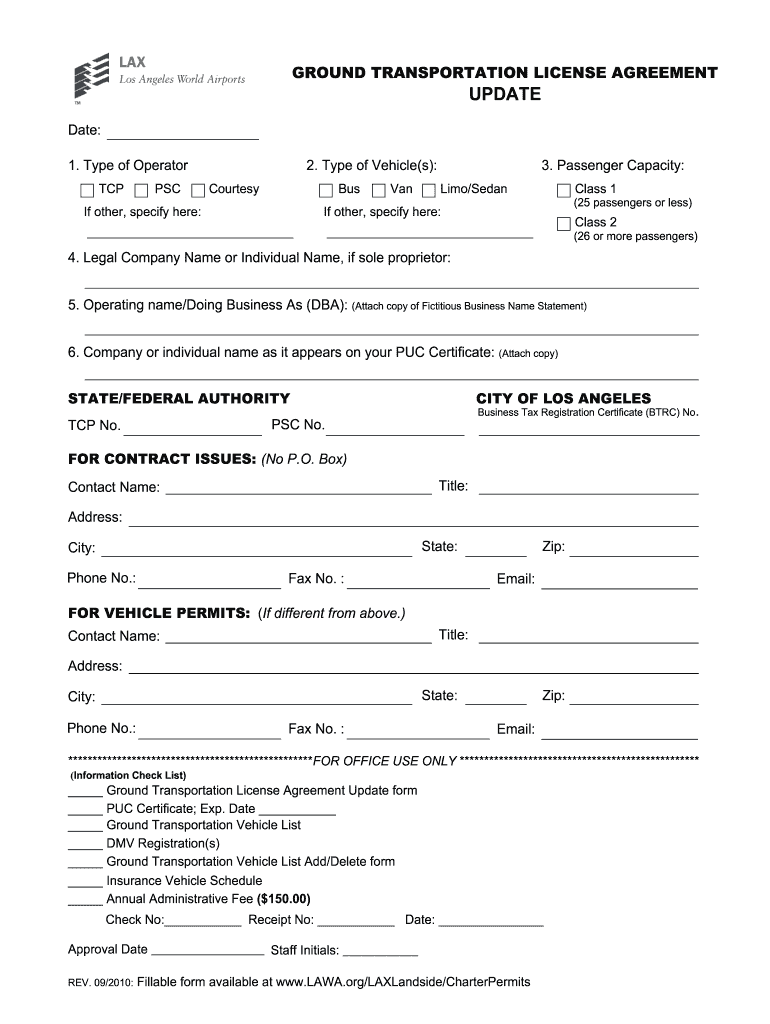
At its core, an unlicensed transport business is any operation that provides transportation services—people or goods—without holding the permits, registrations, or regulatory approvals required by law. The specifics vary by country, state, and even city, but the underlying principle is consistent: transport is regulated because it involves public safety, infrastructure, and financial liability.
When a keyword like mitch t kloter unlicensed transport business circulates online, it usually reflects one of three situations:
- An alleged regulatory violation under investigation
- A civil or administrative dispute involving licensing status
- Public confusion or misinformation around what licensing is required
Licensing is not just a piece of paper. It typically includes:
- Business registration
- Transport authority permits
- Vehicle inspections and certifications
- Commercial insurance coverage
- Driver qualifications and background checks
Operating without one or more of these can place a business into the “unlicensed” category—even if the operator believes they are compliant.
A useful analogy: driving a car without insurance doesn’t stop the car from running, but it dramatically changes the legal consequences of an accident. The same logic applies here.
Why Licensing Exists in the Transport Industry
To understand why the issue matters, it helps to understand why transport licensing is enforced so tightly in the first place.
Transport sits at the intersection of:
- Public safety
- Infrastructure use (roads, ports, airports)
- Consumer protection
- Environmental regulation
When regulators issue licenses, they are not just collecting fees. They are ensuring:
- Vehicles meet safety standards
- Operators carry liability insurance
- Drivers are qualified and vetted
- Pricing and services meet consumer protection laws
In alleged cases like those implied by the phrase mitch t kloter unlicensed transport business, regulators are usually concerned less with punishment and more with risk exposure. One unlicensed operator can create cascading consequences:
- Insurance claims denied
- Injuries without compensation
- Cargo losses with no recourse
- Tax and labor violations
This is why even small, local transport operations are subject to oversight.
How Authorities Determine Whether a Transport Business Is Unlicensed

One of the most misunderstood aspects of these cases is how enforcement actually happens. Contrary to popular belief, regulators don’t usually start with raids or arrests. Most cases begin quietly.
Common triggers include:
- Consumer complaints
- Insurance audits
- Traffic stops revealing commercial activity
- Competitor reports
- Online advertising reviews
Investigators typically look for:
- Proof of operating authority
- Vehicle registration classification
- Commercial insurance policies
- Payment records and invoices
- Advertising language suggesting paid transport
For example, someone offering “private rides” for cash via social media may unintentionally cross the line into commercial activity. If the name mitch t kloter appears in public records, filings, or complaints connected to transport services, that alone does not prove wrongdoing—but it can prompt scrutiny.
This distinction matters, especially in online discussions where allegations can outrun facts.
Real-World Risks of an Unlicensed Transport Business
Whether alleged or confirmed, unlicensed transport operations carry serious consequences. These risks affect everyone involved, not just the operator.
For consumers:
- No guaranteed insurance coverage
- Limited legal recourse in disputes
- Increased safety risks
- Difficulty recovering losses
For operators:
- Heavy fines and penalties
- Vehicle impoundment
- Business shutdown orders
- Civil liability exposure
- Criminal charges in severe cases
For third parties:
- Uninsured accident claims
- Cargo damage disputes
- Infrastructure liability
This is why the phrase mitch t kloter unlicensed transport business draws attention—it touches on a regulatory fault line that affects public trust.
Benefits of Properly Licensed Transport Operations
It’s easy to frame licensing as bureaucracy, but properly licensed transport businesses enjoy real, practical advantages.
Key benefits include:
- Legal protection and predictability
- Access to commercial insurance
- Ability to scale operations
- Eligibility for contracts and partnerships
- Consumer trust and credibility
In contrast, unlicensed operations often remain small and fragile—not by choice, but by constraint.
From a consumer perspective, choosing licensed providers means:
- Clear accountability
- Transparent pricing
- Regulated safety standards
These benefits explain why enforcement exists even when demand for cheaper, informal transport options is high.
Step-by-Step: How Transport Businesses Stay Compliant
Understanding compliance helps clarify where things go wrong.
Step 1: Define the Service Clearly
Is it passenger transport, freight, courier, rideshare, or charter? Each category has different rules.
Step 2: Register the Business
This includes tax registration, business name filings, and operating jurisdiction.
Step 3: Obtain Transport Authority Licenses
This may involve federal, state, or municipal agencies depending on scope.
Step 4: Secure Commercial Insurance
Personal auto insurance is almost never sufficient.
Step 5: Vehicle Compliance
Inspections, emissions, load ratings, and signage often apply.
Step 6: Driver Qualifications
Commercial licenses, background checks, and training records matter.
Step 7: Maintain Records
Logs, invoices, trip records, and maintenance schedules are essential.
When any of these steps are skipped—or misunderstood—an operator may unintentionally fall into the “unlicensed” category.
Tools and Resources for Verifying Transport Licensing
If you’re researching a situation like mitch t kloter unlicensed transport business, verification matters.
Useful tools include:
- State or national transport authority databases
- Business registration lookups
- Insurance certificate verification portals
- Court and administrative records
Free tools often provide basic status checks, while paid compliance platforms offer deeper audits, alerts, and documentation tracking.
Pros of free tools:
- Accessible
- Fast
- Good for initial checks
Cons:
- Limited detail
- May not show pending actions
Paid tools offer:
- Compliance monitoring
- Risk scoring
- Documentation management
For journalists and researchers, combining public records with direct requests for comment is considered best practice.
Common Mistakes That Lead to “Unlicensed” Status
Many operators don’t set out to break the law. The most common mistakes include:
Misclassifying the Service
Calling something “private” doesn’t make it non-commercial if money changes hands.
Relying on Personal Insurance
This is one of the fastest paths to non-compliance.
Operating Across Jurisdictions
Crossing state or regional lines often triggers additional requirements.
Assuming Digital Platforms Handle Licensing
Marketplaces and apps rarely assume legal responsibility for operators.
Ignoring Renewals
Expired licenses are treated the same as no license at all.
Fixes usually involve:
- Immediate cessation of service
- Consulting a transport compliance specialist
- Filing corrective applications
- Paying back fees or penalties
Legal and Ethical Considerations Around Public Allegations
This section matters more than most people realize.
Using a person’s name—such as mitch t kloter—in connection with an “unlicensed transport business” carries ethical and legal responsibility. Allegations should always be:
- Clearly labeled as allegations
- Supported by verifiable sources
- Presented with right-of-reply opportunities
Online content that states or implies guilt without proof can cause reputational harm and legal exposure.
Responsible coverage focuses on:
- Regulatory frameworks
- Public records
- Educational context
That’s the approach this article takes.
What to Do If You’re Affected as a Consumer
If you believe you used an unlicensed transport service:
- Document everything (receipts, messages, photos)
- Contact your insurer if an incident occurred
- File a complaint with the relevant transport authority
- Avoid public accusations without evidence
These steps protect your rights while allowing regulators to do their job.
What to Do If You’re an Operator Facing Questions
If your business is questioned:
- Pause operations immediately if advised
- Consult a transport or regulatory attorney
- Audit your licensing and insurance
- Respond factually and calmly to inquiries
Transparency often reduces penalties and builds credibility.
Conclusion
The keyword mitch t kloter unlicensed transport business represents more than a search query—it reflects a broader concern about how transport services are regulated, perceived, and discussed in public spaces.
Unlicensed transport issues sit at the crossroads of safety, law, and trust. Whether you’re a consumer, operator, or researcher, the most important takeaways are clarity and caution:
- Licensing is not optional
- Allegations are not convictions
- Verification matters more than speculation
Handled responsibly, these discussions can improve standards rather than inflame confusion. If you’re navigating a situation like this, focus on facts, documentation, and expert guidance—and leave the assumptions at the door.
FAQs
What does “unlicensed transport business” legally mean?
It refers to providing transport services without required regulatory approvals, permits, or insurance.
Is mentioning a name like Mitch T Kloter proof of wrongdoing?
No. A name appearing in connection with a keyword does not establish guilt or legal findings.
How can I verify if a transport business is licensed?
Check official transport authority databases and business registries.
Can a small or private operator still need licensing?
Yes. Payment, advertising, or repeated services usually trigger licensing requirements.
What happens if a business is found unlicensed?
Penalties range from fines to shutdowns, depending on jurisdiction and severity.

Michael Grant is a business writer with professional experience in small-business consulting and online entrepreneurship. Over the past decade, he has helped brands improve their digital strategy, customer engagement, and revenue planning. Michael simplifies business concepts and gives readers practical insights they can use immediately.