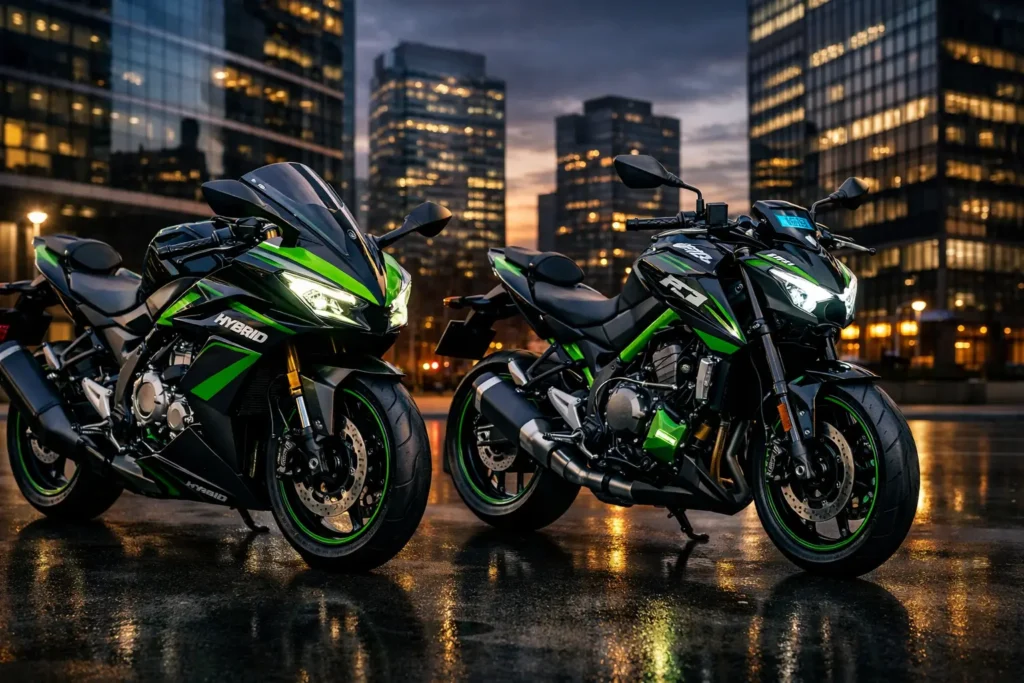
On October 6, 2023, Kawasaki changed the trajectory of the powersports industry by announcing the world’s first mass-produced strong hybrid motorcycle — a title that excludes scooters and refers specifically to full-size motorcycles capable of operating on electric power alone. The Ninja 7 Hybrid and Z7 Hybrid are not concept bikes, not limited-edition prototypes, and not mild-hybrid assisted commuters. They are production motorcycles available for purchase at a US MSRP of $12,499, backed by the full weight of a major global powersports manufacturer.
What makes this moment significant is that no other mainstream motorcycle manufacturer had successfully brought a “strong hybrid” powertrain — one where the electric motor can independently propel the vehicle — to mass production before Kawasaki did. This guide explains how the technology works, what it means to ride one, and whether it represents the future of motorcycling.
What is a “Strong Hybrid” Motorcycle and Kawasaki Hybrid Motorcycle Technology?
The term “strong hybrid” (also called a full hybrid) describes a powertrain where both the internal combustion engine (ICE) and the electric traction motor are capable of independently propelling the vehicle. This is a critical distinction from a “mild hybrid,” where the electric motor only assists the combustion engine and cannot move the vehicle on its own.
In the Kawasaki Hybrid Motorcycle Technology system, the motorcycle can be ridden in a dedicated EV Mode at low speeds using only the traction motor, with zero fuel consumption and zero direct emissions. This qualifies the architecture as a strong hybrid — the same classification used for vehicles like the Toyota Prius. Mild hybrids, by contrast, lack this standalone electric operation capability.
| Feature | Strong Hybrid (Kawasaki) | Mild Hybrid |
| EV-Only Operation | Yes — dedicated EV Mode | No — motor assists only |
| Plug-In Required | No — self-charging via ISG | No |
| Electric Motor Role | Independent propulsion + assist | Assist / regeneration only |
| Examples | Ninja 7 Hybrid, Z7 Hybrid | Some adventure touring bikes |
Why Kawasaki Chose the Hybrid Path Over Full Electric
The full-electric motorcycle market has grown substantially, led by brands like Zero Motorcycles and Energica. Yet Kawasaki chose to invest in a hybrid architecture rather than a pure-electric platform. The reasoning is rooted in the practical realities of motorcycle design.
Battery technology sufficient to match the range of a combustion-powered motorcycle adds enormous weight — a critical penalty in the motorcycle world, where handling dynamics are far more sensitive to mass than in cars. A hybrid approach achieves what Kawasaki calls a “middle ground”: substantially improved fuel economy and the ability to operate emission-free in urban zones, while retaining the extended range, familiar refueling experience, and mechanical character of an ICE motorcycle. Packaging is also a challenge — fitting a battery large enough for meaningful all-electric range within a motorcycle’s slim frame geometry is far more constrained than in an automobile chassis.
Core of the Technology: The 451cc Parallel-Twin Hybrid Power Unit
The Kawasaki Hybrid powertrain is a tightly integrated system consisting of a purpose-built combustion engine, an electric traction motor, a 48V lithium-ion battery, and an Integrated Starter Generator (ISG) — all managed by a unified ECU. Understanding each component reveals why the system achieves results that neither an ICE-only nor a battery-only approach could match at this price and weight point.
Internal Combustion Engine: Liquid-Cooled Parallel Twin
The foundation of the hybrid system is a 451cc, 4-stroke, DOHC (Dual Overhead Cam), 8-valve, liquid-cooled parallel-twin engine. This is not a repurposed unit from an existing model — it has been optimized for hybrid operation, with particular attention paid to low-RPM torque delivery to complement the electric motor’s output characteristics.
| ICE Specification | Value |
| Displacement | 451cc |
| Configuration | 4-stroke, DOHC, 8-valve, parallel twin |
| Cooling | Liquid-cooled |
| Compression Ratio | 11.7:1 |
| Peak Power | 69 PS (51.1 kW) @ 10,500 rpm |
| Peak Torque | 60.4 Nm @ 2,800 rpm |
| Fuel System | Fuel injection |
| Approx. Wet Weight | 227 kg (500 lbs) |
The torque peak at just 2,800 rpm is a deliberate design choice. At low speeds — precisely where the electric motor is most efficient — the ICE already delivers strong twist, creating a seamless power handover between the two energy sources with no discernible “gap” in thrust.
Traction Motor & 48V Lithium-Ion Battery Pack
The traction motor is integrated into the powertrain alongside the parallel twin. It operates on a 48V electrical architecture — higher voltage than a 12V conventional motorcycle system, which enables meaningfully higher power delivery without the weight and cost of a high-voltage (400V+) full-EV system. The battery pack sits under the seat, a placement that contributes to a low center of gravity.
| Battery Specification | Value |
| Nominal Voltage | 50.4V (48V class) |
| Capacity | 27.2 Ah |
| Battery Weight | 13 kg |
| Chemistry | Lithium-ion |
| Location | Under-seat placement |
| Charging Method | Regenerative via ISG — no plug required |
The 27.2 Ah capacity is calibrated to support short-burst EV operation and e-boost launches rather than extended all-electric cruising. This keeps the battery weight to a manageable 13 kg — less than many touring accessories — while still delivering the system’s core value propositions.
Integrated Starter Generator (ISG): How Regenerative Charging Works — No Plug Needed
One of the most misunderstood aspects of the Kawasaki Hybrid is charging. This is not a plug-in hybrid. Riders never need to connect the motorcycle to a charging station or outlet. The 48V battery is maintained entirely through the Integrated Starter Generator (ISG).
The ISG performs three functions: it starts the combustion engine (replacing the conventional starter motor), it generates electricity from engine rotation during normal riding (like an alternator), and it captures kinetic energy during deceleration — converting the motorcycle’s forward momentum back into stored electrical energy rather than dissipating it as heat through the brakes. This is regenerative braking, the same principle used in hybrid and electric cars.
In practical terms, this means the battery state of charge is automatically managed during everyday riding. If you accelerate hard and deplete the battery with e-boost, a period of highway cruising or moderate deceleration will replenish it. The system is self-sustaining within normal riding patterns.
The 6-Speed Automated Manual Transmission (AMT): Riding Without a Clutch
The Kawasaki Hybrid is equipped with a 6-speed Automated Manual Transmission (AMT) — a transmission with the mechanical structure of a conventional manual gearbox but with automated clutch and gear-selection mechanisms managed electronically. There is no clutch lever on the left handlebar. There is no shift pedal on the left footpeg. Gear changes are executed by pressing buttons.
Button-Shift Operation: Left Handle Controls
On the left handlebar, two buttons control gear selection: one for upshifting, one for downshifting. The rider’s thumb or index finger operates these controls while maintaining a full grip on the handlebar. The transmission ECU manages engine speed matching, clutch engagement timing, and motor torque fill during the shift to ensure smooth, seamless power delivery throughout the gear change.
This design has several real-world advantages. New riders who have struggled with clutch coordination can operate the motorcycle more confidently. Experienced riders can focus on throttle, brake, and body position without the cognitive overhead of clutch management in technical situations such as heavy urban traffic, slow-speed parking maneuvers, or canyon riding.
ALPF — Automatic Launch Position Finder: Always in First Gear at Stops
A recurring frustration with automated transmissions on motorcycles is being in the wrong gear when coming to a stop — arriving at a red light in third gear, for example. Kawasaki’s ALPF (Automatic Launch Position Finder) eliminates this entirely. As the motorcycle decelerates toward a stop, the system automatically downshifts through the gears so that the transmission is always in first gear — the correct “launch” gear — when the bike comes to rest. The rider never needs to manually downshift to first at a stoplight.
Automatic (AT) vs. Manual (MT) Mode Selection
The AMT offers two operational philosophies. In Automatic (AT) mode, the transmission manages all gear changes without any input from the rider — the motorcycle shifts up as speed increases and down as speed decreases, much like a conventional automatic car. In Manual (MT) mode, the rider selects every gear using the handlebar buttons, with the AMT only handling clutch actuation. This gives riders the engagement of a manual gearbox without the physical demands of a clutch lever.
The ability to toggle between AT and MT mode means different riders — or the same rider in different situations — can choose the experience that suits the moment. Commuting? AT mode handles the stop-and-go. Canyon carving? MT mode keeps the rider engaged in the gear-selection dialogue.
The Three Drive Modes: Tailoring Power, Economy, and Emissions
The Kawasaki Hybrid’s three drive modes are not simply “eco” and “sport” settings that adjust throttle maps. They represent fundamentally different approaches to how the ICE and electric motor interact — each with distinct performance characteristics, fuel economy figures, and riding experiences.
SPORT-HYBRID Mode: Full Power with Manual Shift Focus
SPORT-HYBRID mode prioritizes performance. Both the combustion engine and the traction motor contribute their full output, and the e-boost function is available. The engine’s throttle response is sharpened, and the transmission defaults to Manual (MT) operation to keep the rider more engaged in the powerband.
Fuel consumption in SPORT-HYBRID mode is approximately 4.0 L/100km in MT operation — equivalent to roughly 59 MPG. This is already exceptional for a motorcycle delivering 1,000cc-class acceleration on demand. CO2 output is 92 g/km in this mode.
ECO-HYBRID Mode: 250cc-Class Economy with Idling Stop
ECO-HYBRID mode recalibrates the entire powertrain toward fuel conservation. The ICE runs on a more fuel-efficient throttle map, the electric motor fills torque demand to reduce engine load at low speeds, and an idling stop function shuts the engine off at standstills — just as in hybrid cars — restarting it silently via the ISG when the throttle is opened.
The result is extraordinary fuel economy for a motorcycle of this capability: 3.7 L/100km in AT operation, approximately 64 MPG equivalent. CO2 output drops to 86 g/km. For a motorcycle with genuine 1,000cc-class launch capability on demand, this economy figure is effectively in the range of a 250cc commuter bike.
EV Mode: Zero-Emission, Quiet Operation
EV Mode disengages the combustion engine entirely and propels the motorcycle solely via the traction motor. The result is silent, zero-emission riding — appropriate for residential areas with noise restrictions, underground parking garages, or short distances where a cold engine would otherwise idle inefficiently.
EV Mode is intentionally limited in scope. It is designed for low-speed, short-distance use — not highway commuting. On 2024 models, the system automatically transitions away from EV Mode above a certain speed threshold. The 2026 model update raises this transition speed to approximately 37 mph (60 km/h), meaningfully extending EV Mode usability in suburban environments. Range in EV Mode is limited by the 27.2 Ah battery capacity, but is sufficient for navigating parking lots, slow urban streets, and short neighborhood stretches.
| Drive Mode | Primary Use | Fuel Economy (approx.) | CO2 | Key Feature |
| SPORT-HYBRID | Performance riding | 4.0 L/100km (~59 MPG) MT | 92 g/km | e-boost active, sharp throttle |
| ECO-HYBRID | Daily commuting | 3.7 L/100km (~64 MPG) AT | 86 g/km | Idling stop, motor torque fill |
| EV Mode | Low-speed zones | Zero fuel (electric only) | 0 g/km direct | Silent operation, no emissions |
Performance Features: e-boost and Real-World Acceleration
The e-boost Function: Five Seconds of 1,000cc-Class Launch
The e-boost function is the Kawasaki Hybrid’s headline performance feature, and it delivers a genuinely startling experience in real-world riding. When the throttle is opened aggressively from a standstill or at low speed, the traction motor adds its full torque output to the combustion engine’s output simultaneously. The combined effect compresses the 0–60 mph time into the range of a 1,000cc supersport — approximately 3.5 seconds — from a motorcycle with a 451cc engine and 250cc-class fuel economy.
The e-boost lasts for a maximum of five seconds per activation, after which the system requires a brief cooldown period before it can be activated again. This prevents thermal overload of the traction motor and battery, and it means e-boost is a tool for launches and overtaking maneuvers rather than a sustained performance mode. The e-boost gauge on the TFT display shows the current state in purple, indicating both when boost is active and the cooldown remaining.
This five-second window is well-matched to real-world use cases: merging onto a highway, pulling away from a stoplight, or initiating an overtaking pass on a two-lane road. In each scenario, five seconds of 1,000cc-class thrust is precisely what is needed.
Real-World Acceleration: Ninja 7 Hybrid vs. Comparable Motorcycles
| Motorcycle | Engine | Approx. 0-60 mph | Fuel Economy (approx.) | Price (USD) |
| Ninja 7 Hybrid (e-boost) | 451cc Hybrid | ~3.5 sec | ~64 MPG ECO | $12,499 |
| Ninja 650 | 649cc Parallel Twin | ~4.5 sec | ~55 MPG | ~$8,199 |
| Ninja 1000SX | 1,043cc Inline-4 | ~3.3 sec | ~40 MPG | ~$13,899 |
| Zero SR/F | Electric | ~3.5 sec | N/A (electric) | ~$19,995 |
| Honda NC750X DCT | 745cc Parallel Twin | ~5.5 sec | ~60 MPG | ~$10,499 |
The data above illustrates the Kawasaki Hybrid’s unique value proposition. It delivers Zero SR/F-class launch performance at a lower price than the Zero, with the range and refueling convenience of a combustion motorcycle. Its fuel economy in ECO mode rivals the Honda NC750X — a motorcycle renowned for efficiency — while offering access to supersport-level acceleration on demand.
Practical Usability: WALK Mode, Regeneration, and Daily Riding
WALK Mode with Reverse: Solving the Parking Problem
One of the most underappreciated features on any large motorcycle is the ability to maneuver it in confined spaces without riding it. Moving a 500-pound motorcycle backward in a parking lot, into a garage spot, or onto a center stand is physically demanding — and for many riders, a source of dropped-bike incidents.
The Kawasaki Hybrid’s WALK Mode addresses this directly. Activating WALK Mode allows the traction motor to propel the motorcycle at walking speed — forward or, crucially, in reverse. By rolling the throttle backward past the zero position, the motor reverses direction, letting the rider walk the bike backward with precision and minimal physical effort. This transforms routine parking from a wrestling match into a simple, controlled operation.
No Regular Charging: How Regenerative Braking Maintains the Battery
For riders unfamiliar with hybrid technology, the question of charging is almost always the first concern: “Where do I plug it in?” The answer with the Kawasaki Hybrid is: you don’t. There is no charging port on the Ninja 7 Hybrid or Z7 Hybrid. The 48V battery is maintained entirely through two self-charging mechanisms.
The first is regenerative deceleration. Whenever the rider releases the throttle or applies the brakes while in motion, the traction motor reverses its role and acts as a generator — converting the motorcycle’s forward kinetic energy into electrical energy stored in the battery. The second mechanism is engine-driven generation via the ISG during normal riding. The ISG extracts a small portion of engine output to top up the battery continuously during cruising.
In combined riding — city and highway — these two mechanisms maintain the battery within its optimal operating state of charge without any rider intervention. The system is fully autonomous in this regard.
How the Hybrid Performs in Five Real-World Scenarios
| Scenario | Recommended Mode | Rider Experience |
| City stop-and-go | ECO-HYBRID AT | Engine auto-stops at lights; near-silent electric creep; maximum MPG |
| Suburban errands | ECO or EV Mode | EV Mode for short hops; seamless ICE start for longer stretches |
| Highway cruising | SPORT or ECO MT | ICE handles sustained speed; battery tops up via ISG |
| Canyon / twisties | SPORT-HYBRID MT | Button-shift engagement; e-boost for overtaking; sporty character |
| Parking / garage | WALK Mode | Motor moves bike forward or backward at walking speed; no physical wrestling |
Chassis, Handling, and Braking
Lightweight Trellis Frame and Ninja 650-Like Geometry
Despite carrying a battery pack, traction motor, and ISG in addition to a conventional powertrain, the Kawasaki Hybrid was engineered to ride as a sporty, approachable middleweight. The chassis uses a lightweight trellis frame — the same type used on the Ninja 650 — which prioritizes stiffness at low weight. The geometry is optimized for a relaxed-sporty riding position: upright enough for comfort on commutes, aggressive enough to communicate feedback during spirited riding.
The seat height of 31.92 inches (810mm) makes the motorcycle accessible to a wide range of rider heights. The slim chassis, despite the additional mechanical complexity of the hybrid system, avoids the rotund appearance of some adventure-touring machines with large fuel or battery volumes.
Suspension: 41mm Telescopic Fork and Uni-Trak Rear
Front suspension is provided by a 41mm telescopic fork — conventional in design but appropriately sized for the motorcycle’s weight class. The rear uses Kawasaki’s proprietary Uni-Trak single-shock linkage system, which provides progressive spring rate characteristics for ride comfort across varying road surfaces while maintaining composure under hard acceleration and braking. Neither unit is fully adjustable at the base specification, consistent with the motorcycle’s positioning as a sophisticated daily rider rather than a track-focused machine.
Braking: Dual 300mm Discs with ABS
The braking system uses dual 300mm front disc rotors with dual-piston calipers, and a single 220mm rear disc. Anti-lock Braking System (ABS) is standard. Higher-specification models include KIBS (Kawasaki Intelligent anti-lock Braking System) and K-ACT (Kawasaki Advanced Coactive-braking Technology), which coordinates front and rear brake distribution for optimal stopping performance.
The regenerative braking contribution from the traction motor adds a mild engine-braking sensation during deceleration, similar to what riders experience when downshifting. This is tuned to blend imperceptibly with the hydraulic brakes for a natural feel rather than the abrupt regeneration some early EV motorcycles exhibited.
Technology and Connectivity: Rideology App and TFT Display
4.3″ TFT Colour Display and Bluetooth
The instrument cluster is a 4.3-inch full-colour TFT screen that presents a clean, information-dense dashboard. In hybrid-specific operation, the display includes a dedicated e-boost gauge (shown in purple), battery state of charge, current drive mode, and active transmission mode (AT or MT). Standard motorcycle information — speedometer, tachometer, gear position, fuel level, trip meters — is presented alongside hybrid-specific data in a unified layout.
Bluetooth connectivity is integrated, enabling pairing with a smartphone for extended functionality through the Kawasaki Rideology application.
Kawasaki Rideology App — HEV Features
The Rideology App has been updated with specific functionality for the Hybrid Electric Vehicle (HEV) system. Through the app, riders can access real-time and historical battery state of charge data, riding logs that track hybrid system performance over time, fuel economy trends broken down by drive mode, telephone notification mirroring (incoming call alerts on the TFT), and vehicle status information including service reminders.
For riders interested in optimising their riding habits for maximum fuel economy — or simply understanding how the hybrid system is performing — the Rideology App provides data visibility that was previously unavailable on production motorcycles.
Models, Pricing, and Availability
Ninja 7 Hybrid ABS vs. Z7 Hybrid: Key Differences
Kawasaki offers the hybrid powertrain in two distinct motorcycle personalities — the faired Ninja 7 Hybrid and the naked Z7 Hybrid — catering to different riding styles and aesthetic preferences while sharing the identical hybrid mechanical package.
| Specification | Ninja 7 Hybrid ABS | Z7 Hybrid |
| Bodywork | Full fairing (sportbike) | Naked / streetfighter |
| Windshield | Large integrated windshield | None / minimal |
| Riding Position | Slightly more aggressive | More upright / relaxed |
| ABS | Standard (KIBS on higher trim) | Standard |
| Hybrid System | Identical | Identical |
| Powertrain | Identical | Identical |
| US MSRP | $12,499 | $12,499 |
The Ninja 7 Hybrid’s full fairing provides wind protection for higher-speed and longer-distance riding, and its sportbike aesthetic signals the motorcycle’s performance potential. The Z7 Hybrid’s naked format emphasizes the hybrid powertrain’s visual architecture — the motor covers with “Hybrid” logos are prominently displayed — and suits urban environments where agility and visibility matter more than aerodynamic protection.
2026 Model Updates
Kawasaki has continued developing the Hybrid platform since launch. Key 2026 model-year updates include a higher EV Mode cutoff speed, now raised to approximately 37 mph (60 km/h), which significantly extends the usefulness of all-electric operation in suburban environments. Additionally, the 2026 update enables Sport-HYBRID mode to function in Automatic (AT) transmission operation — previously, Sport mode was restricted to Manual shift. These updates were delivered via ECU revision and reflect Kawasaki’s commitment to iterative improvement of the platform.
MSRP and Color Options
The Ninja 7 Hybrid ABS is priced at $12,499 USD at launch. Available colorways include Metallic Bright Silver, Metallic Matte Lime Green (a nod to Kawasaki’s “Team Green” heritage), and Ebony. The Z7 Hybrid shares the $12,499 MSRP. Both models are available through Kawasaki’s authorized dealer network in markets where they have been homologated.
Battery Warranty, Lifespan, and Long-Term Ownership
One of the most frequent concerns prospective hybrid motorcycle buyers raise — and one that competitors’ content almost entirely ignores — is the question of battery longevity and replacement cost.
The 48V lithium-ion chemistry used in the Kawasaki Hybrid is a mature, well-understood technology used widely in automotive hybrid applications. Unlike high-voltage full-EV battery packs (which operate at 400V and above), 48V systems experience less thermal and electrical stress per cycle, which generally correlates with longer service life. Industry estimates for lithium-ion batteries in light hybrid applications — where the battery is never deeply discharged and operates within a narrow state-of-charge window — suggest a lifespan in the range of 5 to 8 years or approximately 80,000 to 120,000 km under typical riding conditions.
Because the Kawasaki Hybrid battery is never fully depleted (the system prevents deep discharge), and because it operates in a narrow state-of-charge window rather than cycling between 0% and 100%, its longevity is likely to exceed that of a full-EV battery pack of equivalent capacity. Prospective buyers should confirm warranty terms for hybrid components with their Kawasaki dealer, as coverage may differ from the standard motorcycle powertrain warranty.
Competitive Positioning: Why No One Else Has Done This Yet
Given the Kawasaki Hybrid’s capabilities, the natural question is: why hasn’t every manufacturer followed? The answer lies in the genuine engineering challenges that Kawasaki spent years solving.
Packaging is the primary obstacle. A motorcycle’s frame geometry leaves far less space for additional mechanical components than a car’s chassis. Fitting a battery, traction motor, ISG, and the associated power electronics into a slim motorcycle frame — without making the motorcycle too wide, too heavy, or too tall for normal human ergonomics — requires fundamental engineering decisions, not afterthought additions.
Cost is the secondary challenge. A 48V battery, traction motor, ISG, and AMT add significant bill-of-materials cost over a conventional motorcycle. At $12,499, the Ninja 7 Hybrid is priced at a premium over the Ninja 650 (which shares much of its chassis DNA) but below the Zero SR/F electric motorcycle. Kawasaki’s scale as a major manufacturer allows it to absorb development costs that smaller companies cannot.
Finally, there is the question of rider acceptance. Motorcyclists are historically conservative about powertrain changes. The AMT (no clutch lever) combined with the hybrid system represents two simultaneous paradigm shifts. Kawasaki’s positioning of the Hybrid as a performance upgrade — emphasizing the e-boost launch and 1,000cc-class acceleration rather than leading with “green” messaging — is deliberate. Riders are being asked to adopt new technology because it makes the motorcycle more capable, not merely more responsible.
faqs
What is the difference between a strong hybrid and a mild hybrid motorcycle?
A strong hybrid, like the Kawasaki Ninja 7 Hybrid, can propel the vehicle on electric power alone — the engine is not running during EV Mode operation. A mild hybrid motorcycle uses an electric motor only to assist the combustion engine and cannot independently move the vehicle. The Kawasaki system is a strong (or full) hybrid by this definition.
Do you have to plug in the Kawasaki Ninja 7 Hybrid to charge it?
No. The Kawasaki Hybrid is not a plug-in vehicle. The 48V battery is charged automatically through two self-sustaining mechanisms: regenerative deceleration (the traction motor acts as a generator when slowing down) and engine-driven generation via the Integrated Starter Generator (ISG) during normal riding. Riders never need to connect the motorcycle to an electrical outlet or charging station.
How fast is the Kawasaki Ninja 7 Hybrid with e-boost active?
With e-boost active, the combined output of the 451cc ICE and the traction motor delivers acceleration comparable to a 1,000cc supersport motorcycle. The approximate 0–60 mph time is in the range of 3.5 seconds. This boost lasts for a maximum of five seconds per activation, after which the system requires a brief cooldown before it can be reactivated.
Does the Kawasaki Z7 Hybrid or Ninja 7 Hybrid have a clutch lever?
No. Both models are equipped with a 6-speed Automated Manual Transmission (AMT). The left handlebar features two buttons for upshifting and downshifting in Manual mode, but there is no clutch lever. In Automatic mode, the transmission manages all gear changes without any rider input beyond throttle and brake.
What is the fuel economy of the Kawasaki Ninja 7 Hybrid?
In ECO-HYBRID mode with automatic transmission (AT), the Ninja 7 Hybrid achieves approximately 3.7 L/100km — equivalent to roughly 64 miles per US gallon. In SPORT-HYBRID mode with manual transmission (MT), fuel consumption is approximately 4.0 L/100km (~59 MPG). Both figures are measured under the WMTC test cycle.
How long does the e-boost last and how often can it be used?
Each e-boost activation lasts a maximum of five seconds. After deactivating, the system requires a cooldown period before the next activation is available. The e-boost gauge on the TFT display (shown in purple) indicates current boost status and remaining cooldown. During sustained riding, the ISG and regenerative braking continuously recharge the battery, so e-boost is available regularly throughout a typical ride.
Can the Kawasaki Hybrid run on electric power only?
Yes. EV Mode allows the motorcycle to operate solely on electric power from the traction motor, with the combustion engine off. EV Mode is designed for low-speed, short-distance use — residential areas, parking garages, noise-restricted zones. The 2026 model update raises the EV Mode speed threshold to approximately 37 mph (60 km/h), extending its practical usability.
What is the top speed in EV Mode?
Kawasaki does not publish a specific top speed for EV Mode. The mode is intended for low-speed operation. On 2026 models, the system transitions from EV Mode to hybrid ICE operation at approximately 37 mph. EV Mode is not designed for highway speeds.
How much does the Kawasaki Ninja 7 Hybrid weigh?
The Kawasaki Ninja 7 Hybrid weighs approximately 227 kg (500 lbs) wet — including the 13 kg lithium-ion battery. For comparison, the Ninja 650 weighs approximately 196 kg wet. The additional 31 kg accounts for the battery, traction motor, ISG, and AMT hardware.
Is there a reverse gear on Kawasaki Hybrid motorcycles?
Yes, in a practical sense. WALK Mode allows the traction motor to propel the motorcycle in reverse by rolling the throttle backward past the zero position. The motor moves the bike rearward at walking speed, providing motorized reverse capability that is genuinely useful for parking lot maneuvers and garage positioning.
Conclusion: Is Kawasaki’s Hybrid Technology the Future of Motorcycling?
The Kawasaki Ninja 7 Hybrid and Z7 Hybrid are not novelty items or technology showcases. They are production motorcycles that deliver a genuinely compelling package: 1,000cc-class launch acceleration from a 451cc engine, 64-MPG fuel economy comparable to a 250cc commuter, the ability to operate silently in zero-emission EV Mode, motorized parking assistance via WALK Mode with reverse, and a clutch-free 6-speed AMT that broadens rider accessibility without sacrificing the manual-shift engagement that enthusiasts value.
No other mainstream motorcycle manufacturer has brought a comparable system to mass production as of this writing. That does not mean competitors are standing still — but it does mean Kawasaki has a multi-year head start in developing, refining, and iterating on hybrid motorcycle technology with real-world owner data. The 2026 model updates already demonstrate Kawasaki’s willingness to improve the platform rather than treat it as a static launch product.
Whether this represents “the future” depends on how the industry evolves. Full-electric motorcycles will continue to improve in range, weight, and cost. But the hybrid approach — which requires no charging infrastructure, imposes no range anxiety, adds genuine performance over a comparable displacement ICE bike, and dramatically improves fuel economy — addresses the specific concerns that have prevented mainstream adoption of electric motorcycles most directly.
For riders who want the performance of a 1,000cc motorcycle, the economy of a 250cc, and the practicality of a conventional refueling experience — all in a single platform — the Kawasaki Hybrid is, at this moment, the only motorcycle in the world that delivers all three simultaneously. That alone makes it a landmark product in the history of powered two-wheelers.
Complete Specifications Summary
| Specification | Value |
| Engine | 451cc, DOHC, 8-valve, liquid-cooled parallel twin |
| Peak Power (ICE) | 69 PS (51.1 kW) @ 10,500 rpm |
| Peak Torque (ICE) | 60.4 Nm @ 2,800 rpm |
| Electric Motor | Traction motor (48V system) |
| Battery | 48V lithium-ion, 27.2 Ah, 50.4V nominal, 13 kg |
| Transmission | 6-speed Automated Manual (AMT) |
| Drive Modes | SPORT-HYBRID, ECO-HYBRID, EV Mode |
| Fuel Economy (ECO AT) | 3.7 L/100km (~64 MPG) |
| Fuel Economy (SPORT MT) | 4.0 L/100km (~59 MPG) |
| CO2 (ECO) | 86 g/km |
| CO2 (SPORT) | 92 g/km |
| Front Suspension | 41mm telescopic fork |
| Rear Suspension | Uni-Trak single-shock linkage |
| Front Brakes | Dual 300mm discs, dual-piston calipers, ABS |
| Rear Brake | 220mm disc, ABS |
| Seat Height | 31.92 inches (810mm) |
| Wet Weight (approx.) | 227 kg (500 lbs) |
| Display | 4.3-inch TFT colour, Bluetooth |
| App Connectivity | Kawasaki Rideology App (HEV) |
| US MSRP | $12,499 |
| Model Year | 2024 (launch), 2026 (updated ECU) |

Adrian Cole is a technology researcher and AI content specialist with more than seven years of experience studying automation, machine learning models, and digital innovation. He has worked with multiple tech startups as a consultant, helping them adopt smarter tools and build data-driven systems. Adrian writes simple, clear, and practical explanations of complex tech topics so readers can easily understand the future of AI.