
If you’ve ever tried to understand how engineering companies are grouped, evaluated, licensed, or compared across industries, you’ve probably encountered the phrase engineering firms business classification criteria—and maybe felt a little overwhelmed.
You’re not alone. Whether you’re launching a consulting practice, bidding on government contracts, preparing compliance documentation, or simply researching the competitive landscape, classification rules can feel like a maze of acronyms, legal standards, and technical definitions.
But here’s the truth most guides miss:
Business classification in engineering isn’t just paperwork. It shapes who you can work with, which projects you can win, how clients perceive you, and how regulators evaluate your credibility.
In this deep, practical guide, we’ll break everything down in clear, human language—drawing from real-world industry workflows, procurement processes, and compliance realities. By the end, you’ll understand:
- What engineering firm classification actually means
- The major systems used worldwide to categorize firms
- How classification affects licensing, contracts, and growth
- Step-by-step methods to determine or improve your firm’s category
- Tools, mistakes to avoid, and expert insights from the field
Let’s start at the foundation.
What “Engineering Firms Business Classification Criteria” Really Means

At its core, engineering firms business classification criteria refers to the structured rules used by governments, regulators, procurement bodies, and industry organizations to categorize engineering companies based on measurable characteristics.
Think of it like sorting books in a library.
Instead of genres like mystery or science fiction, engineering firms are sorted by:
- Discipline (civil, mechanical, electrical, structural, etc.)
- Size (small business, mid-tier, large enterprise)
- Ownership structure (private, public, partnership, minority-owned)
- Licensing and certification level
- Revenue, staffing, and project capacity
- Specialized capabilities or technical domains
These classifications serve real operational purposes. They determine:
- Eligibility for public contracts
- Regulatory oversight requirements
- Insurance and liability thresholds
- Professional licensing compliance
- Tax and reporting obligations
Without standardized classification, procurement would be chaos. Governments couldn’t compare bidders fairly. Clients wouldn’t know which firm fits a project’s scale. Regulators couldn’t enforce safety standards consistently.
So classification isn’t bureaucracy for its own sake—it’s infrastructure for trust in the engineering ecosystem.
Why Classification Matters More Than Most Firms Realize
Many early-stage engineering businesses treat classification as a one-time registration task. In reality, it influences nearly every growth decision a firm makes.
Access to Government and Institutional Contracts
Public procurement systems rely heavily on standardized business codes and size definitions.
If your classification is incorrect—or incomplete—you may never appear in bid searches, even if you’re technically qualified.
This alone can determine whether a firm stays local or scales nationally.
Competitive Positioning in the Market
Clients compare engineering firms using shorthand indicators:
- Firm size category
- Specialty designation
- Certification status
- Years in operation
- Revenue band
These signals shape perceived credibility before a proposal is even read.
Regulatory and Licensing Compliance
Different classifications trigger different compliance requirements:
- Professional engineer supervision rules
- Insurance minimums
- Quality assurance standards
- Reporting obligations
Misclassification can create legal exposure—not just administrative inconvenience.
Strategic Growth and Mergers
When firms expand, merge, or diversify services, their classification often changes.
Understanding classification early helps leaders make intentional growth moves instead of reactive ones.
Major Dimensions Used to Classify Engineering Firms
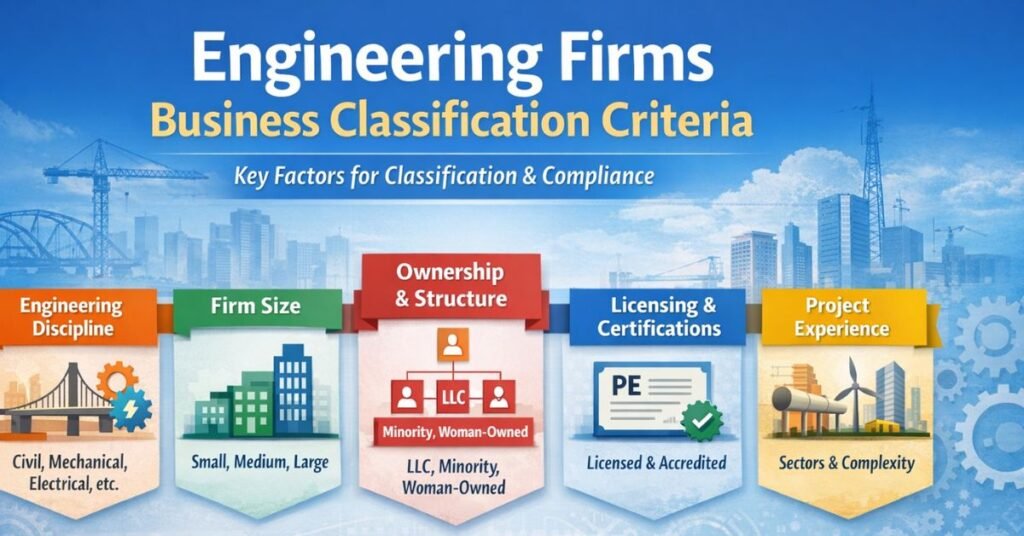
Across countries and industries, most systems evaluate engineering businesses using several shared dimensions. Let’s unpack the most important ones.
1. Technical Discipline and Service Scope
This is the most visible classification layer.
Engineering firms are typically grouped by primary discipline:
- Civil engineering
- Structural engineering
- Mechanical engineering
- Electrical engineering
- Environmental engineering
- Industrial engineering
- Multidisciplinary consulting
Some firms remain highly specialized. Others evolve into full-service design and consulting organizations.
Why this matters:
- Determines project eligibility
- Influences licensing requirements
- Affects insurance coverage
- Shapes staffing strategy
A transportation infrastructure contract, for example, may require certified civil engineering expertise that a mechanical-only firm cannot legally provide.
2. Firm Size and Capacity
Size classification is usually based on:
- Annual revenue
- Number of employees
- Average project value
- Operational footprint
Common size categories include:
- Micro or sole practitioner
- Small business engineering firm
- Mid-size regional firm
- Large national or global firm
This dimension is critical for procurement fairness.
Many governments reserve contracts specifically for small or disadvantaged businesses to promote economic diversity.
3. Ownership and Organizational Structure
Engineering firms can be structured in multiple ways:
- Sole proprietorship
- Partnership
- Limited liability company
- Corporation
- Employee-owned firm
- Publicly traded enterprise
Ownership classification may also include:
- Minority-owned business
- Women-owned business
- Veteran-owned business
- Local or domestic ownership
These distinctions often unlock targeted funding programs and contract set-asides.
4. Licensing, Accreditation, and Certification Level
Professional licensing is central to engineering credibility.
Classification may consider:
- Number of licensed professional engineers
- Jurisdictions where licenses are valid
- Specialized certifications (safety, environmental, quality systems)
- Accreditation of technical processes
Higher certification levels typically correlate with larger, higher-risk project eligibility.
5. Project Experience and Technical Complexity
Some systems classify firms based on:
- Completed project types
- Maximum project value handled
- Sector specialization (energy, transport, water, defense, etc.)
- Innovation or research capability
This dimension helps clients assess real-world competence beyond marketing claims.
Real-World Benefits of Understanding Classification Criteria
Knowing how engineering firms are classified isn’t just academic—it delivers concrete advantages.
Smarter Business Strategy
When leaders understand classification rules, they can:
- Target the right contract tiers
- Build teams to meet certification thresholds
- Expand services strategically
- Avoid compliance risks
This transforms growth from guesswork into deliberate planning.
Stronger Proposal Success Rates
Correct classification ensures:
- Visibility in procurement databases
- Eligibility for restricted bids
- Alignment with project size expectations
Many rejected bids fail before technical review simply due to classification mismatch.
Better Partnerships and Joint Ventures
Firms often collaborate to meet project requirements.
Classification clarity helps partners combine:
- Disciplines
- capacity
- certifications
- geographic coverage
Without overlap or compliance gaps.
Increased Investor and Client Confidence
Clear classification signals maturity and professionalism.
It tells stakeholders the firm operates within recognized industry frameworks.
Step-by-Step Guide to Determining Your Engineering Firm’s Classification
Let’s move from theory to action.
Here’s a practical process used by consultants and compliance teams.
Step 1: Map Your Core Services
Document:
- Primary engineering discipline
- Secondary services
- Consulting vs. design vs. construction roles
Be precise.
Vague descriptions lead to incorrect classification codes.
Step 2: Measure Firm Size Accurately
Gather:
- Last three years of revenue
- Full-time employee count
- Typical project value range
Use official thresholds from your jurisdiction or procurement authority.
Step 3: Verify Licensing and Certifications
Compile:
- Professional engineer registrations
- Geographic license coverage
- Quality or safety certifications
Ensure records are current and verifiable.
Step 4: Identify Ownership Designations
Confirm eligibility for:
- Small business status
- Minority or women-owned certification
- Local enterprise programs
These often require formal documentation and renewal.
Step 5: Register in Official Databases
Typical registrations include:
- Government procurement portals
- Industry directories
- Licensing boards
- Tax classification systems
Consistency across databases is crucial.
Step 6: Review Annually
Classification changes as firms grow.
Schedule a yearly compliance review to avoid outdated status.
Tools, Systems, and Resources That Help with Classification
Several practical tools simplify classification management.
Government Business Code Databases
These provide:
- Official industry codes
- Size standards
- Eligibility definitions
They’re the foundation of procurement compliance.
Licensing Board Portals
Useful for:
- Tracking engineer registrations
- Managing renewals
- Verifying compliance status
Compliance Management Software
Larger firms use software to:
- Store certifications
- Track expiration dates
- Manage multi-jurisdiction licensing
- Generate audit reports
Free vs. Paid Solutions
Free options:
- Government registries
- Spreadsheet tracking
- Manual reminders
Paid options:
- Compliance SaaS platforms
- Legal advisory services
- Procurement intelligence tools
Free tools work for small firms.
Growth usually demands automation and professional oversight.
Common Classification Mistakes Engineering Firms Make
Even experienced firms slip up.
Here are the most frequent—and how to fix them.
Using Incorrect Industry Codes
Problem:
Selecting broad or outdated codes.
Fix:
Cross-check with official procurement definitions annually.
Ignoring Size Reclassification
Problem:
Firms grow but still claim small-business status.
Risk:
Legal penalties or contract disqualification.
Fix:
Monitor revenue and staffing thresholds closely.
Letting Certifications Expire
Problem:
Missed renewal deadlines.
Impact:
Loss of eligibility for regulated projects.
Fix:
Use automated reminders or compliance software.
Overstating Technical Capabilities
Problem:
Claiming services without licensed supervision.
Risk:
Liability exposure and reputational damage.
Fix:
Align marketing strictly with licensed competencies.
How Classification Influences Long-Term Growth Strategy
Smart engineering leaders treat classification as a strategic lever, not paperwork.
Scaling from Small to Mid-Size Firm
Key transitions include:
- Hiring additional licensed engineers
- Expanding insurance coverage
- Increasing project value capacity
- Updating procurement registrations
Each shift unlocks larger contract tiers.
Entering New Engineering Disciplines
Requires:
- Recruiting certified specialists
- Updating business codes
- Securing new licenses
- Demonstrating project experience
Without these steps, diversification remains cosmetic rather than operational.
Preparing for Acquisition or Investment
Buyers examine:
- Classification accuracy
- Compliance history
- Licensing strength
- Market eligibility
Clean classification records increase valuation and deal confidence.
The Future of Engineering Firm Classification
Industry trends are reshaping how firms are categorized.
Digital Procurement and AI Screening
Automated systems now filter firms by:
- Certification metadata
- performance history
- compliance records
Accurate classification is becoming algorithmically essential.
Sustainability and ESG Categories
New classifications evaluate:
- Environmental expertise
- carbon-reduction design capability
- sustainable materials knowledge
Expect these to influence future contract eligibility.
Globalization of Engineering Services
Cross-border projects require:
- multi-jurisdiction licensing
- international certification recognition
- harmonized classification standards
Firms that adapt early gain global competitive advantage.
Conclusion
Understanding engineering firms business classification criteria is one of the most underrated advantages in the engineering world.
It determines:
- Which projects you can pursue
- How clients perceive your credibility
- What regulations you must follow
- How fast your firm can grow
The firms that thrive aren’t just technically skilled—they’re strategically classified, fully compliant, and intentionally positioned.
If you take one action after reading this guide, make it this:
Review your current classification today.
You might discover untapped opportunities—or hidden risks—waiting in plain sight.
FAQs
What is the purpose of engineering firm classification?
It standardizes how firms are evaluated for licensing, procurement, compliance, and market comparison.
How are engineering firms typically categorized?
By discipline, size, ownership, licensing level, and project experience.
Does classification affect government contract eligibility?
Yes. Incorrect classification can prevent firms from qualifying for bids.
How often should a firm review its classification?
At least once per year or after major growth changes.
Can a firm hold multiple classifications?
Yes, especially multidisciplinary engineering consultancies.

Michael Grant is a business writer with professional experience in small-business consulting and online entrepreneurship. Over the past decade, he has helped brands improve their digital strategy, customer engagement, and revenue planning. Michael simplifies business concepts and gives readers practical insights they can use immediately.