Indoor air quality (IAQ) has never been more critical to human health, and the limitations of traditional disinfection methods have never been more apparent. CASPR Technology — short for Continuous Air and Surface Pathogen Reduction — represents a new generation of proactive, no-touch disinfection that works 24 hours a day, 7 days a week to keep occupied spaces safer. Unlike conventional filtration systems that only capture airborne particles, or manual cleaning routines that leave surfaces unprotected between sessions, CASPR delivers continuous, chemical-free protection for both air and surfaces simultaneously.
This complete guide explains how CASPR technology works, what pathogens it eliminates, which products are available, how it compares to alternative disinfection methods, and why facility managers, healthcare administrators, school districts, and HVAC professionals are adopting it as a cornerstone of their infection prevention strategies.
What Is CASPR Technology and How Does It Work?
CASPR is a health-tech disinfection platform developed to address a fundamental gap in indoor environmental safety: the fact that most existing solutions either clean the air or clean surfaces, but not both — and rarely do so continuously. CASPR fills that gap with a passive, automated system that requires no operator intervention and integrates seamlessly into existing infrastructure.
The Science Behind the Natural Catalytic Converter (NCC)
At the heart of every CASPR unit is a proprietary component called the Natural Catalytic Converter (NCC), now advanced in newer iterations as the Natural Catalytic Converter Innovation (NC2I). This device performs a precise photocatalytic process: a multi-wavelength bulb illuminates a mixed metal matrix, which converts ambient air and naturally occurring humidity (moisture) into trace levels of gaseous hydrogen peroxide (H2O2).
This process is entirely filterless and produces no ozone — a critical safety distinction from many competing technologies. The hydrogen peroxide generated exists at concentrations well below any threshold considered harmful to humans or animals, yet remains highly effective at disrupting the cellular membranes of pathogens. The entire process mimics what occurs naturally in the outdoor atmosphere, where hydrogen peroxide is formed via sunlight and humidity, making indoor environments similarly self-purifying.
Disinfection: Air and Surfaces — A Dual Approach
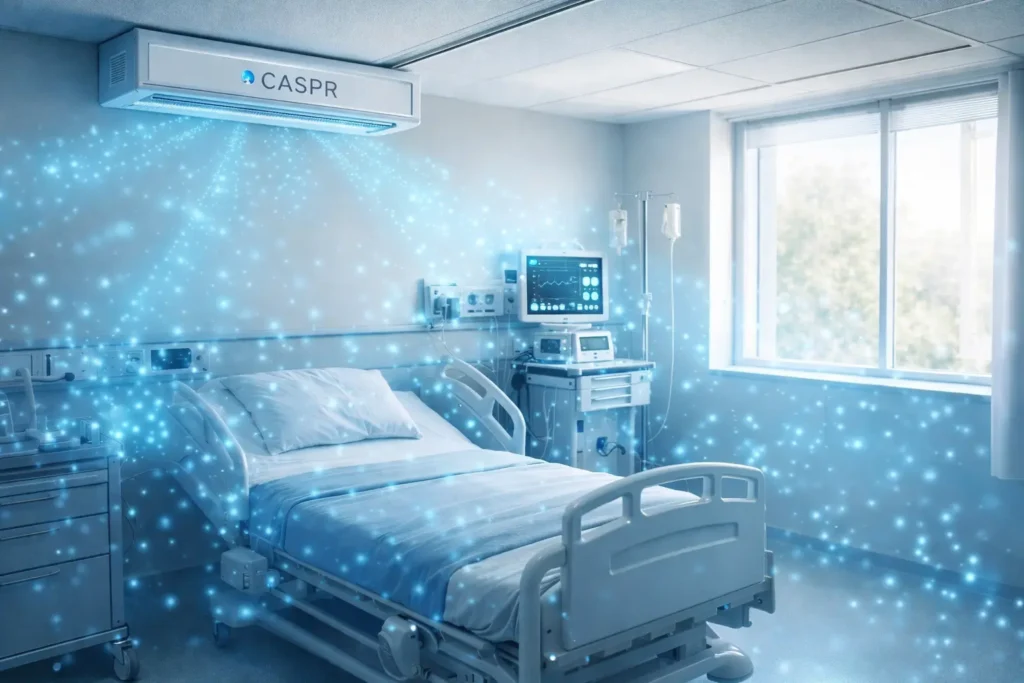
Once the NCC generates gaseous H2O2, the molecules circulate through the conditioned air in the space. Because hydrogen peroxide in gaseous form travels with airflow, it reaches every surface the air touches — including hard-to-reach areas behind equipment, inside cabinets, and around corners that manual cleaning misses entirely. As H2O2 settles on surfaces, it neutralizes pathogens on contact and then degrades into water and oxygen, leaving no residue and requiring no wipe-down or removal process.
This dual-action mechanism — air and surface disinfection occurring simultaneously and continuously — is what sets CASPR apart from HEPA filtration (which captures only airborne particles), UV-C light (which requires direct line-of-sight exposure), and chemical fogging (which is periodic and reactive rather than continuous and proactive).
Proven Efficacy: Reducing Pathogens and Improving Health Outcomes
CASPR technology has undergone rigorous independent and third-party testing across a wide range of pathogens. The results are peer-reviewed and compliant with standards set by organizations including ASHRAE and the CDC.
Independent Testing and Kill Rates
Third-party laboratory studies, including research conducted at the University of Wisconsin, have validated the efficacy of CASPR technology against some of the most dangerous and drug-resistant pathogens encountered in healthcare, food service, and public environments. Below is a summary of documented reduction rates:
| Pathogen | Reduction Rate | Test Environment |
| SARS-CoV-2 (COVID-19) | 99.96% | Surface & Air |
| H1N1 Influenza | 99.9% | Air |
| MRSA | 99.99% | Surface |
| E. Coli | 99.99% | Surface |
| Listeria | 99.9% | Surface |
| Pseudomonas Aeruginosa | 99.99% | Surface |
| Candida Auris | 99.9% | Surface |
| MS2 Bacteriophage | 99.96% | Air |
| Clostridium Difficile (C. diff) | 99.9% | Surface |
CASPR technology also meets the requirements of ASHRAE Standard 241, the benchmark for infection control in built environments, and aligns with CDC protocols for infection prevention in high-risk settings.
Real-World Outcomes: From Absenteeism to Infection Control
In controlled deployments across healthcare settings, facilities using CASPR technology have documented reductions in healthcare-associated infections (HAIs) of 40 to 50 percent. HAIs represent one of the most costly and preventable challenges in hospital administration, and continuous disinfection has proven to be among the most effective systemic interventions.
In K-12 education, the results are equally compelling. School districts that deployed CASPR in classrooms and common areas reported a 40 to 60 percent improvement in student and staff absenteeism related to illness. Reducing the microbial load in high-density environments like classrooms, cafeterias, and gyms has a direct and measurable impact on the number of sick days taken, the continuity of instruction, and the overall health of the school community.
Key Benefits and Advantages of CASPR Technology
Uncompromising Safety for People and Pets
One of the most critical design priorities of CASPR technology is that it operates safely in occupied spaces — with people, children, and pets present — at all times. The trace levels of gaseous hydrogen peroxide produced by the NCC are far below any exposure threshold established by OSHA or public health authorities. The system produces no ozone, no harmful byproducts, and leaves no chemical residue on surfaces. For facilities regulated by health authorities or serving vulnerable populations, this non-toxic, chemical-free profile is often a prerequisite for adoption.
Operational Efficiency and Cost Savings
Facility managers consistently cite low maintenance and operational efficiency as major advantages. CASPR units require no daily attention, no consumable chemicals, and no operator training beyond routine bulb replacement on a periodic maintenance schedule. Beyond the reduced labor costs, facilities report a meaningful secondary benefit: healthier HVAC coils. Because CASPR continuously reduces microbial growth in the air handling system, coils accumulate less biological fouling, which translates to improved thermal efficiency, lower energy consumption, and longer equipment service life. The long-term total cost of ownership is frequently lower than maintaining a comparable chemical disinfection program.
Seamless Integration and Automation
CASPR technology is engineered to integrate with existing building infrastructure with minimal disruption. Duct-mounted models connect directly to existing HVAC air handlers. The ceiling tile model replaces a standard 2’x2′ ceiling tile without modification. The compact unit is simply plugged into a standard electrical outlet. Once installed, the system operates autonomously — a true set-it-and-forget-it solution that delivers 24/7 coverage without manual labor, scheduling, or oversight.
CASPR Product Line: Solutions for Every Space and Industry
CASPR offers a range of purpose-built products to address the unique requirements of different facility types, sizes, and applications. Below is an overview of each model:
| Model | Installation Type | Coverage Area | Ideal Use Case |
| CASPR Pro | Duct-mounted (HVAC) | Up to 5,000 sq ft | Offices, schools, commercial buildings |
| CASPR Medik | Duct-mounted (HVAC) | Up to 5,000 sq ft | Hospitals, clinics, medical facilities |
| CASPR Blu Tile | Ceiling tile replacement | Up to 2,500 sq ft | Retrofits, classrooms, waiting rooms |
| CASPR Compact | Plug-and-play (outlet) | Up to 1,500 sq ft | Small offices, break rooms, supplements |
| CASPR Transit | Vehicle-integrated | Vehicle cabin | Buses, ambulances, trains |
Duct-Mounted Solutions: CASPR Pro and CASPR Medik
The CASPR Pro and CASPR Medik are the flagship duct-mounted models designed for building-wide disinfection through existing HVAC infrastructure. Both units install directly into the return air ductwork of a standard air handler, allowing the generated hydrogen peroxide to distribute throughout the entire conditioned space on every air cycle. The Medik model is purpose-built for healthcare environments, meeting the heightened standards required in clinical and patient-facing settings.
Standalone Solutions: CASPR Blu Tile and CASPR Compact
For facilities that require targeted disinfection without HVAC modification, the CASPR Blu Tile offers an elegant solution: it replaces any standard 2’x2′ suspended ceiling tile and connects to a standard electrical outlet. No HVAC access is required, making it ideal for retrofit projects, leased spaces, or rooms with limited ceiling access. The CASPR Compact is the most flexible unit in the lineup — a self-contained, plug-and-play device that can be deployed anywhere with a standard outlet, covering spaces up to 1,500 square feet.
Specialized Solution: CASPR Transit
Recognizing the unique disinfection challenges in transportation environments, the CASPR Transit was engineered for buses, ambulances, trains, and other vehicle cabins. It is durable, discreet, and designed to operate in the temperature extremes and vibration environments common in transit applications — delivering the same continuous H2O2 disinfection to vehicle occupants.
CASPR vs. Other Disinfection Technologies: A Clear Comparison
Understanding where CASPR fits in the broader landscape of disinfection technologies helps facility decision-makers make informed choices. The following comparisons highlight the key distinctions.
CASPR vs. HEPA Filtration
HEPA (High-Efficiency Particulate Air) filtration is a widely adopted technology for removing particles from the air. However, HEPA is fundamentally a passive capture technology: particles must physically pass through the filter to be captured, meaning it only cleans air — never surfaces. HEPA offers no protection against pathogens that settle on desks, doorknobs, or countertops. CASPR, by contrast, actively generates a disinfectant that travels to and acts upon both airborne and surface-bound pathogens. Additionally, HEPA filters require regular replacement, which introduces cost and maintenance complexity that CASPR does not.
CASPR vs. UV-C Light
UV-C germicidal irradiation is effective at inactivating pathogens — but only those directly exposed to the UV-C beam. This line-of-sight limitation means that any surface in shadow, behind an obstruction, or in an adjacent room receives no protection. UV-C systems that operate in occupied spaces also carry human safety concerns; high-intensity UV-C can cause skin and eye damage, restricting many systems to use only when rooms are unoccupied. CASPR generates hydrogen peroxide that circulates freely with airflow, reaching every surface the air touches — with no line-of-sight restriction and no safety risk to occupants.
CASPR vs. Manual Chemical Cleaning
Manual disinfection using chemical agents (bleach solutions, quaternary ammonium compounds, etc.) remains the standard in many facilities. However, it is fundamentally reactive: surfaces are only protected in the moments immediately following a cleaning event and quickly become re-contaminated through touch, droplets, and air. Manual protocols are also subject to human error, inconsistency, and operator fatigue. CASPR provides continuous, automated protection that does not depend on human scheduling or technique — and does so without introducing harsh chemicals into the environment.
Industries We Serve: Creating Healthier Environments Everywhere
CASPR for Healthcare
Hospitals, outpatient clinics, dental offices, and long-term care facilities face some of the highest pathogen loads of any built environment. Healthcare-associated infections (HAIs) affect millions of patients annually and carry significant clinical and financial consequences. CASPR technology offers a continuous, automated layer of infection prevention that complements existing hand hygiene and surface cleaning protocols. By reducing the ambient microbial load in patient rooms, waiting areas, and corridors, CASPR helps protect both patients and clinical staff without adding to nursing or housekeeping workloads.
CASPR for Education (K-12 Schools)
Schools are high-density environments where respiratory viruses, gastrointestinal pathogens, and skin infections spread rapidly. Reducing illness-related absenteeism has direct educational and economic implications — for students who miss instruction time, for staff who use sick leave, and for districts managing substitute staffing costs. CASPR deployments in K-12 settings have demonstrated dramatic improvements in these metrics, with documented reductions in illness-related absences of 40 to 60 percent in some districts.
CASPR for Commercial and Office Spaces
Open-plan offices, shared conference rooms, and high-traffic lobbies present ongoing pathogen transmission risks, particularly during flu season and following community-level outbreaks. CASPR provides building managers and employers with a defensible, science-backed IAQ solution that supports employee health, reduces sick days, and signals a genuine commitment to occupant wellness — an increasingly important factor in commercial real estate attractiveness and employee retention.
CASPR for Transportation
Public transit vehicles, school buses, and emergency response vehicles serve high-volume, high-turnover populations where disinfection between uses is rarely practical. CASPR Transit units can be installed discreetly within vehicle HVAC systems to deliver continuous protection during operation, reducing the risk of transmission among passengers and operators without requiring any downtime for manual disinfection.
CASPR for HVAC Professionals
Mechanical contractors and HVAC engineers represent a key channel for CASPR technology. Duct-mounted units install quickly in standard air handlers and can be offered as a value-added service during new installations, retrofits, or preventive maintenance visits. CASPR distributors provide technical support and training, and the technology’s demonstrated impact on coil health gives HVAC professionals an evidence-based selling point for clients focused on equipment longevity and energy efficiency.
Installation, Maintenance, and Compliance
Meeting ASHRAE 241 and Infection Control Standards
ASHRAE Standard 241, Control of Infectious Aerosols, establishes minimum requirements for ventilation and air cleaning in built environments to reduce the risk of infectious disease transmission. CASPR technology is designed to support compliance with ASHRAE 241 by providing a continuous, validated layer of pathogen reduction that complements mechanical ventilation. Facilities seeking to document their infection control posture for accreditation, insurance, or risk management purposes can reference CASPR’s third-party test data and white papers as part of their compliance documentation.
Installation Considerations for Professionals
CASPR Pro and Medik units are designed for straightforward HVAC integration. Installation typically requires access to the return air duct upstream of the air handler coil, a standard electrical connection, and basic sheet metal work to secure the unit. No specialized training or certification beyond standard HVAC competency is required. The CASPR Blu Tile replaces any 2’x2′ drop ceiling tile and requires only a nearby standard electrical outlet. The CASPR Compact requires no installation at all — it is simply plugged in. All models ship with complete installation documentation.
Maintenance Requirements
Maintenance requirements for CASPR units are minimal. The primary consumable is the multi-wavelength bulb within the NCC, which should be replaced on a schedule consistent with the manufacturer’s recommendation — typically annually, depending on the model and operating hours. Beyond bulb replacement, there are no filters to change, no chemicals to replenish, and no calibration requirements. This low-maintenance profile significantly reduces the lifetime operational cost of the system compared to filter-based or chemical alternatives.
faqs
What is CASPR technology and how does it work?
CASPR (Continuous Air and Surface Pathogen Reduction) technology uses a Natural Catalytic Converter (NCC) to convert ambient air and moisture into trace levels of gaseous hydrogen peroxide. This H2O2 circulates throughout a space, continuously disinfecting both the air and all surfaces the air contacts — 24 hours a day, without operator intervention.
Is CASPR technology safe for people and pets?
Yes. CASPR operates at hydrogen peroxide concentrations well below any threshold considered harmful by OSHA or public health authorities. The system is specifically designed and tested for use in occupied spaces, including areas where children, elderly individuals, and pets are present.
Does CASPR produce ozone or harmful chemicals?
No. The NCC process does not produce ozone, and the system introduces no synthetic chemicals into the environment. The only byproducts of the H2O2 disinfection process are water and oxygen.
What is the difference between CASPR and an air purifier?
A conventional air purifier filters airborne particles by passing air through a capture medium (such as HEPA). This only addresses airborne contaminants and does nothing to disinfect surfaces. CASPR actively generates a gaseous disinfectant that attacks pathogens in both the air and on surfaces simultaneously, providing far broader and more continuous protection.
How effective is CASPR against COVID-19 (SARS-CoV-2)?
Independent third-party testing has demonstrated a 99.96% reduction in SARS-CoV-2 in both air and surface environments using CASPR technology.
What pathogens does CASPR eliminate?
CASPR has been independently tested against SARS-CoV-2, H1N1 Influenza, MRSA, E. coli, Listeria, Pseudomonas Aeruginosa, Candida Auris, MS2 Bacteriophage, Clostridium Difficile, and mold and fungal spores, among others. Reduction rates of 99.9% to 99.99% have been documented across these pathogens.
Does CASPR meet ASHRAE 241 standards?
Yes. CASPR technology is designed to support compliance with ASHRAE Standard 241 for the control of infectious aerosols, and its efficacy data is available in peer-reviewed and independently validated formats suitable for compliance documentation.
What are the different CASPR products available?
The CASPR product line includes the Pro (duct-mounted, up to 5,000 sq ft), Medik (duct-mounted, healthcare-grade), Blu Tile (ceiling tile replacement, up to 2,500 sq ft), Compact (plug-and-play, up to 1,500 sq ft), and Transit (for buses, ambulances, and vehicles).
How do I maintain a CASPR unit?
CASPR units require minimal maintenance. The primary scheduled task is periodic replacement of the NCC bulb — typically once per year — depending on the model and operating hours. There are no filters, chemicals, or calibration requirements.
Does CASPR help with mold and odors?
Yes. The gaseous hydrogen peroxide produced by CASPR is effective against mold spores and fungal contaminants. It also neutralizes volatile organic compounds (VOCs) and organic odor-causing compounds, resulting in noticeably fresher indoor air quality in most environments.
Experience the CASPR Difference: Cleaner Air, Healthier Spaces
The evidence is clear: continuous, proactive disinfection produces better outcomes than reactive or filtration-only approaches. CASPR technology delivers the only solution that simultaneously protects the air and every surface in a space — around the clock, without chemicals, without operator labor, and without disrupting the people who occupy the building.
Whether you manage a hospital wing, a network of school buildings, a commercial office portfolio, or a fleet of transit vehicles, CASPR offers a product and a deployment model designed to meet your needs. Consult with an authorized CASPR distributor to assess your facility’s requirements, review technical specifications, and begin building a healthier environment today.

Adrian Cole is a technology researcher and AI content specialist with more than seven years of experience studying automation, machine learning models, and digital innovation. He has worked with multiple tech startups as a consultant, helping them adopt smarter tools and build data-driven systems. Adrian writes simple, clear, and practical explanations of complex tech topics so readers can easily understand the future of AI.