
If you’ve ever opened your business bank account and felt a tiny knot in your stomach—wondering whether the numbers will stretch far enough this month—you’re not alone. Budgeting in small business isn’t just about spreadsheets and forecasts. It’s about clarity, confidence, and control. It’s the quiet system behind every calm decision, every sustainable hire, and every growth move that doesn’t keep you up at 2 a.m.
Many small business owners start with passion, skill, and hustle. What they often lack is a clear financial roadmap. Without one, even profitable businesses can feel chaotic. Cash disappears, expenses creep upward, and planning turns reactive instead of intentional.
In this in-depth guide, you’ll learn how budgeting in small business really works in the real world—not theory, not jargon. We’ll walk through practical frameworks, step-by-step systems, tools that actually help, and the most common mistakes that quietly drain profits. By the end, you’ll have a clear path to building a budget that supports stability, growth, and peace of mind.
What Budgeting in Small Business Really Means (In Plain English)
At its core, budgeting in small business is simply the act of deciding—before the money arrives—where that money will go. Think of it like planning a road trip. You choose the destination, estimate fuel, map the route, and set checkpoints. Without that plan, you might still reach somewhere… just not where you intended.
A small business budget tracks:
- Expected income
- Fixed and variable expenses
- Cash flow timing
- Savings and reinvestment goals
Unlike personal budgeting, business budgeting must balance profitability and sustainability at the same time. You’re not only paying bills—you’re funding growth, managing risk, and building long-term stability.
Here’s a relatable comparison:
- No budget = driving with no fuel gauge
- Loose budget = checking fuel occasionally
- Strong budget = GPS, fuel plan, and emergency kit
Most successful small businesses don’t rely on luck. They rely on predictability. Budgeting creates that predictability.
Another key truth: budgeting isn’t restrictive. It’s liberating. When you know exactly what you can spend, invest, or save, decision-making becomes faster and far less stressful. Instead of guessing, you act with confidence.
Why Budgeting Matters More for Small Businesses Than Big Companies
Large corporations have financial teams, deep reserves, and access to credit. Small businesses rarely have those luxuries. That makes budgeting in small business not just useful—but essential for survival.
Small margins and tight cash flow mean even small financial mistakes can create serious pressure. A delayed client payment, an unexpected repair, or seasonal sales dips can quickly become overwhelming without a clear budget structure.
Budgeting provides three powerful protections:
1. Cash flow stability
Profit on paper doesn’t guarantee cash in the bank. A budget ensures timing gaps don’t cripple operations.
2. Smarter decision-making
Should you hire? Invest in ads? Upgrade equipment? Budgeting turns emotional decisions into informed ones.
3. Long-term sustainability
Businesses fail less from lack of sales and more from lack of financial control. Budgeting prevents silent financial leaks.
It also builds credibility. Lenders, investors, and partners trust businesses that understand their numbers. A well-maintained budget signals professionalism and reduces perceived risk.
Most importantly, budgeting shifts your role from survivor to strategist. Instead of reacting to money problems, you start steering the direction of your business.
Real-World Benefits and Use Cases of Budgeting in Small Business
Budgeting isn’t just an accounting exercise. It directly improves daily operations, growth planning, and stress levels.
Here are the most meaningful real-world benefits.
Clear visibility into profitability
Many owners assume they’re profitable because revenue is steady. A detailed budget reveals the truth by separating:
- Revenue
- Cost of goods or services
- Operating expenses
- Net profit
This clarity helps you price correctly, cut waste, and focus on high-margin work.
Confidence in hiring and expansion
Hiring too early strains cash flow. Hiring too late limits growth. Budgeting shows when the business can truly afford help, reducing risky guesses.
Better preparation for slow seasons
Most industries experience cycles. Budgeting helps you:
- Save during strong months
- Reduce spending before slow periods
- Maintain steady operations year-round
Reduced financial stress
Perhaps the most underrated benefit: peace of mind. When you know your numbers, uncertainty fades. Decisions feel calmer, clearer, and more intentional.
Stronger investor or loan readiness
If you ever seek funding, your budget becomes evidence that your business is structured, thoughtful, and scalable.
Step-by-Step Guide to Creating a Small Business Budget That Actually Works
Many budgeting guides stay theoretical. Let’s walk through a realistic, usable process you can apply immediately.
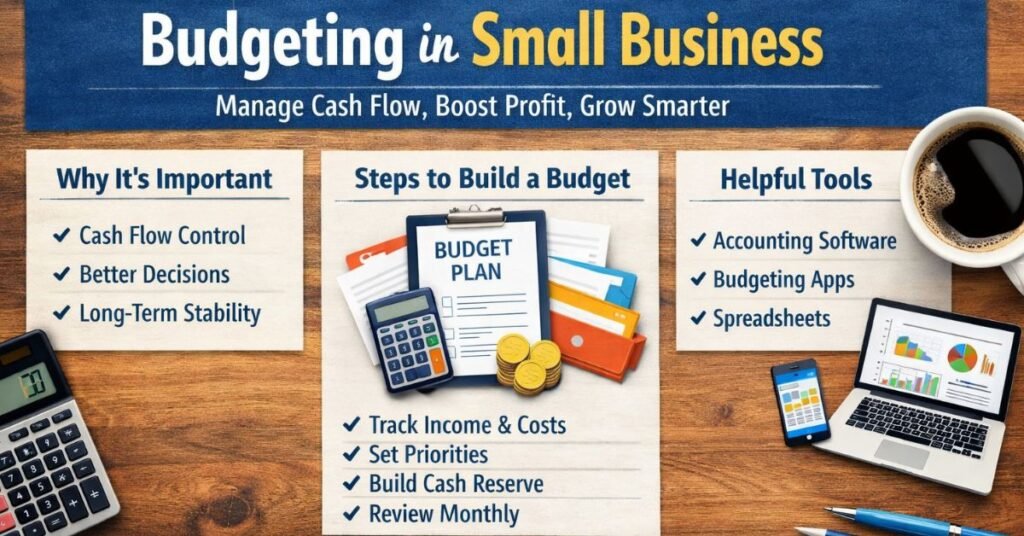
Step 1: Gather accurate financial data
Start with the last 6–12 months of:
- Bank statements
- Expense records
- Sales reports
- Tax filings
Accuracy matters more than perfection. Even rough data is better than guessing.
Step 2: Separate fixed and variable expenses
Fixed expenses stay mostly the same:
- Rent
- Salaries
- Software subscriptions
- Insurance
Variable expenses fluctuate:
- Marketing
- Supplies
- Utilities
- Freelancers
Knowing this difference helps you cut costs intelligently during slow periods.
Step 3: Calculate true monthly income
Don’t rely on your best month. Use average revenue across several months to avoid unrealistic expectations.
If income is seasonal, create separate budgets for high and low seasons.
Step 4: Prioritize essential spending
Cover survival costs first:
- Cost of delivering your product or service
- Core operating expenses
- Owner salary (yes, this matters)
- Taxes
- Savings and reinvestment
Growth spending comes after stability, not before.
Step 5: Build a cash reserve
Aim for at least 2–3 months of operating expenses. This buffer transforms emergencies into manageable inconveniences.
Step 6: Track weekly, review monthly
Budgets fail when ignored. Simple rhythm:
- Weekly quick check
- Monthly full review
- Quarterly adjustment
Consistency beats complexity.
Budgeting Methods Small Businesses Can Use
Not every budgeting style fits every business. Here are the most practical approaches.
Zero-based budgeting
Every dollar gets assigned a purpose before the month begins.
Best for:
- Tight cash flow
- Early-stage businesses
- Owners who want strict control
Percentage-based budgeting
Income is divided into fixed percentages, such as:
- 50% operations
- 20% owner pay
- 15% marketing
- 15% profit and savings
Best for:
- Stable revenue
- Simplicity
- Predictable scaling
Rolling forecast budgeting
Budgets update monthly based on new data instead of staying static all year.
Best for:
- Growing businesses
- Seasonal industries
- Rapid change environments
Tools and Software That Make Budgeting in Small Business Easier
You don’t need complicated systems, but the right tools save enormous time.
Spreadsheets
Pros:
- Free
- Flexible
- Fully customizable
Cons:
- Manual work
- Easy to make mistakes
- Limited automation
Best for beginners or very small operations.
Accounting software
Common strengths:
- Automated expense tracking
- Profit and loss reports
- Tax preparation support
- Real-time dashboards
Paid tools cost money but usually save far more than they cost through clarity and efficiency.
Budgeting apps and forecasting tools
Advanced platforms provide:
- Cash flow predictions
- Scenario planning
- Performance analytics
These are ideal once revenue becomes consistent and growth planning matters more.
Free vs paid tools: honest comparison
Free tools work well when:
- Transactions are few
- Budget is simple
- Time is available
Paid tools become valuable when:
- Transactions increase
- Taxes get complex
- Decisions depend on accurate data
In most cases, businesses outgrow free tools within 12–24 months.
Common Budgeting Mistakes Small Business Owners Make (and How to Fix Them)
Even smart, hardworking owners fall into predictable traps. Recognizing them early prevents financial stress later.
Mixing personal and business finances
This creates confusion, tax issues, and inaccurate budgets.
Fix:
Open separate accounts immediately and pay yourself a clear salary.
Ignoring irregular expenses
Annual software fees, repairs, or tax bills surprise many owners.
Fix:
Divide annual costs into monthly savings amounts inside your budget.
Overestimating revenue
Optimism is natural—but dangerous in budgeting.
Fix:
Base projections on historical averages, not hopes.
Underpaying yourself
Many owners treat themselves as last priority, leading to burnout.
Fix:
Include owner compensation as a non-negotiable expense.
Not reviewing the budget regularly
A static budget becomes useless quickly.
Fix:
Schedule recurring monthly reviews on your calendar.
How Budgeting Supports Long-Term Business Growth
Budgeting isn’t just defensive—it’s a growth engine.
With consistent budgeting, businesses can:
- Identify most profitable products or services
- Invest confidently in marketing
- Plan hiring without panic
- Expand locations or offerings sustainably
Growth funded by clear numbers is far safer than growth fueled by hope.
Budgeting also reveals when not to grow. Sometimes the smartest decision is strengthening margins before expanding. A good budget makes that visible.
Over time, budgeting transforms your mindset. Money stops feeling unpredictable and starts feeling strategic. That shift alone changes how businesses evolve.
Conclusion: Budgeting Is the Quiet Skill Behind Every Stable Small Business
Budgeting in small business isn’t glamorous. It won’t go viral on social media. But behind nearly every calm, profitable, steadily growing company is a simple truth: someone understands the numbers.
Budgeting gives you:
- Control over cash flow
- Confidence in decisions
- Protection during uncertainty
- Freedom to grow sustainably
And perhaps most valuable of all—it gives you peace of mind.
Start simple. Stay consistent. Improve gradually.
Your future business stability is built one clear financial decision at a time.
If this guide helped you see budgeting differently, consider reviewing your numbers this week. Small steps today create powerful stability tomorrow.
FAQs
What is the best budgeting method for a small business?
Zero-based budgeting works best for tight cash flow, while percentage-based budgeting suits stable revenue. Growing businesses benefit from rolling forecasts.
How often should a small business review its budget?
Weekly quick checks and monthly full reviews provide the best balance of control and flexibility.
How much profit should a small business aim for?
Many healthy small businesses target 10–20% net profit, though this varies widely by industry.
Should small businesses use budgeting software?
Yes. Software improves accuracy, saves time, and provides real-time financial visibility once transactions increase.
How much emergency savings should a small business keep?
Ideally 2–3 months of operating expenses, though 6 months provides stronger security.

Michael Grant is a business writer with professional experience in small-business consulting and online entrepreneurship. Over the past decade, he has helped brands improve their digital strategy, customer engagement, and revenue planning. Michael simplifies business concepts and gives readers practical insights they can use immediately.