
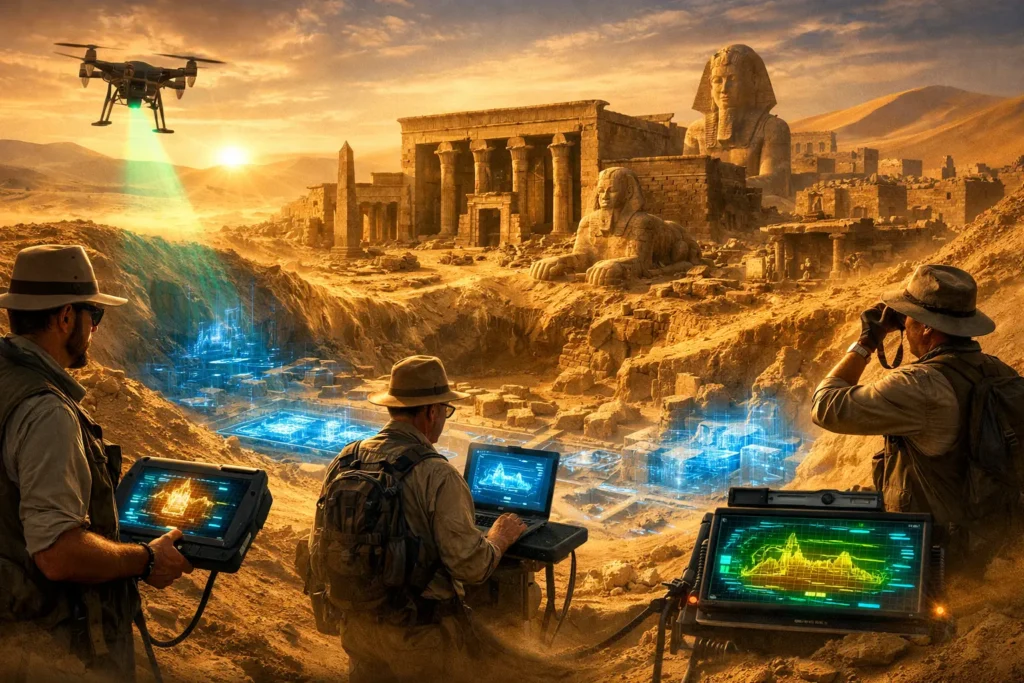
In early 2026, a team of archaeologists and geophysicists announced a finding that rewrote the known map of ancient Lower Egypt: a sprawling complex of mudbrick walls, sacred artifacts, and layered habitation deposits buried three to six meters beneath the agricultural fields surrounding Tell el-Fara’in — the site of the Ancient Egyptian City of Buto, also called Per-Wadjet. The structures date to approximately 600 BCE, placing them firmly within the Saite period, the culturally vibrant 26th Dynasty during which Egypt experienced a remarkable renaissance of art, religion, and trade.
What made this discovery so extraordinary was not merely what was found, but how it was found. No excavator’s trowel broke the ground until scientists already had a detailed three-dimensional blueprint of the buried architecture. Two complementary technologies — Sentinel-1 Synthetic Aperture Radar (SAR) imagery and Electrical Resistivity Tomography (ERT) — had already mapped the hidden city from the surface. The discovery at Buto, situated in the Nile Delta roughly 95 kilometers north-east of Alexandria, marks a turning point in satellite archaeology and non-invasive survey methods.
This article explains both sides of that story: the cutting-edge modern technology that enabled the find, and the Ancient Egyptian City technology that those buried structures represent — from monumental pyramid engineering to the world’s first evidence-based surgical medicine.
The Modern Tech Toolkit: Seeing Underground Without Digging
Before a single electrode was pressed into the soil at Tell el-Fara’in, researchers spent months analyzing data beamed down from orbit. The multi-pronged geophysical survey combined macro-scale remote sensing with micro-scale ground measurements to build an unprecedented picture of the buried Saite-period city.
Satellite Radar (Sentinel-1 SAR)
Synthetic Aperture Radar works by firing focused microwave pulses at the Earth’s surface from a moving satellite and then recording how those pulses bounce back. Unlike optical cameras, SAR penetrates cloud cover and light vegetation. More importantly for archaeology, the C-band radar of the European Space Agency’s Sentinel-1 satellite is sensitive to subtle density contrasts in the near-surface soil — variations that can indicate compacted mudbrick foundations, pottery concentrations, or ancient floor levels buried beneath meters of alluvial silt.
At Kom C (one of three elevated mounds at Tell el-Fara’in, alongside Kom A and Kom B), the SAR backscatter anomalies formed a clear spatial pattern inconsistent with natural geology. These anomalies defined a target zone for the more intensive ground survey that followed. Because Sentinel-1 data is freely available through the Copernicus Open Access Hub, the initial survey cost a fraction of traditional magnetometry campaigns.
Electrical Resistivity Tomography (ERT)
| What is Electrical Resistivity Tomography? ERT is a geophysical method that injects a low-level electrical current into the ground through a line of metal electrodes and measures how strongly the subsurface materials resist that current. Dry mudbrick, dense limestone, and fired ceramics resist current differently than moist alluvial soil or groundwater-saturated sediment. By repeating this across hundreds of electrode configurations and running the data through 3D inversion algorithms, scientists build a volumetric resistivity map — essentially a three-dimensional X-ray of the ground. |
At Buto, the ERT survey deployed multiple electrode arrays across the surface of Kom C in a grid pattern. Each array measured resistivity at depths ranging from less than one metre to more than fifteen metres. The 3D inversion algorithms converted those resistivity readings into a colour-coded tomographic volume, clearly revealing the rectangular geometry of mudbrick walls, the outlines of rooms and courtyards, and a concentration of high-resistivity anomalies at a depth of three to six metres that corresponded with the Saite occupation level.
This depth range placed the ancient structures beneath thick layers of broken pottery, rubble, and debris from the later Ptolemaic and Roman periods — precisely the kind of stratigraphy that makes Nile Delta archaeology so challenging.
Combining Methods for Accuracy
Neither SAR nor ERT alone would have been sufficient to justify large-scale excavation. The real power of the Buto survey lay in the multi-pronged methodology: SAR identified where in the broad landscape anomalies existed; ERT confirmed their depth, three-dimensional extent, and likely material composition; and targeted trial trenches then validated the geophysical predictions against actual physical layers. This sequential workflow — remote sensing, then geophysical survey, then excavation — is now considered best practice in satellite archaeology and non-invasive survey, particularly in the water-logged, sediment-rich conditions of the Nile Delta.
What Technology Found: The Structure of Kom C
Layers of History (3–6 Metres Deep)
The stratigraphy revealed at Kom C reads like a compressed history of Egyptian civilization. The uppermost layers, down to roughly two metres, contained debris characteristic of the early Islamic era — fragments of glazed pottery and architectural rubble from roughly the seventh century CE onward. Below this, a thick deposit of broken pottery, limestone statue fragments, and mudbrick debris belongs to the Ptolemaic period (304–30 BCE) and the subsequent Roman occupation of Egypt. It was beneath all of this — between three and six metres — that the Saite-period city emerged intact.
The mudbrick walls here are extraordinarily well-preserved, their courses still aligned and mortared with the fine Nile silt that Egyptian builders had used for millennia. The ground plan suggests a formal religious precinct: regularly spaced rooms, wide processional corridors, and open courts consistent with a temple enclosure.
The Religious Artifacts Cluster
Concentrated within the Saite-period deposit, the artifact assemblage speaks directly to the religious character of the site. Among the most significant finds are:
- A bronze statue of Horus, the falcon-headed sky deity and divine kingship symbol, still bearing traces of gold-leaf gilding
- A steatite scarab inscribed with the cartouche of Thutmose III — an 18th Dynasty king who ruled over 800 years before the Saite buildings were constructed, suggesting the scarab was already an ancient heirloom or votive object when it was deposited
- Faience amulets representing Isis, Taweret (hippopotamus goddess of childbirth), and Bes (dwarf deity of household protection)
- A rare hybrid figurine combining the features of a baboon, a falcon, and the Greco-Egyptian deity Patikos — evidence of the religious syncretism already underway in the Late Period
- Abundant pottery vessels, many still sealed, likely used in ritual offerings
Presiding over all of this, in name and tradition, was Wadjet — the cobra goddess whose cult city Buto was. One of Egypt’s most ancient deities, Wadjet was worshipped from at least the Predynastic period (before 3100 BCE) as the protector of Lower Egypt. She appears on the uraeus, the rearing cobra worn on the brow of every pharaoh. The persistence of her cult at Buto across more than three thousand years — from Predynastic times through the Saite, Ptolemaic, and Roman periods — speaks to her central role in Egyptian religious identity.
Beyond Buto: A Deep Dive into Ancient Egyptian City Technology
The structures and artifacts discovered at Tell el-Fara’in are the product of a civilization whose technological achievements still astonish engineers and historians. From the macro-scale engineering of the pyramids to the micro-scale precision of surgical sutures, ancient Egyptian technology was both broader in scope and more sophisticated in application than is often recognized.
Construction and Engineering: The Pyramid Tech
Ancient Egyptian construction technology reached its apex in the Old Kingdom (c. 2686–2181 BCE) with the building of the Giza plateau monuments, but its principles were applied across three millennia of pharaonic construction — including the mudbrick temple complexes of the Saite period at Buto.
The core structural vocabulary of Egyptian building relied on post-and-lintel architecture, in which vertical stone or mudbrick posts support horizontal beams or lintels. This system, combined with thick sloping walls (battered walls) for stability, allowed builders to construct enormous enclosure walls without mortar in cut stone, and with Nile-silt mortar in mudbrick. Lime mortar, introduced during the New Kingdom, improved the bonding of limestone-block facades.
For moving and lifting heavy elements, Egyptians employed wooden sledges hauled over wetted ground (dramatically reducing friction), wooden rollers, and an extensive system of earthen construction ramps. Copper and later bronze core drills, fitted with abrasive emery or corundum powder, cut through granite with remarkable speed and accuracy — as confirmed by drill marks still visible on unfinished obelisks at Aswan.
The Obelisk Mystery: Moving 100+ Tonne Stones
Among the most persistent engineering puzzles is the transport and erection of obelisks — single granite shafts weighing between 20 and over 1,000 tonnes, quarried at Aswan and then shipped hundreds of kilometres north on purpose-built barges. The quarrying method is partially documented by the Unfinished Obelisk at Aswan, where workers drove wooden wedges into slots cut along the stone’s length, then soaked the wedges with water to split the granite along natural fracture planes. Erection likely involved removing sand from beneath a partially buried base, allowing the obelisk to pivot upright into a prepared socket — a theory supported by experimental archaeology at multiple sites.
Egypt’s extraordinary river and sea trade networks depended on sophisticated boat-building technology that dated back to the Predynastic period. The earliest Egyptian vessels were made of bundles of papyrus reeds lashed together, the natural buoyancy and flexibility of the plant making them ideal for navigating the Nile’s seasonal shallows.
By the Old Kingdom, Egyptian shipwrights had mastered cedar woodworking — importing timber from Lebanon because Egypt’s native trees produced wood too short and curved for large-hull planking. The result was the plank-built vessel, whose hull planks were joined by mortise-and-tenon joints (without a central keel) and then lashed with rope passed through internal cleats. The Khufu ship, discovered disassembled in a sealed pit beside the Great Pyramid in 1954 and carefully reconstructed, is 43.6 metres long and demonstrates the full sophistication of this tradition.
Sails were in use from at least 3200 BCE, and Egyptian sail design evolved significantly over time — from simple square rigs oriented perpendicular to the hull for downwind sailing, to broader aspect-ratio designs that allowed more effective sailing across the wind on the Mediterranean. The aerodynamic principles implicit in this evolution appear to have been arrived at empirically over generations of seafaring.
The First Harbor: Wadi al-Jarf
The world’s oldest known harbor was discovered at Wadi al-Jarf on the Red Sea coast of Egypt, and dates to the reign of Khufu (c. 2550 BCE). The harbor’s associated papyri — the Diary of Merer, found on-site — provide a first-person account of transporting limestone blocks from Tura across the Nile to Giza. This document, the oldest papyrus ever found in Egypt, also confirms that Wadi al-Jarf was a deep-water anchorage serving copper-mining expeditions to the Sinai Peninsula.
Writing and Paper Technology
The invention of papyrus as a writing surface represents one of the ancient world’s most consequential technological achievements. The process began with the triangular stems of the papyrus plant (Cyperus papyrus), which grew abundantly in the Nile Delta marshes. Strips of the pithy inner stem were cut, soaked in water, then laid in overlapping perpendicular layers and pressed together. The natural sugar in the pith acts as an adhesive, binding the layers into a smooth, flexible sheet.
Writing was done with a sharpened reed pen using two standard inks: black ink made from carbon soot suspended in gum arabic, and red ink made from ochre pigment. These materials are so stable that manuscripts written over 3,500 years ago remain legible today. Combined with the hieroglyphic, hieratic, and later demotic scripts, Egyptian writing technology enabled the administration of a state that stretched from sub-Saharan Africa to the Levant.
The Library of Alexandria, built during the Ptolemaic period in the city founded by Alexander the Great near the Nile Delta coast, represented the culmination of this tradition — an institution that sought to collect every scroll in the known world and employed the most brilliant scientists and mathematicians of the Hellenistic age.
Medical Technology
Egyptian medical technology is documented in several surviving papyri, but none is more remarkable than the Edwin Smith Papyrus (c. 1600 BCE), a surgical text that describes 48 clinical cases of trauma injuries — including head fractures, spinal injuries, and dislocations — using a remarkably systematic, observation-based methodology that anticipates the scientific method by three millennia. Each case is presented as: examination, diagnosis, treatment plan, and prognosis. The text explicitly distinguishes between treatable and untreatable conditions.
Physical evidence of surgical practice includes wooden prosthetic toes found on Egyptian mummies — functional replacements that show wear marks consistent with walking — as well as evidence of successful cataract surgery and suture techniques using linen thread. Egyptian physicians distinguished between the roles of the heart (which they correctly identified as the center of the circulatory system) and the brain, and their understanding of anatomy — aided by the embalming process that required removal and examination of internal organs — far exceeded that of contemporary Mediterranean cultures.
Egyptian medical knowledge, transmitted through Greek physicians who studied at temple schools in Memphis and Sais, formed the foundation of Hippocratic medicine in the ancient world — a direct line of intellectual inheritance that connects the Saite-period temple precinct at Buto to the entire Western medical tradition.
Irrigation and Agriculture Technology
Egyptian civilization was, at its core, a hydraulic civilization — built on the ability to manage, store, and distribute the Nile’s annual floodwaters. The Nilometer, a graduated stone column set into the riverbed, allowed officials to measure flood levels and predict the harvest yield months in advance. This data drove tax assessment, grain storage, and famine planning with a sophistication unmatched in the ancient world.
Water-lifting technology evolved over time: by the New Kingdom, the shaduf (a counterweighted pole and bucket) allowed individual farmers to lift water from canals to fields. By the Ptolemaic and Roman periods, the sakia (an ox-driven water wheel with a chain of ceramic pots) could irrigate significantly larger areas. These systems, combined with an extensive network of irrigation canals and basin flood-containment earthworks in the Fayum depression, sustained a population that may have reached seven million by the Late Period — one of the densest in the ancient world.
Why the Nile Delta Is a Challenge for Archaeologists
The very geographic feature that made ancient Buto prosperous — its location in the watery, fertile Nile Delta — is what makes it so difficult to excavate today. Understanding this challenge is essential to appreciating why non-invasive geophysical survey methods like ERT and SAR are not merely convenient alternatives to traditional digging; in the Delta, they are often the only viable option.
The core problem is groundwater. Unlike the narrow Nile Valley to the south, where ancient sites sit on dry desert terraces above the flood plain, Delta sites exist on low-lying land where the water table can be less than two metres below the current surface. This means that any trench dug deeper than two metres floods almost immediately, making it impossible to excavate the Saite and earlier deposits that sit three to six metres below ground without enormously expensive pumping operations.
Compounding this, the annual flooding of the Nile over thousands of years has deposited thick blankets of fine alluvial clay — sometimes ten metres or more — above the archaeological levels. This deep overburden protects ancient structures from surface disturbance, but it also makes them effectively invisible to traditional survey methods. Pottery scatters and architectural fragments that lead archaeologists directly to sites in the desert are simply absent on the Delta surface.
Finally, the Nile Delta has been among the most densely farmed agricultural land on Earth for over five thousand years. Modern irrigation, deep ploughing, and urban expansion have destroyed or disturbed the upper archaeological layers extensively, making surface survey results difficult to interpret. ERT and SAR cut through all of these obstacles to deliver reliable sub-surface data without disturbing the fragile deposits below.
How This Discovery Changes What We Know
The 2026 Buto discovery carries implications that extend well beyond the site itself. At the most immediate level, the three-dimensional plan of the Saite-period precinct revealed by ERT is the most detailed picture yet obtained of a 26th Dynasty religious complex in the Nile Delta — a region from which very little monumental architecture survives above ground, despite its central importance to pharaonic religion and administration.
The hybrid figurine combining baboon, falcon, and Patikos iconography is particularly significant. It confirms that the religious syncretism of the Late Period — the blending of Egyptian, Greek, and Near Eastern religious imagery — was already well advanced during the Saite period, a full century before Alexander’s conquest. The persistence of Wadjet worship at Buto across this period of political and cultural change suggests that local cult traditions were more resilient than broader historical narratives have sometimes implied.
The steatite scarab of Thutmose III, deposited in a Saite context eight centuries after it was made, speaks to the reverence in which earlier pharaonic objects were held by later generations. It may have functioned as a palladium — a sacred protective object — within the temple precinct, its antiquity lending it special power in the religious imagination of Saite priests.
More broadly, the success of the multi-pronged geophysical methodology at Buto has provided a replicable model for future surveys across the Nile Delta — a region where dozens of major ancient cities, including the Saite capital of Sais itself, are known to be buried under alluvial deposits but have never been fully mapped. Future survey seasons at Tell el-Fara’in will extend the ERT grid to include Kom A and Kom B, and researchers expect the measurements to reveal even more extensive buried architecture beneath the thick clay layers.
FAQs
What is the oldest technology found in ancient Egypt?
Among the earliest confirmed technologies are copper smelting (c. 4000 BCE), papyrus manufacture (c. 3000 BCE), and the invention of the reed pen and black carbon ink. Core drills used at Giza predate the pyramids themselves.
How do archaeologists use radar to find buried cities?
Satellite Synthetic Aperture Radar (SAR) sends microwave pulses at the Earth’s surface. Dense or compact subsurface structures reflect these pulses differently than loose soil, creating anomaly maps that guide ground teams to promising excavation zones.
What is the difference between SAR and ERT?
SAR is a satellite-based remote-sensing tool that surveys large areas quickly from orbit. ERT is a ground-level method that injects electrical current through electrodes and measures resistance — providing much deeper, higher-resolution data for confirmed target zones.
Who was the snake goddess Wadjet?
Wadjet was one of Egypt’s oldest deities, a cobra goddess worshipped from Predynastic times. She served as the patron protector of Lower Egypt and appears on the uraeus (royal headdress cobra) worn by pharaohs.
What happened during the Saite period in Egypt?
The Saite period (664–525 BCE), also called the 26th Dynasty, was a cultural renaissance centered on the city of Sais. Egyptian art, architecture, and religion deliberately revived Old Kingdom styles, and the era saw booming trade with Greece.
Can modern technology find Cleopatra’s tomb?
Possibly. Researchers have used ERT and GPR at the Taposiris Magna temple complex near Alexandria. While chambers have been detected underground, no definitive royal burial has been confirmed yet.
What is the most advanced ancient Egyptian invention?
Many historians point to surgical medicine — documented in the Edwin Smith Papyrus (c. 1600 BCE) — as the most sophisticated. It describes 48 clinical cases with rational, observation-based diagnosis: an unprecedented approach in the ancient world.
Technology Comparison: SAR vs. ERT vs. GPR
The following table summarizes the key characteristics of the three principal non-invasive survey technologies currently used in Egyptian archaeological contexts:
| Feature | SAR (Sentinel-1) | ERT | GPR | Best For |
| Depth | Surface–2 m | Up to 20 m | 0.5–5 m | Broad survey |
| Speed | Very fast (satellite) | Moderate | Fast | ERT deep targets |
| Cost | Low (open data) | Medium | Medium–High | SAR initial scan |
| Mudbrick | Limited | Excellent | Good | GPR shallow walls |
| Stone | Good | Good | Excellent | Stone monuments |
The Future of Archaeology in Egypt
The Buto discovery is almost certainly the first of many. Across the Nile Delta, dozens of major ancient cities — Sais, Tanis, Bubastis, Avaris, Tell el-Dab’a — are known from ancient sources and fragmentary surface evidence but have never been comprehensively mapped at depth. The combination of freely available Sentinel-1 SAR data and increasingly affordable ERT equipment means that systematic geophysical survey of these sites is now technically and economically feasible.
Elsewhere in Egypt, the search continues for Cleopatra’s tomb at Taposiris Magna, for the lost labyrinth described by Herodotus near the Fayum, and for the unexcavated portions of the ancient Memphis necropolis beneath the suburbs of modern Cairo. In each case, ERT and SAR surveys have already identified subsurface anomalies that demand further investigation.
Perhaps most exciting is the prospect of applying machine-learning pattern recognition to the growing archive of historical SAR data — identifying settlement signatures across entire regions of Egypt simultaneously, in the same way that satellite archaeologists have already mapped thousands of previously unknown Neolithic settlements in the Arabian Peninsula. More extensive geophysical measurements over larger areas, combined with advances in electrode array design and 3D inversion algorithms, promise to push ERT depth limits beyond twenty metres — sufficient to reach the earliest pharaonic levels beneath even the most deeply buried Delta sites.
The ancient Egyptians built to last. The mudbrick walls of Buto have survived 2,600 years beneath the fields of the Delta. Modern technology has finally found them — and the search for what else lies hidden beneath Egypt’s ancient soil has only just begun.

Adrian Cole is a technology researcher and AI content specialist with more than seven years of experience studying automation, machine learning models, and digital innovation. He has worked with multiple tech startups as a consultant, helping them adopt smarter tools and build data-driven systems. Adrian writes simple, clear, and practical explanations of complex tech topics so readers can easily understand the future of AI.