Not long ago, a physician’s most sophisticated diagnostic tool was a stethoscope. Today, algorithms can detect cancers from medical images before a trained eye can spot them, patients consult doctors from their living rooms, and surgeons operate using robotic arms controlled with sub-millimeter precision. Healthcare technology — encompassing every digital, informational, and mechanical innovation applied to medicine — has fundamentally rewritten what patient care looks like.
This guide explores that transformation in full: what Technology in Healthcare is, the key applications reshaping medicine, the undeniable benefits it delivers, the serious challenges it poses, and the emerging trends set to define the next decade of care. Whether you are a clinician, health IT professional, patient advocate, or simply someone curious about the future of medicine, this is your comprehensive resource.
What is Healthcare Technology? A Broad Overview
More Than Just Machines: Defining the Scope
Healthcare technology — often called health tech, digital health, or medical technology — is an umbrella term covering every application of organized knowledge and skills in the form of devices, medicines, vaccines, procedures, and systems developed to solve health problems and improve quality of life. In practical terms, this spans an enormous range: the IT infrastructure hospitals depend on (cloud servers, cybersecurity systems, electronic health record platforms), the clinical tools clinicians rely on (AI-powered diagnostic software, robotic surgical systems, medical imaging hardware), and the patient-facing innovations that put health management in the hands of individuals (wearable devices, mobile health apps, telehealth platforms).
What ties all of these together is a single purpose: the application of technology to improve health outcomes, reduce costs, expand access, and enhance the experience of care for everyone involved.
The Core Goal: Empowering Patients and Providers
At its core, healthcare technology serves two primary beneficiaries. For patients, it delivers empowerment — the ability to access records, monitor their own health, communicate with providers, and receive care regardless of geography. For providers and healthcare systems, it delivers efficiency, accuracy, and data-driven decision-making capabilities that were simply impossible in an analog world. These two goals are deeply intertwined: when providers work more efficiently and accurately, patients receive better, safer care.
Key Applications of Technology in Modern Healthcare
The breadth of healthcare technology in active use today is staggering. The following sections map out the most consequential areas, from patient access to surgical precision.
Revolutionizing Patient Care and Access
Telemedicine and Virtual Care
Telemedicine — the delivery of clinical health care at a distance using telecommunications technology — has moved from a niche convenience to a mainstream pillar of modern medicine. Through secure video consultations, phone appointments, and asynchronous messaging platforms, patients can access primary care, mental health services, dermatology, and a host of specialty consultations without leaving their homes.
The impact is particularly pronounced for rural and underserved populations, for whom a specialist visit might otherwise require hours of travel. Telehealth platforms also reduce the burden on emergency departments by routing non-urgent cases to virtual care, while enabling post-discharge follow-ups that reduce readmission rates. The COVID-19 pandemic catalyzed an enormous acceleration of telehealth adoption globally, and utilization rates have remained significantly elevated compared to pre-pandemic levels.
Wearables and the Internet of Medical Things (IoMT)
The Internet of Medical Things refers to the network of connected medical devices, sensors, and applications that collect, transmit, and analyze health data in real time. Consumer wearables — smartwatches, fitness trackers, and biosensors — represent the patient-facing edge of this ecosystem, continuously monitoring metrics like heart rate, blood oxygen saturation, sleep patterns, and physical activity.
At the clinical end of the spectrum, IoMT encompasses remote patient monitoring (RPM) systems that track post-surgical patients, implantable cardiac monitors, continuous glucose monitors for diabetic patients, and smart infusion pumps. Together, these devices shift healthcare from reactive — treating illness after it occurs — to proactive, identifying deterioration trends before a patient reaches a crisis point. Analysts estimate the IoMT market will surpass $190 billion by 2028, underscoring the scale of this transformation.
Patient Portals and Mobile Health (mHealth) Apps
Patient portals give individuals direct, secure access to their own health information: lab results, prescription histories, appointment records, imaging reports, and clinical notes. When implemented effectively, they break down the historical information asymmetry between patient and provider, making patients active participants in their care rather than passive recipients.
Mobile health applications extend this further into daily life. From medication reminder apps and mental health support platforms to chronic disease management tools for diabetes, hypertension, and asthma, mHealth apps place clinical guidance in patients’ pockets. The FDA has increasingly engaged with this space through its Digital Health Center of Excellence, establishing regulatory frameworks that help distinguish wellness apps from software that functions as a medical device.
Transforming Clinical Workflows and Operations
Electronic Health Records (EHRs) and Interoperability
The electronic health record is arguably the most foundational infrastructure investment in modern healthcare. EHRs replaced paper charts with structured digital records containing a patient’s complete clinical history: diagnoses, medications, allergies, lab results, imaging, clinical notes, and more. In the United States, federal incentive programs under the HITECH Act drove adoption from roughly 10% of hospitals in 2008 to over 96% today.
However, EHR adoption has created a paradox: while data is now digital, it is often trapped in siloed systems that cannot communicate with one another. This interoperability challenge is one of the most pressing issues in health IT. Initiatives built on standards like HL7’s Fast Healthcare Interoperability Resources (FHIR) protocol and the SNOMED CT clinical terminology system are working to enable seamless data exchange across providers, payers, and care settings. True interoperability — the ability for any authorized provider to access a patient’s complete health history regardless of where care was delivered — remains a work in progress, but progress is measurable and accelerating.
Streamlining Administration with Automation
A striking proportion of healthcare spending — estimates range from 25% to 34% in the United States — goes toward administrative costs: billing, coding, claims processing, prior authorizations, scheduling, and documentation. Healthcare technology is aggressively targeting this waste. Robotic process automation (RPA) handles repetitive billing tasks. Natural language processing (NLP) tools convert physician dictation into structured clinical notes. Automated prior authorization systems reduce the days-long delays that currently frustrate both patients and clinicians.
The promise is substantial: McKinsey has estimated that automation could reduce administrative healthcare spending by hundreds of billions of dollars annually. The downstream benefit is equally important — by reducing documentation burden, these tools free clinicians to spend more time on patient care rather than paperwork, directly addressing a root cause of clinician burnout.
Data Analytics and Business Intelligence
Healthcare organizations now generate extraordinary volumes of data — clinical, operational, financial, genomic, and social. Big data analytics platforms transform this raw information into actionable intelligence. Population health management tools identify at-risk patient cohorts before they become high-cost cases. Predictive analytics models forecast hospital census and staffing needs. Financial analytics platforms identify billing inefficiencies and revenue cycle gaps.
Epidemiologists and public health officials use healthcare data analytics to track disease spread, evaluate intervention effectiveness, and model health system capacity. During the COVID-19 pandemic, real-time analytics dashboards became essential infrastructure for health authorities worldwide, demonstrating how data-driven decision-making at scale can directly save lives.
Advancing Diagnosis and Treatment
AI-Powered Diagnostics and Medical Imaging
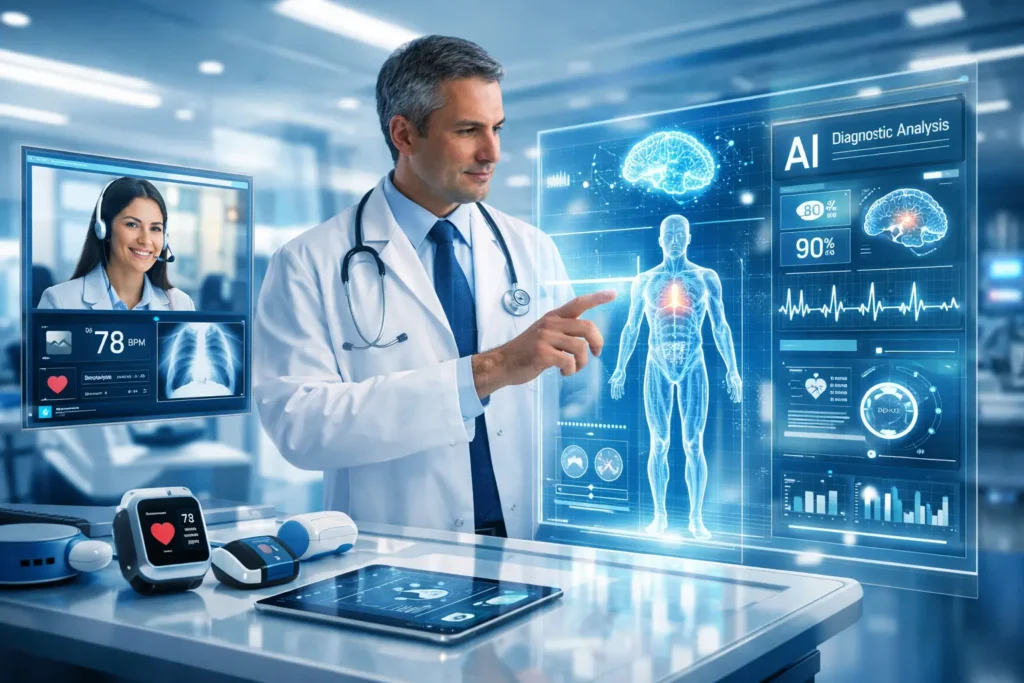
Artificial intelligence and machine learning have found their most impactful healthcare applications in diagnostics, particularly medical imaging. Deep learning algorithms — trained on millions of labeled images — can analyze X-rays, CT scans, MRIs, and pathology slides with accuracy that rivals, and in some domains surpasses, experienced specialists.
Google Health’s AI system demonstrated performance comparable to radiologists in detecting breast cancer from mammograms. FDA-cleared AI tools now assist radiologists in detecting pulmonary embolism, intracranial hemorrhage, and diabetic retinopathy. Pathology AI tools analyze tissue slides at the cellular level, identifying cancerous patterns that might be missed on manual review.
Beyond imaging, clinical decision support (CDS) systems powered by AI provide real-time guidance to clinicians at the point of care: alerting physicians to dangerous drug interactions, flagging deteriorating patient vitals in the ICU, and recommending evidence-based treatment pathways for complex diagnoses. These systems are not designed to replace clinical judgment but to augment it — providing a safety net that reduces the cognitive load on clinicians and catches errors before they reach patients.
Robotics in Surgery and Rehabilitation
Robotic surgical systems, led by platforms like the da Vinci Surgical System, have transformed a range of procedures across urology, gynecology, general surgery, and cardiac surgery. These systems do not operate autonomously — a surgeon controls robotic arms from a console — but they provide capabilities impossible with human hands alone: tremor filtration, sub-millimeter precision, 3D visualization of the operative field, and access to anatomical spaces too confined for traditional instruments.
The result is often minimally invasive procedures that were previously open surgeries, delivering shorter hospital stays, reduced infection risk, less blood loss, and faster patient recovery. In rehabilitation, robotic exoskeletons and assistive devices help patients recovering from stroke, spinal cord injury, or orthopedic surgery regain mobility through repetitive, precisely controlled movement therapies that would be exhausting for human physical therapists to deliver consistently.
Personalized Medicine and Genomics
Personalized medicine — sometimes called precision medicine — represents a paradigm shift from the traditional “one-size-fits-all” treatment model toward therapies tailored to an individual’s unique biological profile. Advances in genomic sequencing technology, which has seen its cost fall from approximately $100 million per genome in 2001 to under $1,000 today, are central to this revolution.
Pharmacogenomics uses a patient’s genetic data to predict how they will respond to specific medications, avoiding the trial-and-error that characterizes much of current prescribing practice. In oncology, genomic tumor profiling identifies the specific mutations driving a patient’s cancer, enabling targeted therapies that attack those mutations specifically rather than using broadly toxic treatments like traditional chemotherapy. The NIH’s All of Us Research Program, which aims to collect genetic data from one million Americans, illustrates the institutional commitment to building the data infrastructure that precision medicine requires.
The Promise of Digital Therapeutics (DTx)
Digital therapeutics are software-based interventions — delivered through apps, platforms, or devices — that prevent, manage, or treat medical conditions using clinically validated, evidence-based therapeutic mechanisms. Unlike wellness apps, DTx products undergo rigorous clinical trials and, in many cases, receive regulatory authorization as medical devices.
FDA-authorized DTx products currently in use include software-based cognitive behavioral therapy programs for insomnia and substance use disorders, digital rehabilitation programs for musculoskeletal conditions, and game-based attention training for pediatric ADHD. The appeal is powerful: a clinically effective DTx product can be prescribed like a medication and accessed by patients on their own devices, dramatically improving access to evidence-based care, particularly for mental and behavioral health conditions where specialist shortages are severe.
The Undeniable Benefits of Healthcare Technology
For Patients: Empowerment, Access, and Personalization
Healthcare technology has shifted medicine’s center of gravity toward the patient. Key benefits include:
- Expanded access to care: Telehealth, mobile apps, and remote monitoring remove geographic, physical, and time-based barriers that previously excluded rural, elderly, and mobility-limited populations from timely care.
- Proactive and preventive health management: Wearables and RPM tools detect early warning signs of deterioration, enabling intervention before acute crises develop. Patients with chronic conditions like heart failure or diabetes can have their metrics monitored continuously, with alerts sent directly to their care team.
- Personalized treatment: Genomic medicine and AI-driven treatment planning move toward therapies matched to each patient’s unique biology, increasing efficacy and reducing adverse effects.
- Greater transparency and engagement: Patient portals and shared clinical notes (mandated under the 21st Century Cures Act in the United States) give patients full visibility into their own health records, fostering a more collaborative relationship with their care team.
- Convenience: Appointment scheduling, prescription refills, test results, and follow-up consultations can now be handled digitally, reducing the time and friction involved in managing health.
For Providers and Systems: Efficiency, Accuracy, and Cost Savings
At the system level, the benefits of healthcare technology are equally transformative:
- Reduced medical errors: Clinical decision support systems, automated medication checks, and standardized EHR workflows reduce the kinds of preventable errors — wrong medication doses, missed diagnoses, harmful drug interactions — that cause significant patient harm and system cost.
- Streamlined operations: Automation of scheduling, billing, and prior authorization frees administrative staff and reduces operational costs, enabling resources to be redirected toward direct patient care.
- Data-driven decision-making: Leaders at every level — from bedside nurses to hospital CEOs — now have access to real-time performance data, enabling faster and better-informed decisions.
- Improved collaboration: Shared EHR systems and secure messaging platforms enable care teams — primary care, specialists, nurses, pharmacists — to coordinate seamlessly across settings and institutions, reducing fragmentation.
- Cost reduction at scale: While the upfront investment in health technology is significant, the downstream financial benefits — fewer hospitalizations, shorter stays, reduced administrative waste, earlier intervention in chronic disease — are well documented.
A credible assessment of healthcare technology must look unflinchingly at its challenges. The same digital infrastructure that enables so much good also introduces new vulnerabilities, ethical dilemmas, and implementation obstacles that the field is still learning to manage.
The Critical Importance of Data Privacy and Security
Health data is among the most sensitive personal information that exists, and the healthcare sector is among the most heavily targeted by cybercriminals. According to the HHS Office for Civil Rights, healthcare data breaches exposed over 133 million records in 2023 alone — a record figure that reflects the growing scale and sophistication of cyberattacks on health systems. A single breach can expose not just names and addresses but diagnoses, medications, mental health history, and financial information.
Ransomware attacks represent an acute threat: in 2024, the Change Healthcare cyberattack disrupted prescription processing for thousands of pharmacies across the United States, illustrating how deeply interconnected — and therefore how broadly vulnerable — modern health IT infrastructure has become. Regulatory frameworks like HIPAA in the United States and GDPR in Europe establish baseline protections for health data, requiring covered entities to implement encryption, access controls, breach notification procedures, and security risk assessments. But compliance with regulations does not guarantee security, and the sophistication of attackers continues to outpace many organizations’ defenses.
Ethical Considerations in an AI-Driven World
As AI systems take on greater roles in clinical decision-making, questions of ethics and accountability become urgent. Algorithmic bias is among the most pressing concerns: AI systems trained predominantly on data from certain demographic groups may perform significantly worse for underrepresented populations, potentially exacerbating existing healthcare disparities. Studies have documented racial bias in clinical prediction tools, including a widely used algorithm that underestimated Black patients’ medical needs relative to White patients with the same health burden.
The transparency problem compounds this: many high-performing AI systems are “black boxes” whose reasoning is opaque even to their developers. When an AI flags a patient as high-risk or recommends against a treatment, clinicians and patients deserve to understand why. The explainable AI (XAI) field is working to address this, but progress is uneven. Related concerns include questions of liability (when an AI-assisted diagnosis is wrong, who is responsible?), informed consent (should patients know when AI was involved in their care?), and the digital divide (will AI-driven healthcare primarily benefit wealthy, connected populations, widening health inequities?).
Overcoming Interoperability and Integration Hurdles
Despite decades of digitization, much health data remains effectively inaccessible: locked in EHR systems that do not communicate with one another, stored in formats that cannot be exchanged, or siloed within institutions unwilling or unable to share. This fragmentation has real clinical consequences. A patient seen by a specialist at a different health system, or treated in an emergency department while traveling, may have critical clinical history unavailable to the treating team.
The technical barriers are significant — different EHR vendors use proprietary data structures, legacy systems predate modern interoperability standards, and integration requires substantial technical investment. But organizational and commercial barriers are often equally formidable: health systems that view patient data as a competitive asset may resist sharing it, even when sharing would improve patient outcomes. Progress through FHIR-based APIs and national health information exchanges is real, but a truly unified, patient-centered health data ecosystem remains years away.
The Human Factor: Usability, Training, and Change Management
Technology is only as effective as the people who use it, and the healthcare sector’s track record with technology adoption is complicated. EHR systems, in particular, have been widely criticized for contributing to clinician burnout: poorly designed interfaces require physicians to spend more time navigating screens than engaging with patients. Studies have documented physicians spending more than half their working hours on EHR documentation — time taken directly from patient care and personal recovery.
Human factors engineering and user-centered design (UCD) principles offer a path forward, prioritizing the real workflows of clinicians in system design rather than retrofitting clinical work around technological constraints. Equally important is change management: introducing new technology into clinical environments requires thoughtful training, ongoing support, and cultural leadership that acknowledges staff concerns rather than dismissing resistance. The history of health IT is littered with technically sound systems that failed because implementation ignored the human beings expected to use them.
The Future of Technology in Healthcare: Trends to Watch
The Next Wave of Innovation
The pace of healthcare innovation shows no sign of slowing. Several emerging technologies are positioned to reshape medicine over the coming decade:
- Generative AI in clinical workflows: Large language model (LLM)-based tools are already being piloted for ambient clinical documentation — listening to patient-physician conversations and automatically generating structured clinical notes. These tools promise to dramatically reduce documentation burden, though questions around accuracy, liability, and patient privacy require careful management. Generative AI is also being used to synthesize complex clinical literature, draft patient communications, and support medical coding.
- Digital twins: A digital twin is a dynamic computational model of a biological system — an organ, a physiological process, or even an individual patient — that can be used to simulate the effects of treatments before they are applied. In drug development, digital twins of specific cancer types could allow researchers to test thousands of molecular compounds in silico before advancing the most promising candidates to clinical trials. In critical care, patient-specific digital twins could allow clinicians to simulate the hemodynamic effects of different treatment approaches before committing to a course of action.
- Federated learning: One of the most promising solutions to the tension between data sharing and privacy, federated learning allows AI models to be trained across multiple institutions’ datasets without the underlying patient data ever leaving those institutions. Model parameters rather than patient records are shared, enabling powerful multi-institutional AI development while preserving data governance and patient privacy.
- Advanced bioprinting and nanotechnology: 3D bioprinting — using bioinks composed of living cells to print tissue structures — is moving from research curiosity toward clinical application. Researchers have successfully bioprinted skin grafts, cartilage, and corneal tissue. Longer-term, the ability to print functional organs could transform transplantation medicine. In parallel, nanotechnology is enabling drug delivery systems that can target cancerous cells with extraordinary precision, releasing therapeutic payloads only in the presence of tumor-specific biomarkers.
- Smart hospitals: Next-generation hospital facilities are being designed around ambient sensing, real-time location systems (RTLS), automated logistics, and AI-driven operational management. Smart hospital infrastructure tracks equipment, monitors patient acuity across wards, automates supply chain management, and optimizes clinical workflows — transforming the hospital from a static environment into a responsive, data-driven care system.
faqs
What is healthcare technology?
Healthcare technology is the application of organized knowledge, skills, devices, medicines, vaccines, procedures, and systems to solve health problems and improve quality of life. It encompasses everything from EHR platforms and diagnostic AI to surgical robots and patient-facing mobile health apps.
How is artificial intelligence used in healthcare?
AI is applied across a wide range of healthcare functions: diagnosing disease from medical images, predicting patient deterioration, supporting clinical decisions at the point of care, automating administrative tasks, accelerating drug discovery, and enabling personalized treatment planning through genomic analysis.
What are the main benefits of technology in healthcare?
Key benefits include expanded access to care, reduced medical errors, improved care coordination, faster and more accurate diagnosis, personalized treatment, reduced administrative burden, and lower long-term costs through earlier intervention in chronic disease.
What are electronic health records (EHRs) and why are they important?
EHRs are digital versions of a patient’s complete medical history, replacing paper charts. They are foundational to modern healthcare because they make clinical data available at the point of care, support data exchange between providers, enable population health analytics, and serve as the infrastructure through which most other health IT systems operate.
How does telemedicine work?
Telemedicine uses secure video conferencing, telephone, and messaging platforms to enable clinical consultations between patients and providers who are not in the same physical location. Visits can be synchronous (real-time video) or asynchronous (store-and-forward messaging), and can range from primary care check-ins to specialist consultations and mental health therapy.
What is the Internet of Medical Things (IoMT)?
The IoMT is the network of connected medical devices, sensors, software, and systems that collect and transmit health data. It encompasses consumer wearables, implanted monitors, remote patient monitoring systems, smart hospital equipment, and clinical decision support tools connected to central analytics platforms.
What are the biggest challenges facing healthcare technology today?
The most significant challenges include cybersecurity and data privacy risks, algorithmic bias in AI systems, interoperability failures between EHR platforms, clinician burnout driven by poorly designed technology, the digital divide that excludes low-income and elderly populations, and the high cost and complexity of technology implementation.
What is interoperability in healthcare, and why is it difficult to achieve?
Interoperability is the ability of different health IT systems to exchange and use data seamlessly. It is difficult because EHR vendors historically used proprietary formats, legacy systems predate modern standards, implementation requires substantial investment, and some health systems have commercial incentives to limit data sharing. FHIR-based APIs are improving the landscape but full interoperability remains a long-term work in progress.
What is personalized medicine?
Personalized (or precision) medicine uses an individual’s genetic, molecular, and lifestyle data to inform treatment decisions. Rather than applying standard protocols, personalized medicine tailors therapy to the patient’s unique biology — particularly impactful in oncology, where genomic tumor profiling guides the selection of targeted therapies.
What is the future of healthcare technology?
Near-term advances include generative AI for clinical documentation and drug discovery, FHIR-enabled interoperability, expanded remote monitoring, and AI-powered diagnostics. Longer-term, digital twins, federated learning, advanced bioprinting, and nanotechnology-based drug delivery are poised to fundamentally reshape treatment, drug development, and hospital operations.
Conclusion: Embracing the Future of Health
Healthcare technology is neither a simple good nor a simple threat — it is a profoundly powerful set of tools that, when implemented thoughtfully and equitably, have the capacity to deliver better health to more people at lower cost than any previous era of medicine has achieved. The AI that detects a cancer earlier, the telehealth visit that reaches a patient in a community without a specialist, the wearable that alerts a care team before a heart failure patient deteriorates — these are not hypothetical futures. They are happening today, in clinics and homes around the world.
But the challenges are equally real. Cybersecurity threats that endanger patient safety, algorithmic biases that widen health disparities, interoperability failures that fragment care, and implementation approaches that burn out the clinicians technology is meant to help — these are not minor friction points. They are serious systemic issues that demand the same rigor and investment as the technologies themselves.
The organizations, policymakers, and clinical leaders who will shape the best version of this future are those who hold both truths simultaneously: that healthcare technology’s potential to improve and save lives is immense, and that realizing that potential requires confronting its risks, limitations, and unintended consequences with clear eyes and sustained commitment. The definitive story of healthcare technology is still being written — and the choices made today will determine the chapter that comes next.

Adrian Cole is a technology researcher and AI content specialist with more than seven years of experience studying automation, machine learning models, and digital innovation. He has worked with multiple tech startups as a consultant, helping them adopt smarter tools and build data-driven systems. Adrian writes simple, clear, and practical explanations of complex tech topics so readers can easily understand the future of AI.