
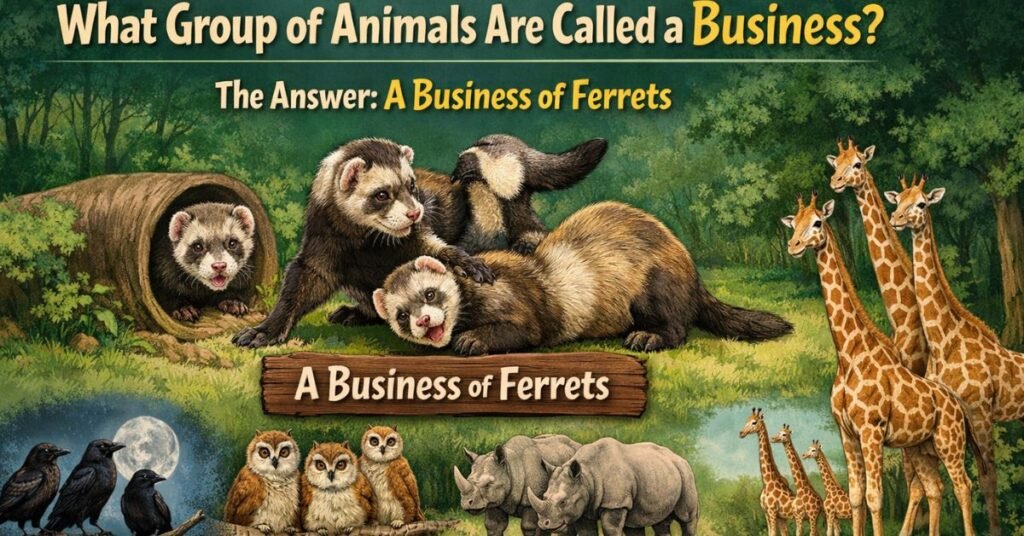
If someone asked you “what group of animals are called a business?”, your first guess might be ants, bees, or even humans in suits rushing to meetings. The answer is far more surprising — a group of ferrets is called a business.
Yes, the playful, curious little mammals that love tunnels and mischief share a collective noun that sounds like it belongs in a corporate office. It’s one of the many wonderfully strange and poetic group names in the animal kingdom.
But this raises a bigger question: why do animals have such unusual collective names in the first place? And how did ferrets end up with something as peculiar as a “business”?
In this in-depth guide, we’ll explore everything behind the phrase “what group of animals are called a business.” You’ll learn:
- The exact animal that forms a “business”
- The historical origin of animal collective nouns
- Why ferrets earned this particular name
- Other strange and fascinating animal group names
- How these terms are used in language, education, and storytelling
- Common myths and misunderstandings
- A practical guide to learning and remembering collective nouns
By the end, you’ll not only know the answer — you’ll understand the cultural history and linguistic creativity behind it.
Let’s dive in.
Understanding the Question: What Group of Animals Are Called a Business?
The answer to the question “what group of animals are called a business” is ferrets.
A group of ferrets is known as:
- A business of ferrets
- Sometimes also a fesnyng
Among the two, “business” is the term most widely recognized today.
Ferrets are small, long-bodied mammals related to weasels, otters, and mink. They belong to the Mustelidae family, which includes many energetic and intelligent predators.
When several ferrets gather, their behavior becomes lively and chaotic. They run, chase, tumble, dig, and explore constantly. Watching a group of ferrets interact can feel like observing a busy workplace full of activity — which likely explains why the term “business” was chosen centuries ago.
The phrase originated from historical traditions of giving animals imaginative collective nouns. These names were often humorous, poetic, or descriptive.
Examples include:
- A murder of crows
- A parliament of owls
- A crash of rhinoceroses
- A tower of giraffes
- A bloat of hippopotamuses
These names weren’t necessarily scientific. Instead, they reflected human creativity and observation of animal behavior.
In the case of ferrets, their energetic nature perfectly matches the idea of being constantly “busy,” making a business of ferrets a fitting label.
The Origin of Animal Collective Nouns
To fully understand what group of animals are called a business, we need to go back hundreds of years to the origins of collective animal names.
Most of these unusual group names date back to medieval England, especially the late 1400s.
One of the earliest sources is a book called “The Book of Saint Albans” (1486), which contained a section known as “The Terms of Venery.”
These terms were used primarily by hunters and aristocrats.
During that time, hunting was not just a practical activity — it was also a symbol of status and sophistication. Knowing the correct collective nouns for animals was considered part of being well educated.
The list included dozens of imaginative terms such as:
- A pride of lions
- A gaggle of geese
- A herd of deer
- A pack of wolves
But the authors also added playful or poetic expressions:
- A murmuration of starlings
- A charm of goldfinches
- A pandemonium of parrots
Over time, many of these names became part of everyday English.
Some survived because they perfectly captured the nature of the animals involved. Others persisted simply because they were memorable.
The phrase “a business of ferrets” belongs to this tradition — an example of how language blends observation, humor, and storytelling.
Why a Group of Ferrets Is Called a Business
Ferrets earned the collective noun “business” largely because of their behavior.
If you’ve ever watched multiple ferrets together, you’ll quickly understand why the name fits.
Ferrets are:
- Extremely energetic
- Highly curious
- Social and interactive
- Constantly moving and exploring
When several ferrets are together, they rarely sit still.
They tumble over each other, investigate every corner, wrestle playfully, and dart around tunnels and objects. Their activity level makes them appear as if they’re always engaged in important work.
This constant movement resembles the hustle and bustle of a busy workplace — hence “a business of ferrets.”
Ferrets were historically used by humans for hunting rabbits, a practice called ferreting.
During these hunts:
- Ferrets would enter burrows
- Flush rabbits from their tunnels
- Work cooperatively with hunters and dogs
Their efficiency and tireless energy may have further reinforced the idea that ferrets were always “on business.”
The term captures both their work ethic and lively personalities.
Meet the Animal Behind the Name: The Ferret
To truly appreciate what group of animals are called a business, it helps to understand the animal itself.
Ferrets have been domesticated for more than 2,000 years.
They likely descended from the European polecat, a wild member of the weasel family.
Key characteristics of ferrets include:
Size
- Length: 20–24 inches including tail
- Weight: 1–4 pounds
Appearance
- Long, slender body
- Short legs
- Pointed face
- Thick fur in various colors
Common ferret coat colors include:
- Sable
- Albino
- Cinnamon
- Chocolate
- Black
Behavior
Ferrets are famous for their playful personalities.
They love:
- Tunnels
- Toys
- Exploring hidden spaces
- Social interaction
One of their most charming behaviors is the “weasel war dance.”
This playful dance involves:
- Hopping sideways
- Puffing their tail
- Making excited sounds
It’s a sign of pure joy and excitement.
Ferrets sleep 14–18 hours per day, but when awake they are incredibly active.
Watching several ferrets interact is chaotic, adorable, and endlessly entertaining — which again explains why their group name suggests constant activity.
Other Strange and Fascinating Animal Group Names
The animal kingdom is full of unusual collective nouns.
If you enjoyed learning what group of animals are called a business, you’ll probably love some of these equally quirky names.
Here are some famous examples:
A Murder of Crows
One of the most well-known collective nouns.
Crows have long been associated with mystery and folklore, which likely inspired the dramatic name.
A Parliament of Owls
Owls symbolize wisdom, so the idea of them gathering like politicians in debate created the phrase “parliament.”
A Crash of Rhinoceroses
Rhinos are massive animals capable of charging with incredible force.
The word “crash” captures that powerful image.
A Tower of Giraffes
Because giraffes are so tall, the word “tower” perfectly describes their presence when standing together.
A Smack of Jellyfish
This strange term may come from the way jellyfish appear to “smack” against water currents.
A Kaleidoscope of Butterflies
This beautiful phrase reflects the colorful patterns formed when butterflies gather.
These collective nouns show how language blends imagination, observation, and culture.
Why Animal Group Names Matter in Language and Learning
At first glance, animal collective nouns may seem like trivia.
But they serve several valuable purposes.
1. Language Enrichment
Collective nouns add color and personality to language.
Instead of saying “a group of ferrets,” saying “a business of ferrets” creates imagery and curiosity.
2. Education and Memory
Students often remember unusual phrases more easily.
For example:
- “Murder of crows”
- “Parliament of owls”
- “Business of ferrets”
These phrases stick in memory because they’re unique.
3. Cultural Heritage
Many of these names have existed for centuries.
They represent a tradition of storytelling embedded in language.
4. Wildlife Awareness
Learning these terms often leads people to learn more about animals themselves.
Someone curious about “a business of ferrets” might go on to discover:
- Ferret domestication history
- Their role in hunting
- Their behavior as pets
In this way, language becomes a gateway to deeper knowledge about nature.
A Simple Step-by-Step Guide to Learning Animal Collective Nouns
If you want to remember unusual terms like “what group of animals are called a business,” you can use a few effective learning techniques.
Step 1: Start With Familiar Animals
Begin with animals you already know.
Examples:
- Lions — pride
- Wolves — pack
- Geese — gaggle
Step 2: Learn the Story Behind the Name
Understanding why a name exists makes it easier to remember.
For example:
Ferrets are busy → business of ferrets
Step 3: Group Similar Names Together
Many names follow themes:
- Authority terms: parliament, congress
- Emotional terms: murder, pride
- Visual terms: tower, cloud
Step 4: Use Flashcards or Lists
Write the animal on one side and the group name on the other.
Step 5: Use the Names in Conversation
The more you say them, the more they stick.
For example:
“I saw a video of a business of ferrets playing in a tunnel maze.”
Common Mistakes and Misconceptions
Because collective nouns are unusual, people often misunderstand them.
Here are some common mistakes related to what group of animals are called a business.
Mistake 1: Thinking “Business” Refers to Ants or Bees
Because ants and bees are known for hard work, many people assume they form a “business.”
In reality:
- Ants form a colony
- Bees form a swarm or hive
Mistake 2: Believing Collective Nouns Are Scientific Terms
Most collective nouns are linguistic traditions, not scientific classifications.
Biologists typically just say group, herd, or colony.
Mistake 3: Assuming Every Animal Has One Official Name
Some animals have multiple collective nouns.
For example:
- Ferrets: business or fesnyng
Mistake 4: Thinking They Must Always Be Used
In everyday conversation, saying “group of ferrets” is perfectly acceptable.
Collective nouns are mainly used for fun, literature, or education.
Tools and Resources for Learning More Animal Group Names
If you enjoy discovering quirky animal terms like a business of ferrets, several tools can help expand your knowledge.
Online Animal Dictionaries
Wildlife websites and educational resources often list collective nouns with explanations.
Educational Books
Books on animal trivia or English vocabulary often include large lists of group names.
Wildlife Documentaries
Watching animals in nature helps connect group names to real behavior.
Classroom Activities
Teachers often use collective nouns in:
- Vocabulary games
- Quizzes
- Memory challenges
These methods make learning both fun and memorable.
Why Ferrets Continue to Fascinate Animal Lovers
Ferrets aren’t just famous for their group name.
They’ve also become beloved pets worldwide.
Their popularity stems from several qualities:
- Playful personalities
- High intelligence
- Strong curiosity
- Social nature
Ferrets form strong bonds with their owners.
They enjoy:
- Puzzle toys
- Tunnels
- Hide-and-seek games
However, they require responsible care.
Prospective owners should understand:
- Ferrets need daily playtime
- They require proper diet
- Their enclosures must be secure
Because of their mischievous behavior, ferrets often hide objects or squeeze into small spaces.
But that playful curiosity is exactly what makes them so charming — and why watching a business of ferrets can be endlessly entertaining.
Conclusion
So, what group of animals are called a business?
The answer is ferrets.
A gathering of these lively, curious mammals is known as a business of ferrets — a phrase that perfectly captures their busy, playful behavior.
This unusual term is part of a centuries-old tradition of imaginative animal collective nouns. These names blend observation, humor, and storytelling, giving language a creative way to describe the natural world.
From a murder of crows to a parliament of owls, collective nouns remind us that language can be just as fascinating as the animals themselves.
And the next time you see several ferrets tumbling around together, you’ll know exactly what you’re looking at:
A very busy business.
FAQs
What group of animals are called a business?
A group of ferrets is called a business.
Why is it called a business of ferrets?
The name likely comes from their energetic behavior. Ferrets are constantly moving, exploring, and interacting, making them appear “busy.”
Yes. Ferrets are highly social and enjoy interacting with other ferrets and humans.
Is “business” the only group name for ferrets?
No. Another historical term is “fesnyng,” though it’s rarely used today.
Are collective animal nouns scientifically official?
Most collective nouns are part of linguistic tradition, not scientific classification.

Michael Grant is a business writer with professional experience in small-business consulting and online entrepreneurship. Over the past decade, he has helped brands improve their digital strategy, customer engagement, and revenue planning. Michael simplifies business concepts and gives readers practical insights they can use immediately.