
If you’ve ever tried opening a business bank account, applying for a payment gateway, or signing a commercial lease, you’ve probably been asked for one thing almost immediately: your business registration certificate.
And if you’re new to entrepreneurship, that request can feel confusing.
What is a business registration certificate? Is it the same as a business license? Is it like an LLC certificate? Do freelancers need one? What about online businesses?
I’ve worked with founders across different industries — from solo consultants launching from their kitchen tables to startups preparing for venture capital. And one thing is consistent: understanding your business registration certificate early saves you time, money, and unnecessary stress.
In this in-depth guide, you’ll learn:
- What a business registration certificate really is (in plain English)
- Why it matters more than most entrepreneurs realize
- Who needs one (and who doesn’t)
- How to get it step-by-step
- Common mistakes that can cost you delays or penalties
- Tools and resources that make the process easier
- Expert-level insights most blogs don’t explain
Let’s break it down properly — no jargon, no fluff, just clarity.
What Is a Business Registration Certificate?
At its simplest:
A business registration certificate is an official government document that proves your business legally exists.
That’s it.
It’s issued by a government authority (usually at the state, provincial, or national level) after you formally register your business name and structure.
Think of it like a birth certificate — but for your business.
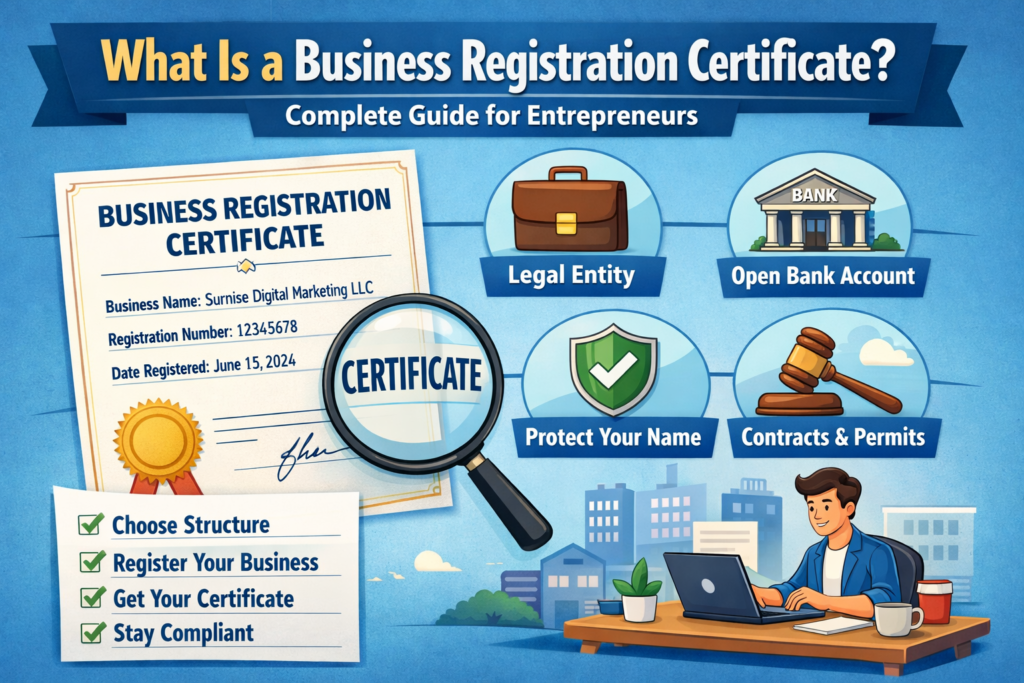
Just as a birth certificate proves a person exists legally, a business registration certificate confirms:
- Your business name
- Your business structure (sole proprietorship, LLC, corporation, etc.)
- The registration date
- A unique registration number
- The governing authority that approved it
The Legal Identity of Your Business
Before registration, your business idea is just that — an idea.
After registration, it becomes a recognized legal entity.
That means you can:
- Open business bank accounts
- Sign contracts under your business name
- Pay taxes properly
- Apply for funding
- Protect your business name
Without this certificate, you’re operating informally — and that can limit growth opportunities.
Business Registration Certificate vs Business License: Not the Same Thing
This is where many entrepreneurs get confused.
A business registration certificate proves your business legally exists.
A business license gives you permission to operate in a specific location or industry.
Let’s use a simple example.
If you register “Sunrise Digital Marketing LLC,” you receive your business registration certificate. That proves the company exists.
If you open a physical office in your city, you may need a local business license to operate legally in that municipality.
If you open a restaurant, you’ll likely need:
- Food safety permits
- Health department approval
- Fire department clearance
Each of those is separate from your business registration certificate.
In short:
Registration = legal identity
License = operational permission
You usually need both.
Why a Business Registration Certificate Matters More Than You Think
Many new entrepreneurs assume registration is just paperwork.
It’s not.
It’s the foundation of your company’s credibility and legal protection.
1. It Builds Legitimacy
Clients, suppliers, and investors take registered businesses more seriously.
If you’re pitching corporate clients and they ask for proof of registration — and you don’t have it — that’s a red flag.
2. It Enables Financial Access
Banks won’t open a business account without proof of registration.
Payment processors may require it.
Loan providers definitely will.
No certificate = no access to serious financial infrastructure.
3. It Protects Your Business Name
When you register your business name, it prevents others from registering the same name in your jurisdiction.
Without registration, someone else could legally claim your brand name.
4. It Separates Personal and Business Liability (For Certain Structures)
If you register as an LLC or corporation, your personal assets are generally protected from business debts.
But that protection only exists if you properly register.
Who Needs a Business Registration Certificate?
Short answer: almost anyone operating as a business.
But let’s break it down by category.
Sole Proprietors
If you’re operating under your personal legal name, some jurisdictions may not require formal registration.
However, if you use a business name (like “Bright Future Consulting”), you’ll usually need to register it.
Freelancers and Online Entrepreneurs
Yes, even digital businesses need registration.
Running an ecommerce store?
Offering consulting services?
Selling online courses?
If you’re generating income under a business name, registration is typically required.
Partnerships
If two or more people run a business together, registration is essential to formalize ownership and responsibilities.
LLCs and Corporations
Registration is mandatory. Without it, your entity legally does not exist.
Types of Business Structures and How They Affect Your Certificate
Your business registration certificate will reflect your chosen structure.
Here are the most common ones.
Sole Proprietorship
- Simplest structure
- One owner
- Minimal paperwork
- No liability protection
Often quickest to register.
Partnership
- Two or more owners
- Shared profits and responsibilities
- Requires partnership agreement
Registration confirms joint ownership.
Limited Liability Company (LLC)
- Separate legal entity
- Personal liability protection
- Flexible tax structure
Most popular for small businesses.
Corporation
- Separate legal entity
- Shareholders
- More compliance requirements
- Ideal for large-scale growth or investment
Your certificate will clearly state which structure you’ve chosen.
Step-by-Step Guide: How to Get a Business Registration Certificate
Now let’s walk through the process.
Keep in mind: exact steps vary by country and region. But the overall framework is similar almost everywhere.
Step 1: Choose Your Business Structure
Before registering, decide:
- Sole proprietorship?
- LLC?
- Corporation?
- Partnership?
Your structure affects taxes, liability, and paperwork.
If unsure, consult:
- An accountant
- A business attorney
- A local business advisory center
Step 2: Choose and Check Your Business Name
Most government portals allow you to check name availability.
Avoid:
- Names too similar to existing businesses
- Restricted words (like “Bank” or “Insurance” in many regions)
Once approved, your name is reserved during registration.
Step 3: Prepare Required Documents
Typically needed:
- Identification documents
- Proof of address
- Business address
- Articles of incorporation (for companies)
- Partnership agreement (if applicable)
Some regions may require notarization.
Step 4: Submit Registration Application
You can usually apply:
- Online via government portal
- In person at business registration office
- Through authorized service providers
Pay the registration fee (varies widely by location).
Step 5: Receive Your Business Registration Certificate
Once approved, you’ll receive:
- A registration certificate
- A business registration number
- Sometimes digital and physical copies
Keep both versions secure.
How Long Does It Take?
Processing time varies.
- Online registrations: 1–7 days (sometimes faster)
- Manual/in-person: 1–4 weeks
- Corporations: Often longer than sole proprietorships
Pro tip: Submit complete and accurate documents to avoid delays.
Costs of Getting a Business Registration Certificate
Costs vary depending on:
- Country
- State or province
- Business structure
- Expedited processing options
Approximate ranges globally:
- Sole proprietorship: Low fee
- LLC: Moderate fee
- Corporation: Higher fee
Additional costs may include:
- Legal assistance
- Name reservation fees
- Notary fees
- Registered agent fees
Don’t just budget for registration — budget for compliance.
Tools, Platforms, and Professional Help: What Should You Use?
You have three main options when registering.
1. Direct Government Portal (DIY Approach)
Pros:
- Cheapest
- Full control
Cons:
- Can be confusing
- Risk of errors
Best for:
Confident entrepreneurs comfortable with paperwork.
2. Online Business Formation Services
Pros:
- Faster
- Guided process
- Often include compliance reminders
Cons:
- Service fees
Best for:
Busy founders who value convenience.
3. Hiring a Lawyer or Accountant
Pros:
- Personalized advice
- Structure optimization
- Tax planning included
Cons:
- Highest cost
Best for:
Businesses with multiple partners, investors, or complex models.
Common Mistakes When Getting a Business Registration Certificate
I’ve seen these repeatedly.
1. Choosing the Wrong Structure
Many founders default to sole proprietorship because it’s easy.
Later they realize they needed liability protection.
Fix:
Understand your risk exposure before registering.
2. Using a Home Address Without Understanding Privacy Risks
Your business address may become public record.
Fix:
Consider a registered office service if privacy matters.
3. Not Checking Name Availability Properly
Registering a name too similar to another can lead to disputes.
Fix:
Search thoroughly and consider trademark checks.
4. Ignoring Ongoing Compliance
Registration is not one-and-done.
You may need:
- Annual renewals
- Tax filings
- Updated records
Missing deadlines can result in penalties.
Real-World Example: Why Registration Saved a Founder
A freelance web designer once delayed registration because “it was just side income.”
Then a corporate client requested:
- Registration certificate
- Tax ID
- Official invoice details
Without them, she lost the contract.
After registering properly, she:
- Opened a business bank account
- Increased credibility
- Landed higher-paying clients
Sometimes registration isn’t about legality — it’s about growth readiness.
How to Store and Use Your Business Registration Certificate
Once you receive it:
- Keep a digital copy in cloud storage
- Print certified copies if needed
- Share only when required
- Keep your registration number accessible
You’ll often need it for:
- Bank accounts
- Vendor agreements
- Government tenders
- Payment processor verification
- Insurance applications
Conclusion: Your Business Registration Certificate Is Your Foundation
So, what is a business registration certificate?
It’s more than paperwork.
It’s the legal backbone of your company.
It’s your credibility badge.
It’s your gateway to banking, contracts, funding, and scale.
Without it, you’re operating informally.
With it, you’re building something real.
If you’re serious about growth, stability, and professionalism — registration isn’t optional. It’s foundational.
Take the step. Do it properly. Set your business up for long-term success.
FAQs
What is a business registration certificate used for?
It’s used to prove your business legally exists and is authorized to operate under its registered name.
Is a business registration certificate the same as an LLC certificate?
Not exactly. An LLC registration certificate confirms your LLC is officially formed. It’s a type of business registration certificate.
Do freelancers need a business registration certificate?
Often yes, especially if operating under a business name or generating consistent income.
How long is a business registration certificate valid?
It depends on your jurisdiction. Some are permanent but require annual filings.
Can I operate without registering my business?
In some cases, yes — but it limits credibility, banking access, and legal protection.

Michael Grant is a business writer with professional experience in small-business consulting and online entrepreneurship. Over the past decade, he has helped brands improve their digital strategy, customer engagement, and revenue planning. Michael simplifies business concepts and gives readers practical insights they can use immediately.