
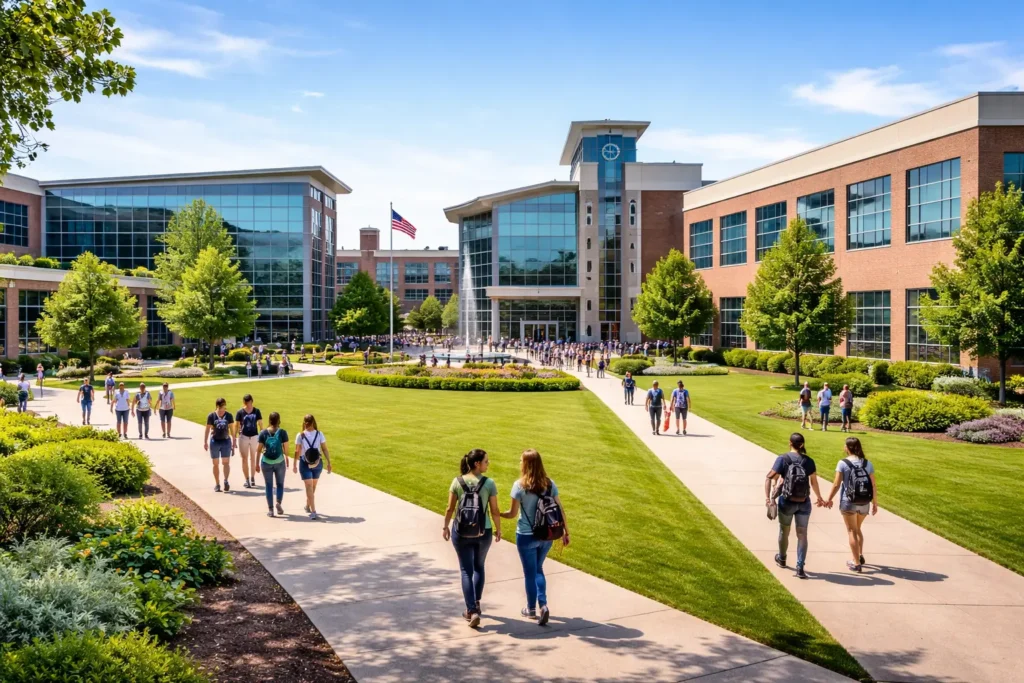
Pennsylvania College of Technology — commonly known as Penn College or Penn Tech — is one of Pennsylvania’s premier public institutions dedicated to applied technology education. Located in Williamsport, PA, Penn College offers a hands-on learning experience unlike any traditional university, preparing students for real-world careers from day one. Whether you are a prospective student, parent, or researcher, this comprehensive guide covers everything you need to know about Penn College: its academic programs, admissions process, costs, campus life, athletics, and outstanding career outcomes.
At a Glance: Key Facts About Penn College
Here is a quick snapshot of the most essential data points about Pennsylvania College of Technology, drawn from U.S. News & World Report and the official Penn College website:
| Category | Details |
| Location | Williamsport, PA (One College Avenue) |
| Institution Type | Public college — special mission affiliate of Penn State |
| Campus Size | 516 acres, city setting |
| Undergraduate Enrollment | 4,526 |
| Student-to-Faculty Ratio | 12:1 |
| Acceptance Rate | 76% (test-blind admissions) |
| In-State Tuition | $18,690 |
| Out-of-State Tuition | $26,640 |
| Average Net Price | $24,769 |
| Room & Board | $12,872 |
| Graduation Rate | 42% |
| Graduate Placement Rate | 98% |
| Median Starting Salary | $47,995 |
| Application Deadline | July 1 (rolling admissions) |
Why Choose Penn College? The “Future Made By Hand”
Penn College’s motto — “Future Made By Hand” — is more than a marketing slogan. It is the foundational philosophy that shapes every aspect of the educational experience here. While most universities prioritize theory and lecture-based learning, Penn College flips the ratio. The college maintains a 3:1 lab-to-lecture ratio, meaning students spend three times as many hours in hands-on labs, workshops, and real-world simulations as they do in traditional classrooms.
This approach produces industry-ready graduates who do not need months of on-the-job training before they become productive contributors. Employers know this. It is a primary reason why Penn College boasts a remarkable 98% graduate placement rate — among the highest of any comparable institution in the country.
Penn College is a self-governing affiliate of Penn State University, giving students the credibility of a Penn State connection while benefiting from a specialized, applied technology curriculum that Penn State itself does not offer. This unique positioning makes Penn College a one-of-a-kind institution in the Pennsylvania higher education landscape.
National Recognition & Rankings
Penn College has earned significant national recognition for its quality, value, and commitment to innovation. According to the most recent U.S. News & World Report rankings, Penn College holds impressive positions across multiple categories:
- #4 Regional Colleges North — a top-tier ranking among colleges in the northeastern United States
- #1 Most Innovative Schools — recognized for pioneering approaches to applied education
- #1 Best Colleges for Veterans — a top destination for military-connected students
- #3 Top Public Schools in the Regional Colleges North category
These rankings reflect Penn College’s ongoing commitment to innovation, accessibility, and service to diverse student populations, including active-duty military and veterans.
Exploring Academic Programs at Penn College
Penn College offers a wide range of credentials — from short-term certificates to master’s degrees — across several distinct academic schools. Programs are consistently updated to reflect industry demand, ensuring graduates enter the workforce with current, relevant skills. Degree types available include associate degrees, bachelor’s degrees, master’s degrees, and professional certificates.
School of Engineering Technologies
The School of Engineering Technologies is the flagship academic division at Penn College, housing the institution’s most recognizable and in-demand programs. Students learn by doing — in cutting-edge labs equipped with the same tools and machinery used by leading employers.
Popular programs within this school include automation and robotics, electromechanical technologies, welding engineering technology, manufacturing and fabrication, and computer information technology. The school emphasizes not just technical skill but also problem-solving, critical thinking, and communication — qualities that make Penn College graduates stand out in the job market.
New for 2026–27: Artificial Intelligence (AI) Minors
In one of its most exciting recent developments, Penn College is launching two new Artificial Intelligence (AI) minors for the 2026–27 academic year, reflecting growing demand for AI literacy across virtually every industry.
The two new minors are: Artificial Intelligence in Industry & Society, and Artificial Intelligence Foundations & Applications. These programs are designed to give students — regardless of their primary major — a rigorous grounding in machine learning, deep learning, algorithms, and data science, taught with Penn College’s signature hands-on methodology.
Faculty spearheading this initiative include Rick Crossen and Alicia McNett, who have worked closely with industry partners to ensure the curriculum reflects real-world AI applications. These minors position Penn College students to be competitive in an increasingly AI-driven economy and represent a significant step forward in the college’s ongoing evolution.
School of Nursing & Health Sciences
Healthcare is one of the fastest-growing employment sectors in the United States, and Penn College’s School of Nursing & Health Sciences prepares students to meet that demand. Programs are rigorous, accredited, and designed to produce clinical professionals who are ready to work from their first day on the job.
Key programs include Registered Nursing (RN), Dental Hygiene, Physician Assistant Studies (Master’s level), and Nursing (Master’s level). Salary outcomes for graduates in this school are among the strongest at Penn College — nursing graduates report a median starting salary of $79,336, while dental hygiene graduates also command competitive wages in the market.
School of Business, Arts & Sciences
Penn College rounds out its academic portfolio with a strong School of Business, Arts & Sciences, offering programs in business administration, management, communication, and the liberal arts. This school provides students with the critical thinking and communication skills that complement technical training and are valued by employers across all sectors.
A unique highlight of this school is Le Jeune Chef, an award-winning student-run restaurant located on campus. Culinary arts and hospitality management students gain real-world experience operating a functioning restaurant, managing inventory, serving actual diners, and receiving live feedback — an experience that mirrors professional culinary environments.
Workforce Development & Apprenticeships
Beyond traditional degree programs, Penn College is a significant regional hub for workforce development and apprenticeship training. These programs serve adult learners, incumbent workers, and regional employers looking to upskill their teams.
Offerings include robotics and automation training, industrial maintenance, mechatronics, and commercial facilities training. Apprenticeship programs allow participants to earn while they learn, combining on-the-job experience with classroom instruction. Penn College’s workforce development division reflects the institution’s broader commitment to serving the economic needs of the surrounding community.
Admissions: How to Get into Penn College
Penn College welcomes motivated students who are ready to commit to a hands-on, career-focused education. The admissions process is straightforward and student-friendly, with a high acceptance rate that reflects the college’s belief that access to quality education should not be unnecessarily restricted.
Admissions Requirements & Deadlines
Penn College accepts applications through the Common Application, making it easy for students already applying to other schools to add Penn College to their list. Key admissions details include:
- Acceptance Rate: 76% — Penn College is accessible to a wide range of applicants
- Test-Blind Policy: Standardized test scores (SAT/ACT) are not required or considered
- Average High School GPA: 3.1 — a solid B average is the typical profile of admitted students
- Application Deadline: July 1 (rolling admissions — apply early for best program access)
- Required Materials: High school transcript; some programs may have additional prerequisites
Because Penn College practices rolling admissions, students can apply and receive decisions throughout the year. However, applying earlier is strongly recommended, as some specialized programs — particularly in health sciences and engineering — have limited enrollment and fill up quickly.
Understanding the Cost & Financial Aid
Concerns about college affordability are entirely valid, and Penn College takes cost transparency seriously. Here is a breakdown of what students can expect to pay and what financial support is available:
| Cost Category | Amount |
| In-State Tuition | $18,690 |
| Out-of-State Tuition | $26,640 |
| Room & Board (Food & Housing) | $12,872 |
| Average Net Price (after aid) | $24,769 |
| Students Receiving Need-Based Aid | 65% |
The majority of Penn College students receive some form of financial assistance. The college participates in all major federal and state aid programs, including Pell Grants, subsidized and unsubsidized federal loans, and work-study programs. Institutional scholarships are also available for students with strong academic records or specific program interests.
Penn College is also one of the nation’s Best Colleges for Veterans, meaning it has robust systems in place to help military-connected students access GI Bill benefits, military tuition assistance, and Yellow Ribbon Program funding. The college’s dedicated veterans services office supports students through every step of the financial aid process.
Campus Life: The Student Experience at Penn College
Life at Penn College extends well beyond the lab bench and the lecture hall. With more than 60 student organizations, a lively campus culture, and a strong sense of community, Penn College offers a rich student experience that complements its rigorous academics.
The campus is set on 516 acres in the city of Williamsport, PA — a mid-sized Pennsylvania city that offers students access to local restaurants, entertainment, and cultural events while maintaining the tight-knit feel of a college community. Greek life is part of the campus culture as well, with chapters including Sigma Pi and Phi Mu Delta.
On-Campus Housing
Penn College offers several on-campus housing options to suit different preferences and budgets. Residence hall options include Rose Street Commons, Campus View Apartments, and The Village at Penn College. Housing facilities are coed, modern, and located within easy walking distance of academic buildings, the library, and dining facilities.
Living on campus is strongly encouraged for first-year students, as it accelerates community building and provides easy access to academic and support resources. The college works to ensure that on-campus living is comfortable, safe, and conducive to academic success.
Safety & Security
Penn College prioritizes the safety and well-being of its campus community. The Penn College Police Department operates 24 hours a day, seven days a week, and partners with local Williamsport law enforcement to maintain a secure environment. Campus emergency response systems, blue-light emergency phones, and active safety education programs are all part of the college’s comprehensive security infrastructure.
Beyond the Main Campus: Satellite Locations
Penn College’s educational reach extends well beyond its main Williamsport campus. The institution operates several specialized satellite locations that expand access to unique programs and facilities:
- Lumley Aviation Center (Montoursville, PA) — dedicated facility for aviation training programs
- Schneebeli Earth Science Center (Allenwood, PA) — specialized facility supporting earth sciences and environmental programs
- Advanced Automotive Technology Center — cutting-edge facility for automotive technology training
- Penn College at Wellsboro — regional location expanding access to Penn College programs in northcentral Pennsylvania
These satellite locations reflect Penn College’s commitment to meeting students and industry partners where they are, rather than requiring everyone to come to a single central location.
Penn College Athletics: The Wildcats
Penn College’s athletic teams compete under the Wildcats banner in NCAA Division III as members of the United East Conference. Division III athletics emphasize the student-athlete experience, balancing competitive sport with academic priorities — a good fit for the college’s career-focused culture.
Penn College fields teams in a range of men’s and women’s sports, including archery, baseball, basketball, soccer, and wrestling, among others. The Wildcats have developed a reputation for competitive performance within their conference, and athletic participation provides an important outlet for students seeking camaraderie, leadership development, and physical wellness alongside their demanding coursework.
Where Are They Now? Notable Alumni & Career Outcomes
Perhaps the most compelling argument for attending Pennsylvania College of Technology is what happens after graduation. With a 98% graduate placement rate, Penn College consistently demonstrates that its hands-on, career-focused model works — and works remarkably well.
| Program / Field | Median Starting Salary |
| Welding Engineering Technology | $81,358 |
| Nursing (RN) | $79,336 |
| Overall College Median | $47,995 |
These figures represent exceptional return on investment, particularly when measured against Penn College’s relatively affordable tuition. Career fairs held on campus connect students directly with regional and national employers who specifically recruit Penn College graduates for their job-ready skills.
Penn College’s alumni network includes notable figures across politics and business. Among its distinguished alumni are Jake Corman, longtime Pennsylvania State Senator and Senate President Pro Tempore; Tom Marino, former U.S. Congressman representing Pennsylvania’s 10th congressional district; and Scott Wagner, Pennsylvania State Senator and 2018 Republican gubernatorial candidate. These alumni reflect the breadth of opportunity available to Penn College graduates.
faqs
Is Penn College part of Penn State?
Penn College is a special mission affiliate of Penn State University — meaning it has a formal, legally defined relationship with Penn State, but operates as a self-governing institution. Penn College students are not Penn State students, but the affiliation provides Penn College with academic resources, credibility, and a connection to the broader Penn State system.
What is the acceptance rate at Pennsylvania College of Technology?
The acceptance rate at Penn College is 76%, making it an accessible institution for most qualified applicants. The college is test-blind, so SAT and ACT scores are not considered in admissions decisions. The average admitted student has a high school GPA of approximately 3.1.
What is Penn College known for?
Penn College is nationally recognized for its hands-on, applied technology education philosophy. Its 3:1 lab-to-lecture ratio, 98% graduate placement rate, and rankings as the #1 Most Innovative School and #1 Best College for Veterans (per U.S. News) have cemented its reputation as one of the best career-focused institutions in the northeastern United States.
How much is tuition at Penn College?
In-state tuition at Penn College is $18,690 per year. Out-of-state tuition is $26,640 per year. When room, board, and fees are factored in, the average net price paid by students after financial aid is approximately $24,769 — a competitive figure compared to many four-year institutions.
Does Penn College have dorms?
Yes. Penn College offers several on-campus housing options, including Rose Street Commons, Campus View Apartments, and The Village at Penn College. All housing is coed and conveniently located near academic and campus life facilities.
What division is Penn College athletics?
Penn College’s Wildcats compete in NCAA Division III as members of the United East Conference. Sports offered include archery, baseball, basketball, soccer, wrestling, and more.
Is Pennsylvania College of Technology a good school?
By virtually every measurable standard, yes. Penn College ranks #4 in Regional Colleges North, #1 for Innovation, and #1 for Veterans (U.S. News & World Report). Its 98% graduate placement rate and strong salary outcomes — particularly in nursing and welding engineering — demonstrate that a Penn College degree delivers real, measurable value in the job market.
Conclusion: Is Penn College Right for You?
Pennsylvania College of Technology is not a traditional college — and that is precisely the point. If you are the type of learner who thrives by doing, who wants your education to translate directly into a career, and who values a strong return on your educational investment, Penn College deserves serious consideration.
With its unique “Future Made By Hand” philosophy, nationally ranked programs, outstanding graduate placement outcomes, and newly expanding offerings in Artificial Intelligence, Penn College is positioned for continued growth and relevance in an evolving economy. Its combination of Penn State affiliation, applied academics, affordable tuition, and a welcoming campus culture make it one of the most compelling choices for applied technology education in the northeastern United States.
Ready to take the next step? Visit Penn College’s website, schedule a campus tour, or reach out directly to the admissions office at admissions@pct.edu or by calling 800-367-9222. Your future — made by hand — starts here.
Sources: Pennsylvania College of Technology (pct.edu), U.S. News & World Report, Penn State News, Wikipedia. All data reflects the most recently available figures as of 2026.

Adrian Cole is a technology researcher and AI content specialist with more than seven years of experience studying automation, machine learning models, and digital innovation. He has worked with multiple tech startups as a consultant, helping them adopt smarter tools and build data-driven systems. Adrian writes simple, clear, and practical explanations of complex tech topics so readers can easily understand the future of AI.