
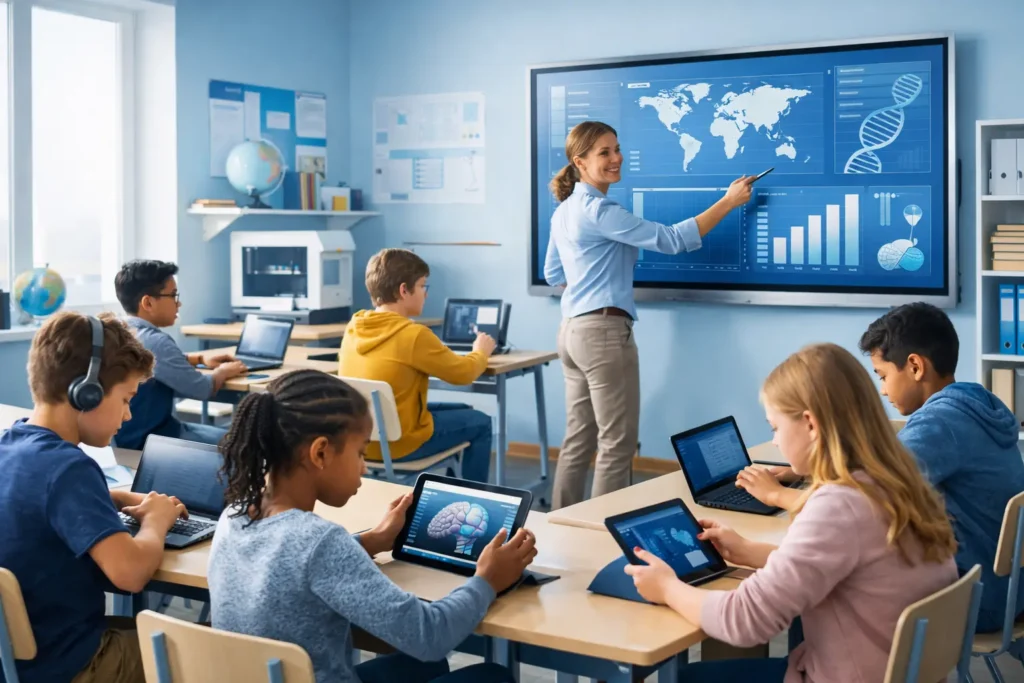
The global EdTech market is projected to surpass $400 billion by 2028, a figure that underscores just how fundamentally technology is reshaping learning at every level. From a child practising maths on a tablet in rural Kenya to a postgraduate student attending a virtual reality lecture from their living room, technology is rewriting the rules of what education can look, feel, and reach.
Yet for all its promise, technology in education is not a magic solution. It raises serious questions about equity, ethics, and the enduring role of human teachers. This guide offers a holistic view of the field, examining what educational technology actually is, the genuine benefits it can deliver, the challenges that must be overcome, the ethical responsibilities that accompany its adoption, and the trends that will define its future. Whether you are an educator, a school leader, a policymaker, or simply a curious learner, this resource is designed to give you the complete picture.
What is Technology in Education?
A Simple Definition
Educational technology, commonly abbreviated to EdTech, refers to the integration of digital tools, resources, and systems into the learning and teaching process to improve educational outcomes. The term encompasses a vast spectrum of applications: a primary school teacher projecting an interactive lesson on a smart board, a university delivering courses through an online learning management system, or a corporate training department using AI-powered simulations to upskill employees. At its heart, EdTech is not about technology for its own sake; it is about using technology purposefully to make learning more effective, accessible, and engaging.
Information and Communication Technology (ICT) in education is a closely related concept, often used in government and international policy contexts, that refers broadly to the use of computers, the internet, and telecommunications tools within educational systems. ICT tends to focus on infrastructure and access, while EdTech has a wider scope that includes pedagogy, learning design, and outcomes.
Key Components of EdTech
Educational technology rests on three interconnected pillars. The first is hardware: the physical devices through which learning takes place. These include laptops, desktop computers, tablets, smartphones, interactive whiteboards, and, increasingly, virtual reality headsets and robotics kits. The second pillar is software: the digital applications that deliver, manage, and assess learning. This category includes learning management systems (LMS) like Moodle, Canvas, and Google Classroom; e-learning platforms like Coursera and Khan Academy; productivity suites; and specialist apps for everything from coding to creative writing. The third pillar, and arguably the most important, is pedagogy: the teaching approaches and learning strategies that determine how hardware and software are used in practice. Technology without sound pedagogy is simply expensive equipment. The most successful EdTech implementations align tools carefully with clear learning objectives and evidence-based teaching methods.
The Most Important Benefits of Technology in Education
Enhanced Engagement and Personalisation
One of the most transformative capabilities of modern EdTech is the ability to tailor learning to the individual. Traditional classroom instruction necessarily pitches content at the middle of the class, inadvertently leaving both struggling students and advanced learners under-served. AI-driven adaptive learning platforms address this directly. Systems such as Squirrel AI analyse each student’s responses in real time, identify knowledge gaps, and adjust the difficulty and type of content accordingly. The result is a genuinely personalised learning path that responds to how a student is actually progressing rather than where a curriculum assumes they should be.
Gamification adds another layer of engagement, applying game design principles such as points, badges, leaderboards, and narrative challenges to learning tasks. Platforms like Duolingo have demonstrated that gamification can turn what might otherwise feel like a chore, practising a foreign language daily, into a habit millions of people maintain voluntarily. When students are intrinsically motivated to engage, learning outcomes tend to improve substantially.
Unprecedented Access and Flexibility
Technology has the potential to democratise education in ways that were unimaginable a generation ago. Massive Open Online Courses (MOOCs) offered by platforms such as Coursera, edX, and FutureLearn make world-class instruction from leading universities available to anyone with an internet connection, often free of charge. A learner in a remote village who lacks access to specialist teachers can study advanced mathematics, computer science, or philosophy through their smartphone.
Flexibility is equally valuable. Asynchronous learning, where students engage with pre-recorded lectures and materials at a time of their choosing, removes the rigid structure that excludes many adult learners who are balancing education with work and family responsibilities. For students with disabilities, technology offers assistive tools, such as screen readers, speech-to-text software, and captioning, that make learning environments far more inclusive than they have historically been.
Preparing Students for the Future Workforce
The World Economic Forum consistently identifies digital literacy as one of the most critical skills for the 21st-century economy, and technology integration in education is the primary means of developing it. When students learn to code, work collaboratively on cloud-based documents, analyse data in spreadsheets, or build and test digital projects, they are not just learning specific tools; they are cultivating computational thinking, problem-solving discipline, and an adaptive mindset that is transferable across many careers.
STEM education in particular benefits enormously from technology. Physics simulations allow students to conduct experiments that would be impossible or dangerous in a real laboratory. Coding platforms like Scratch introduce computational logic to young children in a playful, visual way. Robotics kits make engineering principles tangible and hands-on. These experiences build the technical confidence and creative capability that employers across every sector increasingly demand.
Fostering Global Collaboration
Technology dissolves geographical boundaries, enabling students in different countries to collaborate on shared projects, exchange perspectives, and develop genuine cross-cultural understanding. Programmes like eTwinning in Europe connect classrooms across the continent, while tools like Zoom, Google Meet, and collaborative platforms like Padlet and Miro make it easy for groups of students to work together in real time regardless of where they are located. This kind of global collaboration is not merely an add-on to learning; it develops communication skills, empathy, and the ability to work effectively in diverse teams, competencies that are essential in an interconnected world.
Empowering Educators
It is important to recognise that technology is not only transforming the experience of learners; it is also a powerful resource for teachers. Learning analytics tools give educators rich data about how their students are engaging with content, which concepts are causing difficulty across the class, and which students may need additional support before problems escalate. Rather than waiting for an end-of-term examination to discover that a student has fallen behind, a teacher using an analytics-enabled LMS can intervene early and precisely.
Technology also opens up new possibilities for professional development. Online communities of practice, webinars, and digital teaching resources allow educators to learn from peers around the world, share lesson plans and ideas, and stay current with new pedagogical approaches, often without needing to travel or take extended leave.
Overcoming the Challenges of Technology in Education
Bridging the Digital Divide
The most fundamental challenge facing EdTech is also the most uncomfortable: technology in education risks widening rather than narrowing existing inequalities if access is not equitable. The digital divide refers to the gap between those who have reliable access to the internet and suitable devices and those who do not. This divide operates along multiple fault lines: between wealthy and low-income households, between urban and rural communities, between high-income and low-income countries, and between different demographic groups within a single society.
The COVID-19 pandemic made this divide starkly visible. When schools shifted to remote learning overnight, millions of students globally could not participate because they lacked a device, a stable internet connection, or both. Addressing the digital divide requires sustained investment in infrastructure, subsidised device programmes, and public internet access points. Governments, international organisations like UNESCO and UNICEF, and the private sector all have roles to play. Without deliberate action on connectivity and access, the EdTech revolution will bypass exactly the communities that stand to benefit from it most.
Investing in Teacher Training
Technology alone does not improve learning. A classroom full of tablets managed by a teacher who has received no training in how to integrate them into effective pedagogy is unlikely to produce better outcomes than a classroom with no tablets at all. Teacher training is consistently identified as one of the most critical success factors in EdTech implementation, and one of the most frequently underfunded.
Effective professional development for educators goes beyond basic technical training. It must address how to select the right tools for specific learning objectives, how to manage a digitally enabled classroom, how to interpret learning analytics, and how to maintain student wellbeing in a screen-heavy environment. Ongoing, embedded support, rather than a single introductory workshop, is what tends to produce lasting change in teaching practice.
Managing Distraction and Screen Time
The same devices that give students access to rich educational resources also give them access to social media, games, and an endless stream of entertainment. Managing digital distraction is a genuine challenge, particularly for younger students who are still developing self-regulation skills. Research suggests that heavy recreational screen time is associated with reduced sleep quality, attention difficulties, and lower wellbeing in children and adolescents, though the picture is complex and depends significantly on what kind of screen use is involved and in what context.
Schools can address this through clear policies on device use, the deployment of filtering and monitoring tools, and most importantly by developing students’ own digital wellness awareness. Teaching young people to understand and manage their relationship with technology is itself a crucial 21st-century skill, and one that purely reactive or restrictive approaches are unlikely to cultivate effectively.
Updating Outdated Curricula and Securing Adequate Funding
Technology integration cannot succeed within a curriculum framework designed for a pre-digital world. Many national education systems are still built around subject structures, assessment methods, and skill sets that do not reflect the realities of contemporary life and work. India’s National Education Policy 2020 represents a significant attempt to address this, embedding digital literacy, coding, and vocational skills into the national framework from an early stage.
Budget constraints are a persistent barrier, particularly for state-funded schools in low-income areas. Hardware becomes obsolete, software licences require annual renewal, and infrastructure demands ongoing maintenance. Schools that invest in technology without a sustainable funding plan often find themselves managing an ageing, unreliable digital environment that creates more problems than it solves. Strategic planning, including lifecycle costing and collaboration with local authorities and donors, is essential for long-term success.
Critical Considerations: Ethics, Safety, and Rights in EdTech
Data Privacy and Cybersecurity
Educational technology generates enormous volumes of sensitive data: academic performance records, behavioural patterns, communications between students and teachers, health and accessibility information, and more. This data is extraordinarily valuable, and consequently an attractive target for malicious actors. Schools and EdTech providers have a legal and ethical duty to protect it rigorously.
Best practice in EdTech data security includes end-to-end encryption of sensitive communications, multi-factor authentication for staff and student accounts, regular security audits, and robust data retention and deletion policies. Compliance with relevant legal frameworks, such as the General Data Protection Regulation (GDPR) in Europe or the Children’s Online Privacy Protection Act (COPPA) in the United States, is a minimum requirement, not an aspiration. Parents should be clearly informed about what data is collected, how it is stored, who has access to it, and how long it is retained.
The Ethics of AI in the Classroom
As AI-powered tools become more prevalent in education, new ethical challenges arise that require careful attention. Algorithmic bias is among the most serious: if an AI system is trained on historical data that reflects existing inequalities, it may perpetuate or even amplify those inequalities in its recommendations. An AI assessment tool trained predominantly on data from one demographic group may perform significantly less well for students from different backgrounds, disadvantaging already-marginalised groups.
Transparency is equally important. Students and teachers should understand, in accessible terms, how AI tools are making decisions about learning pathways, assessments, or flags for additional support. Opaque systems that make consequential decisions without explanation undermine trust and remove the ability of educators to exercise professional judgement. Human oversight must remain central: AI should augment the teacher’s role, not replace the human relationships and contextual understanding that lie at the heart of good education.
Technology as a Tool for the Right to Education
Access to education is a fundamental human right, enshrined in Article 26 of the Universal Declaration of Human Rights and reinforced by international frameworks including the UN Sustainable Development Goals. Technology has genuine potential to extend this right to communities and individuals who have historically been excluded, including people with disabilities, girls and women in regions where cultural barriers limit access, children in conflict zones and humanitarian emergencies, and learners in remote and under-resourced communities.
However, this potential is only realised when EdTech is implemented with equity explicitly at its centre. Technology that is expensive, inaccessible to people with disabilities, available only in dominant languages, or dependent on infrastructure that only privileged communities possess, does not advance the right to education. It narrows it. Policymakers, educators, and technology developers must evaluate EdTech not only by its technical capabilities but by whether it genuinely broadens access and inclusion for those who need it most.
Major Trends Shaping the Future of Education Technology
AI-Driven Personalisation and Content Creation
Artificial intelligence is arguably the most consequential technology now entering the classroom. Beyond the adaptive learning platforms already discussed, generative AI tools are beginning to transform how educational content is created, delivered, and assessed. AI can generate customised practice questions, provide instant formative feedback on student writing, translate content into multiple languages, and create differentiated versions of the same material for learners at different levels. For educators, AI-powered tools can reduce the time spent on routine administrative tasks, freeing them for the higher-value human work of mentoring, facilitating discussion, and building relationships.
The pace of development in this area is rapid and the implications are still unfolding. Questions about academic integrity, appropriate use of generative AI in assessed work, and the evolving role of the teacher in an AI-assisted classroom are live debates in education systems around the world. What is clear is that ignoring AI is not a viable option for schools and institutions that want to prepare students for a world in which it is ubiquitous.
Immersive Learning with VR and AR
Virtual reality (VR) and augmented reality (AR) offer something that no textbook or video can replicate: the experience of being somewhere or doing something. A history student can walk through ancient Rome. A medical student can practise a surgical procedure in a risk-free virtual environment before ever approaching a real patient. An engineering apprentice can disassemble and reassemble complex machinery in augmented reality overlay before working on the real thing.
The cost of VR headsets has fallen dramatically in recent years, and platforms designed specifically for education, such as Immersive VR Education’s Engage and Google Expeditions, have made immersive content more accessible to schools. While VR and AR remain out of reach for many institutions, particularly in lower-income settings, the trajectory is toward broader accessibility, and the pedagogical potential for experiential, contextualised learning is substantial.
The Rise of Micro-credentials and Blockchain Credentialing
The traditional model of education, in which qualifications are awarded after multi-year programmes and recorded on paper certificates, is being supplemented by a more granular and flexible approach. Micro-credentials are short, focused certifications that demonstrate competency in a specific skill or knowledge area. Digital badges, which can be shared on professional profiles like LinkedIn, make these credentials visible and portable in ways that paper qualifications are not.
Blockchain technology is emerging as a mechanism for making credentials tamper-proof and easily verifiable by employers, eliminating the possibility of fraudulent qualifications. Institutions including MIT and the Open University have already issued blockchain-verified digital diplomas. As employers increasingly value demonstrated skills over formal degrees, micro-credentials and blockchain credentialing are likely to play an ever-larger role in the education and employment landscape.
The Mainstreaming of Hybrid Learning Models
The COVID-19 pandemic accelerated the adoption of online and blended learning to a degree that would have taken many years under normal circumstances. While the emergency conditions of pandemic-era remote learning were often difficult and far from optimal, they demonstrated that a great deal of valuable learning can happen outside a physical classroom. The result has been a widespread shift towards hybrid or blended learning models that combine face-to-face instruction with online components.
Done well, blended learning offers real benefits: it allows students to revisit recorded content at their own pace, frees classroom time for discussion, collaboration, and application rather than passive content delivery, and provides flexibility for students with diverse needs and circumstances. Effective blended learning design, however, requires significant investment in curriculum development and teacher training. The technology is a means to an end; the pedagogy determines whether it works.
The Power of Learning Analytics
Learning analytics, the measurement, collection, analysis, and reporting of data about learners and their contexts, is giving educators and institutions an unprecedented window into how learning actually happens. Rather than relying solely on summative assessments, teachers can now track engagement in real time, identify students who are disengaging early, and adapt their approach based on evidence rather than intuition.
At a system level, learning analytics can identify patterns across schools and districts, informing curriculum development, resource allocation, and policy decisions. Adaptive teaching, in which instructional approaches are continuously adjusted based on data, represents one of the most promising frontiers in evidence-based education. The challenge is ensuring that the data is used to support rather than surveil students, and that its interpretation remains in the hands of skilled, reflective educators.
FAQS
What is the role of technology in modern education?
Technology in modern education serves multiple functions: it delivers and manages learning content through platforms and apps, enables personalised and adaptive learning pathways, connects learners and educators across geographical boundaries, and provides data to support teaching decisions. At its best, it extends access to quality education and enhances outcomes; at its worst, it can create new inequalities if implemented without attention to equity and pedagogy.
How does technology improve student engagement?
Technology improves engagement through interactivity, personalisation, and gamification. Interactive simulations, collaborative digital tools, and adaptive platforms respond to students in ways that static textbooks cannot. Gamified learning elements, such as progress tracking and rewards, can sustain motivation over time. The key is purposeful design: engagement-enhancing technology should be chosen to serve specific learning objectives, not adopted simply because it is novel.
What are the main disadvantages of using technology in the classroom?
The main disadvantages include the risk of digital distraction, potential negative effects of excessive screen time on wellbeing, the cost and maintenance burden of hardware and software, the possibility of widening inequalities if access is not equitable, cybersecurity and data privacy risks, and the danger of deprioritising human interaction and physical activity. These disadvantages are real but manageable with thoughtful implementation, clear policies, and sustained investment in teacher training.
What is the digital divide, and how does it affect education?
The digital divide refers to the gap between those who have reliable access to internet connectivity and digital devices and those who do not. In education, it means that students without home internet or a suitable device are excluded from online learning, placing them at a significant disadvantage compared to peers with full digital access. The divide intersects with income, geography, disability, and other dimensions of inequality. Addressing it requires coordinated investment in infrastructure, devices, and connectivity support.
How is artificial intelligence used in education?
AI is used in education for adaptive learning (adjusting content difficulty based on student performance), intelligent tutoring systems that provide personalised feedback, administrative automation (scheduling, grading routine assessments), learning analytics, language translation, accessibility tools such as real-time captioning, and, increasingly, generative AI tools that can create customised learning materials. Ethical implementation requires transparency, human oversight, and active attention to algorithmic bias.
What are micro-credentials and digital badges?
Micro-credentials are short, focused certifications that validate competency in a specific skill or knowledge area. They are typically shorter than traditional degrees or diplomas and are designed to be completed online, often at the learner’s own pace. Digital badges are visual representations of these achievements that can be shared on professional profiles and verified online. Blockchain technology is increasingly used to make these credentials tamper-proof and universally verifiable.
How can teachers protect student data privacy?
Teachers and school leaders can protect student data by choosing EdTech platforms that comply with relevant data protection regulations (such as GDPR or COPPA), using strong password policies and multi-factor authentication, limiting data collection to what is strictly necessary, ensuring students and parents understand what data is collected and why, and regularly reviewing the data practices of third-party providers. Data privacy should be treated as a non-negotiable element of any EdTech procurement decision, not an afterthought.
What is blended learning, and why is it effective?
Blended learning combines face-to-face instruction with online learning components. Students might attend in-person classes for discussion, collaboration, and hands-on activities, while engaging with recorded lectures, readings, and practice activities online. It is effective because it offers the flexibility of online learning alongside the relational and interactive benefits of in-person teaching. It also allows class time to be reserved for higher-order learning activities rather than passive content delivery.
What are the latest trends in educational technology?
The leading trends in EdTech currently include AI-driven personalisation and generative AI tools for content creation, immersive learning through virtual and augmented reality, the growth of micro-credentials and blockchain-verified digital qualifications, the consolidation of hybrid and blended learning models, and the increasing sophistication of learning analytics platforms. Cybersecurity and data privacy have also become critical concerns as digital systems become more central to education.
How can schools in low-income countries implement education technology?
Implementation in resource-constrained environments requires prioritising low-bandwidth solutions (offline-capable apps, downloadable content), solar-powered or low-energy devices, open-source software to reduce licensing costs, and community-based device-sharing models. Partnerships with NGOs, government programmes, and international bodies such as UNICEF and UNESCO can provide funding, infrastructure support, and technical expertise. Teacher training is especially critical in contexts where professional development opportunities are limited. Above all, implementation should begin with the specific needs and circumstances of the community, not with the technology.
Conclusion: Embracing a Balanced Technological Future in Education
Technology is a powerful tool for education. It can personalise learning, extend access to communities that have historically been excluded, prepare students for a digital economy, and give educators new ways to understand and support their students. The trends shaping its future, from artificial intelligence and immersive learning to micro-credentials and learning analytics, suggest that its role will only deepen in the years ahead.
But technology is not a solution in itself. Its impact depends entirely on how it is implemented: whether teachers are supported to use it effectively, whether equity is placed at the centre of decision-making, whether the ethical dimensions of data and AI are taken seriously, and whether the human relationships that lie at the heart of good education are protected rather than eroded.
The most successful EdTech initiatives are those that start with clear learning goals, invest in teachers as much as in tools, design explicitly for inclusion and accessibility, and maintain a clear-eyed view of both the potential and the limitations of technology. Schools and institutions that approach technology with that kind of thoughtfulness, rather than chasing every new innovation for its own sake, are the ones most likely to harness it for genuine, lasting educational benefit.

Adrian Cole is a technology researcher and AI content specialist with more than seven years of experience studying automation, machine learning models, and digital innovation. He has worked with multiple tech startups as a consultant, helping them adopt smarter tools and build data-driven systems. Adrian writes simple, clear, and practical explanations of complex tech topics so readers can easily understand the future of AI.