
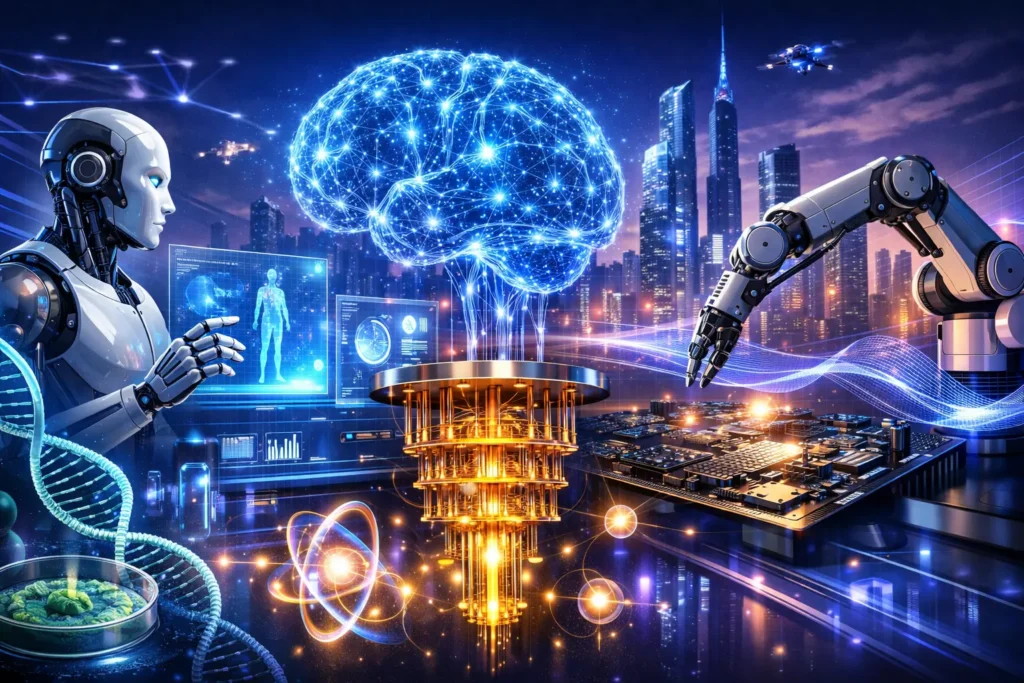
We live in an era of unprecedented technological change. Emerging technologies—those innovative, cutting-edge tools and systems that are rapidly evolving from research labs into real-world applications—are reshaping every aspect of human life. From artificial intelligence that can write, design, and diagnose to quantum computers that promise to solve previously impossible problems, these transformative technologies are not just changing how we work and live; they’re redefining what’s possible.
But what exactly qualifies as an “emerging technology”? How do we distinguish genuine innovation from hype? And most importantly, how can individuals, businesses, and governments prepare for a future that’s arriving faster than ever? This comprehensive guide explores the landscape of emerging technologies in 2026, examining their characteristics, applications, challenges, and implications for our collective future.
Defining an “Emerging Technologies”: Key Characteristics
The term “emerging technology” is often used loosely, but scholars and policy analysts have identified specific characteristics that define this category. An emerging technology isn’t simply “new”—it represents a fundamental shift in capability, application, or understanding. These technologies typically exhibit several defining traits that set them apart from incremental improvements.
Radical Novelty and Relatively Fast Growth
Emerging technologies are characterized by radical novelty—they represent genuinely new approaches or capabilities rather than incremental refinements of existing solutions. This novelty often comes from fundamental breakthroughs in research and development, whether in materials science, computer science, biotechnology, or other fields.
Equally important is the pace of development. Emerging technologies grow relatively fast compared to traditional innovation cycles. What might have taken decades to move from laboratory concept to commercial application in the 20th century can now happen in just a few years. This acceleration is driven by factors including increased R&D investment, global collaboration networks, advanced simulation tools, and the compounding effects of previous technological advances.
Consider CRISPR gene editing technology: discovered in bacteria in 2012, by 2020 it had earned its developers the Nobel Prize and was being used in human clinical trials. Or look at large language models like GPT—the technology went from research curiosity to mainstream business tool in less than five years.
Coherence and Prominent Impact
Emerging technologies demonstrate coherence—they consist of interrelated components that work together as a system. This coherence often leads to technological convergence, where multiple emerging technologies combine to create entirely new capabilities. For instance, autonomous vehicles require the convergence of artificial intelligence, computer vision, edge computing, 5G networks, and advanced sensor technology.
The prominent impact characteristic means these technologies have the potential to create substantial changes across industries, societies, or scientific domains. They’re not niche solutions but transformative forces that can disrupt entire sectors. Machine learning algorithms are now used everywhere from healthcare diagnostics to financial fraud detection to climate modeling. Blockchain technology has implications for banking, supply chain management, digital identity, and governance.
Disruptive technology is a related concept—these are innovations that create entirely new markets or value networks, eventually displacing established competitors. Not all emerging technologies are disruptive, but many have this potential. The smartphone disrupted cameras, GPS devices, music players, and countless other standalone products by converging their functions.
Uncertainty, Ambiguity, and Risk
Perhaps the most defining characteristic of emerging technologies is the uncertainty and ambiguity surrounding their ultimate trajectory and impact. When a technology is truly emerging, we cannot fully predict how it will develop, how society will adopt it, or what its second- and third-order effects will be.
This uncertainty brings inherent risks. These include technical risks (will the technology actually work at scale?), economic risks (will it be cost-effective?), social risks (how will it affect employment, inequality, and social structures?), and ethical risks (does it raise moral concerns about privacy, autonomy, or human dignity?).
The ethical debates surrounding emerging technologies are particularly intense. Artificial intelligence raises questions about algorithmic bias, surveillance, and the nature of intelligence itself. Genetic engineering forces us to confront our power to alter human heredity. Autonomous weapons systems challenge fundamental principles of warfare and accountability. Some thinkers even warn of existential risks—scenarios where advanced technologies could pose threats to human civilization itself.
Security and privacy concerns are paramount. As technologies become more powerful and interconnected, the potential for misuse grows. Deepfake technology can create convincing false videos. Quantum computers could break current encryption methods. The Internet of Things creates millions of potential entry points for cyberattacks.
The Top Emerging Technologies to Watch in 2026
Emerging technologies can be overwhelming in their diversity and complexity. To make sense of this landscape, it’s helpful to organize them by their primary function—what they fundamentally do. Here are the most impactful technologies shaping our future, grouped into five functional categories.
Technologies that Think: AI and Its Offspring
Artificial intelligence represents perhaps the most transformative category of emerging technology. AI encompasses systems that can perform tasks typically requiring human intelligence—learning from experience, understanding language, recognizing patterns, and making decisions.
Key technologies in this category:
- Machine Learning (ML): Algorithms that improve through experience without explicit programming. From recommendation systems to fraud detection, ML is everywhere.
- Deep Learning: Neural networks with multiple layers that can discover intricate patterns in massive datasets. Powers image recognition, speech synthesis, and much more.
- Natural Language Processing (NLP): Enables computers to understand, interpret, and generate human language. Large language models can now write, summarize, translate, and even reason about text.
- Computer Vision: Allows machines to derive meaning from visual inputs. Used in medical imaging, autonomous vehicles, quality control, and facial recognition.
- Predictive Analytics: Uses historical data and machine learning to forecast future outcomes. Applications span from weather prediction to demand forecasting to disease outbreak modeling.
The rapid advancement of AI, particularly generative AI, has captured global attention. These systems can now create text, images, music, video, and code that are often indistinguishable from human-created content. This capability has profound implications for creativity, work, education, and even our concept of human uniqueness.
Technologies that Connect: The Invisible Infrastructure
While AI grabs headlines, equally important are the technologies creating the connective tissue of our digital world. These systems enable communication, data exchange, and coordination at unprecedented scales.
Key technologies in this category:
- Internet of Things (IoT): Networks of physical devices embedded with sensors, software, and connectivity. Smart homes, industrial IoT, wearable health monitors, and smart cities all depend on IoT infrastructure.
- 5G and Advanced Networks: Fifth-generation cellular networks provide dramatically faster speeds, lower latency, and the capacity to connect millions of devices simultaneously. Essential for autonomous vehicles, remote surgery, and real-time industrial applications.
- Edge Computing: Processing data near its source rather than in centralized data centers. Reduces latency, saves bandwidth, and enables real-time applications. Critical for autonomous systems that can’t afford delays.
- Blockchain and Distributed Ledger Technology: Decentralized systems for recording transactions without a central authority. Beyond cryptocurrency, blockchain is being explored for supply chain tracking, digital identity, voting systems, and more.
These connecting technologies often work together. IoT devices generate massive amounts of data that edge computing processes locally, with critical information moving over 5G networks to cloud systems, where blockchain may provide trust and transparency. This technological convergence creates capabilities that none of these systems could achieve alone.
Technologies that Build: The Physical-Digital Bridge
As digital technologies advance, we’re also seeing revolutionary changes in how we create physical objects and interact with the physical world.
Key technologies in this category:
- Robotics: Autonomous and semi-autonomous machines that can perform physical tasks. Industrial robots have evolved from simple repetitive tasks to complex assembly and even collaborative work alongside humans. Service robots are entering healthcare, hospitality, and homes.
- 3D Printing and Additive Manufacturing: Building objects layer by layer from digital designs. Now extends beyond plastics to metals, ceramics, biological materials, and even food. Enables rapid prototyping, custom medical implants, on-demand spare parts, and potentially affordable housing.
- Extended Reality (XR): Encompasses Augmented Reality (AR), Virtual Reality (VR), and Mixed Reality (MR). AR overlays digital information on the real world; VR creates fully immersive digital environments; MR combines both. Applications range from entertainment and training to remote collaboration and medical procedures.
These technologies blur the boundary between digital and physical. A surgeon can practice a procedure in VR, guided by AI analysis of patient scans, then perform the actual surgery using robotic tools. A manufacturer can design a part using AI optimization, test it in virtual reality, and produce it with 3D printing—all in a fraction of the time traditional methods required.
Technologies that Cure: The Bio-Revolution
Perhaps no field holds more promise—or raises more profound questions—than emerging biotechnologies. These tools give us unprecedented power to understand and modify living systems.
Key technologies in this category:
- Gene Therapy: Treating diseases by modifying genes. CRISPR and other gene-editing tools can now correct genetic defects, potentially curing hereditary diseases. The first gene therapies have been approved for conditions like sickle cell disease and certain cancers.
- Stem Cell Therapy: Using stem cells to repair or replace damaged tissue. Shows promise for treating injuries, degenerative diseases, and potentially even aging itself.
- Cancer Vaccines and Immunotherapies: Training the immune system to recognize and attack cancer cells. CAR-T therapy and mRNA cancer vaccines represent fundamentally new approaches to treating this disease.
- Nanotechnology and Targeted Drug Delivery: Engineered particles at the molecular scale can deliver drugs precisely to diseased cells, reducing side effects and improving efficacy. Nanomedicine is also enabling new diagnostic tools and biosensors.
- Cultured Meat and Cellular Agriculture: Growing meat, dairy, and other animal products directly from cells, without raising and slaughtering animals. Promises to address environmental, ethical, and food security challenges.
These biotechnologies intersect with AI (for protein folding prediction and drug discovery), nanotechnology (for delivery mechanisms), and advanced manufacturing (for lab-grown tissues). They offer hope for eliminating diseases that have plagued humanity for millennia, but also raise questions about equity, access, and the boundaries of what we should modify.
Technologies that Compute: The Next Frontier
Finally, we’re seeing the emergence of entirely new computing paradigms that could unlock problems currently beyond our reach.
Quantum Computing: Uses quantum mechanical phenomena—superposition and entanglement—to process information in fundamentally different ways than classical computers. Quantum computers excel at certain types of problems: simulating molecular behavior for drug discovery, optimizing complex logistics, breaking current encryption methods, and potentially accelerating machine learning.
While still largely experimental, quantum computing has reached important milestones. Several companies and research institutions now operate quantum computers with dozens to hundreds of quantum bits (qubits). We’re in what experts call the “NISQ” era—Noisy Intermediate-Scale Quantum computing—where systems are powerful enough to be useful but not yet reliable enough for most practical applications.
The race for quantum advantage—demonstrating a quantum computer solving a useful problem faster than any classical computer—is intensifying. Success could revolutionize fields from materials science to cryptography to artificial intelligence itself.
From Lab to Life: The Path of an Emerging Technology
Understanding emerging technologies requires more than knowing what they are. We must also understand the journey from scientific breakthrough to widespread adoption. This path is rarely straightforward and involves distinct phases, each with its own challenges and stakeholders.
The Role of Research and Development (R&D)
Every emerging technology begins with fundamental research—curiosity-driven investigation into how nature works or what might be possible. Researchers at universities, government laboratories like DARPA, and corporate research centers explore new ideas, often without immediate applications in mind.
This basic research gradually transitions into applied research and development, where scientists and engineers work to turn discoveries into functional prototypes. This phase requires significant investment, technical expertise, and patience. Many promising technologies fail here—they prove too expensive, unreliable, or impractical for real-world use.
Computer scientists, technologists, and specialized researchers drive this phase. Their work is supported by funding from governments, venture capital, corporations, and increasingly, a global network of collaborators sharing data and methods. The pace of R&D has accelerated dramatically thanks to simulation tools, machine learning for experimental design, and open science practices.
As technologies move toward practical application, they encounter regulatory frameworks designed to ensure safety, efficacy, and ethical use. This phase is particularly critical for technologies affecting health, safety, or public infrastructure.
The U.S. Food and Drug Administration (FDA) provides an excellent case study through its Emerging Technology Program (ETP). Recognizing that traditional regulatory approaches might not fit novel technologies, the FDA created the ETP to provide manufacturers with a voluntary, collaborative pathway for innovative manufacturing methods. The program offers enhanced communication, dedicated staff, and inspection expertise for technologies like 3D printing of medical devices, continuous pharmaceutical manufacturing, and advanced data analytics.
This model of adaptive regulation is being replicated globally. Standards organizations develop technical specifications, governments create policy frameworks, and industry groups establish best practices. The goal is to enable innovation while protecting public welfare—a delicate balance that requires ongoing dialogue between regulators, technologists, and stakeholders.
International organizations also play crucial roles. NATO, for instance, coordinates among member nations on defense-related emerging technologies, addressing questions of security, interoperability, and ethical constraints on autonomous weapons. Governance of emerging technologies is inherently global—technologies cross borders faster than regulations can keep up.
Commercialization and Industry Adoption
The final phase is commercialization—bringing the technology to market and achieving widespread adoption. This requires more than technical success; it demands business models, supply chains, trained workforces, and customer acceptance.
Businesses adopt emerging technologies seeking competitive advantage. AI provides insights from data, IoT optimizes operations, blockchain improves supply chain transparency, and robotics increases efficiency. Companies that successfully implement these technologies can differentiate themselves, reduce costs, and create new revenue streams.
However, implementation is challenging. It requires significant investment, organizational change, and often new skills. Many emerging technologies are initially expensive and unreliable. Early adopters take on substantial risk, but successful implementation can yield enormous returns.
A robust ecosystem of services and solutions has emerged to help businesses navigate this journey. Consultants, system integrators, training providers, and specialized vendors offer implementation support. As technologies mature and standardize, they become more accessible to smaller organizations, eventually “graduating” from “emerging” to “mainstream.”
The Dual-Edged Sword: Opportunities and Challenges
Emerging technologies are neither inherently good nor bad—they are tools that can be used for various purposes with various consequences. Understanding both their promise and their perils is essential for making wise decisions about development, deployment, and governance.
The Promise: Solving Humanity’s Greatest Challenges
Proponents of emerging technologies point to their potential to address problems that have long seemed intractable. Consider:
- Healthcare: AI-powered diagnostics can detect diseases earlier and more accurately than human doctors in some cases. Gene therapy offers potential cures for hereditary diseases. Telemedicine and remote monitoring expand access to care. Personalized medicine tailors treatments to individual genetics.
- Climate and Environment: Clean energy technologies, optimized through AI, could decarbonize our economy. Precision agriculture reduces water and chemical use. Lab-grown meat could dramatically reduce the environmental impact of food production. Advanced materials and manufacturing reduce waste.
- Poverty and Development: Mobile technology and blockchain could bank the unbanked. AI tutors could provide quality education to anyone with internet access. Automation could reduce the cost of goods and services. Renewable energy could bring power to remote areas.
- Human Capability: Extended reality can provide immersive education and training. Brain-computer interfaces might restore function to paralyzed individuals. AI assistants could augment human creativity and productivity. These technologies might help us eliminate suffering and enhance human flourishing.
The efficiency and optimization gains alone are staggering. Businesses using advanced analytics make better decisions. Smart cities reduce congestion and energy use. Predictive maintenance prevents equipment failures. The economic value created by these technologies is measured in trillions of dollars.
The Peril: Ethical Dilemmas and Societal Risks
Yet these same technologies raise profound concerns:
- Employment and Inequality: Automation and AI threaten millions of jobs, particularly those involving routine tasks. While new jobs will be created, the transition could be painful and unequal. Those with skills to work alongside AI may thrive; others may face unemployment or wage stagnation. Without intervention, emerging technologies could exacerbate inequality rather than reduce it.
- Privacy and Surveillance: IoT devices, facial recognition, and data analytics enable unprecedented surveillance. Governments and corporations can track individuals’ movements, communications, purchases, and behaviors. The trade-off between convenience and privacy is rarely explicit or fully understood by users.
- Security and Misuse: Powerful technologies can be weaponized. Autonomous drones could be used for assassination. AI can generate convincing misinformation. Biotechnology could create dangerous pathogens. Quantum computers might break encryption protecting sensitive data. Cybersecurity becomes more critical and more difficult as systems grow complex.
- Ethical Boundaries: Gene editing raises questions about designer babies and human enhancement. AI decision-making in criminal justice, lending, or hiring may perpetuate bias. Who is accountable when an autonomous vehicle causes harm? How much should we modify human biology? The ethical debates are intense and unresolved.
- Existential Risks: Some thinkers warn that advanced AI could pose existential risks to humanity if not developed carefully. A superintelligent system with goals misaligned with human welfare could be catastrophic. While opinions differ on the likelihood of such scenarios, the stakes are high enough to warrant serious consideration.
These challenges are not merely technical—they require philosophical, political, and social solutions. Transparency, accountability, and trust must be built into technological systems. Safety assessment and quality assurance processes must evolve. We need frameworks for navigating ambiguity when we cannot fully predict consequences.
Future-Proofing Your Career and Business
Understanding emerging technologies intellectually is one thing; preparing practically for their impact is another. Whether you’re an individual planning your career or a business leader strategizing for the future, certain principles can help you navigate technological change.
Essential Skills for the Next Decade
The job market is shifting toward roles that either work with emerging technologies or do things machines cannot easily replicate. Key skills include:
- Technical Literacy: You don’t need to be a programmer, but understanding how AI, data systems, and algorithms work is increasingly essential. Data science, machine learning engineering, and software development skills are in high demand.
- Data Fluency: The ability to work with data—collecting, cleaning, analyzing, visualizing, and drawing insights—is valuable across virtually all fields. Statistics and data analytics are foundational.
- Interdisciplinary Thinking: Emerging technologies require combining expertise from multiple domains. Understanding both technology and specific applications (healthcare, finance, manufacturing) creates unique value.
- Adaptive Learning: The half-life of technical skills is shrinking. The ability to learn continuously, unlearn outdated approaches, and master new tools is perhaps the most important meta-skill.
- Human Skills: Creativity, emotional intelligence, ethical judgment, and complex communication remain distinctively human. As machines handle more routine cognitive work, these capabilities become more valuable.
Many universities now offer computer science programs with specializations in AI, cybersecurity, bioinformatics, and other emerging technology fields. Online education platforms provide accessible training. The key is to start developing expertise now rather than waiting for disruption.
How Businesses Can Prepare for Technological Disruption
For organizations, preparing for emerging technologies requires both strategic vision and practical action:
- Scan and Assess: Systematically monitor technological developments relevant to your industry. Assess which emerging technologies could disrupt your business model or create opportunities. Don’t just follow competitors—look for innovations from adjacent sectors.
- Experiment and Pilot: Run small-scale pilots to test technologies before full deployment. Learn through experimentation. Accept that some initiatives will fail—the goal is organizational learning and capability building.
- Invest in Talent: Hire people with emerging technology expertise or upskill existing workforce. Create partnerships with universities and research institutions. Sometimes acquiring startups is the fastest way to gain capabilities.
- Build Infrastructure: Modern technologies require modern infrastructure—cloud computing, data systems, APIs, and security. Technical debt is a strategic liability. Digital transformation isn’t just about new tools; it’s about rewiring your organization.
- Think Ecosystems: No organization can master every emerging technology alone. Build partnerships, join industry consortia, and engage with the broader innovation ecosystem. Competitive advantage increasingly comes from network position, not just internal capability.
The businesses that thrive won’t necessarily be those with the most advanced technology, but those that can integrate technology into superior value propositions and business models. Technology is a means, not an end.
FAQS
What is the simple definition of an emerging technology?
An emerging technology is an innovation that is in early stages of development or adoption but shows potential for significant impact. It is characterized by radical novelty, relatively fast growth, coherence as a system, and prominent potential effects on society, industry, or knowledge domains. Importantly, emerging technologies carry significant uncertainty about their ultimate trajectory and consequences.
What is the difference between emerging and disruptive technology?
All disruptive technologies are emerging, but not all emerging technologies are disruptive. “Emerging technology” describes the stage—something new that’s developing rapidly. “Disruptive technology” describes the impact—an innovation that displaces established technologies or business models. Some emerging technologies improve existing solutions incrementally; disruptive ones create entirely new markets or radically change existing ones.
What are the main emerging technologies in computer science right now?
The most significant are artificial intelligence and machine learning (especially large language models and generative AI), quantum computing, edge computing, advanced cybersecurity methods, and blockchain/distributed systems. These often combine with each other—for example, AI running on edge devices or quantum algorithms for machine learning.
How does the FDA regulate emerging technologies in medicine?
The FDA’s Emerging Technology Program (ETP) provides a voluntary pathway for manufacturers using innovative methods to produce medical products. The program offers enhanced communication with FDA staff, dedicated expertise, and inspection resources to help bring safe, effective products to market faster. It covers technologies like 3D printing of devices, continuous pharmaceutical manufacturing, and advanced analytics. The goal is to enable innovation while maintaining safety standards.
What are the biggest risks associated with new technologies?
The risks include economic displacement (job losses from automation), privacy erosion (surveillance technologies), security threats (cyberattacks, weaponization), ethical concerns (bias in AI, questions about human modification), inequality (unequal access to benefits), and systemic risks (failures in interconnected systems). Some experts also warn of potential existential risks from advanced AI. Managing these risks requires technical safeguards, regulatory frameworks, and ongoing ethical deliberation.
Will AI and robotics cause mass unemployment?
This question generates intense debate. Historically, automation has displaced some jobs while creating others, often net positive for employment over time. However, the pace and scope of AI and robotics may be unprecedented. Many routine cognitive and physical tasks are increasingly automatable. The key question is whether new jobs are created fast enough and whether displaced workers can transition. The answer likely depends on policy choices about education, social support, and economic structure as much as the technology itself.
What is the role of governments like NATO in managing new tech?
International organizations coordinate national approaches to emerging technologies, particularly those with security implications. NATO, for instance, works to ensure member nations can interoperate militarily with new technologies, establishes norms around autonomous weapons, and addresses cyber threats. More broadly, governments fund research, establish regulatory frameworks, set standards, and address societal impacts that markets alone won’t solve.
How can I start a career in an emerging technology field?
Start by developing foundational skills in computer science, mathematics, or a relevant science field. Many paths are available: university degrees in AI, data science, biotech, or related fields; online courses and bootcamps; self-directed learning through projects and open-source contribution; or transitioning from adjacent fields by adding technical skills. Most importantly, stay curious and learn continuously—emerging technology fields evolve rapidly, so adaptability matters more than any single credential.
What is technological convergence?
Technological convergence occurs when multiple technologies combine to create new capabilities that none could achieve alone. For example, autonomous vehicles converge AI (for decision-making), computer vision (for perception), IoT sensors, 5G networks (for communication), and edge computing (for processing). This convergence often creates emergent properties—capabilities or applications that weren’t predictable from the individual technologies. Many of the most transformative innovations come from convergence rather than single breakthroughs.
Conclusion: Embracing the Unknowable Future
We stand at a unique moment in human history. The technologies emerging today have the potential to solve problems that have plagued us for centuries—disease, poverty, environmental degradation, the limits of human knowledge itself. Yet they also carry risks we’re only beginning to understand.
The future will not be determined by technology alone but by the choices we make about how to develop, deploy, and govern these powerful tools. This requires technical competence, certainly, but also wisdom—ethical judgment, democratic deliberation, and a commitment to human flourishing.
For individuals, the imperative is to stay informed and adaptable. Learn about these technologies, develop relevant skills, and think critically about their implications. For businesses, the challenge is to innovate while maintaining core values and serving stakeholders responsibly. For societies, the task is to create governance frameworks that enable beneficial innovation while protecting against harms.
The word “emerging” reminds us that these technologies are not fixed—they are still taking shape. We have agency in how they develop. The future is not something that happens to us; it’s something we create, one decision at a time.
As we navigate this era of transformation, let’s embrace both the tremendous opportunities and the real responsibilities that come with powerful technologies. The goal is not just innovation for its own sake, but progress that makes life better for everyone. That future is within reach—if we choose it wisely.

Adrian Cole is a technology researcher and AI content specialist with more than seven years of experience studying automation, machine learning models, and digital innovation. He has worked with multiple tech startups as a consultant, helping them adopt smarter tools and build data-driven systems. Adrian writes simple, clear, and practical explanations of complex tech topics so readers can easily understand the future of AI.