
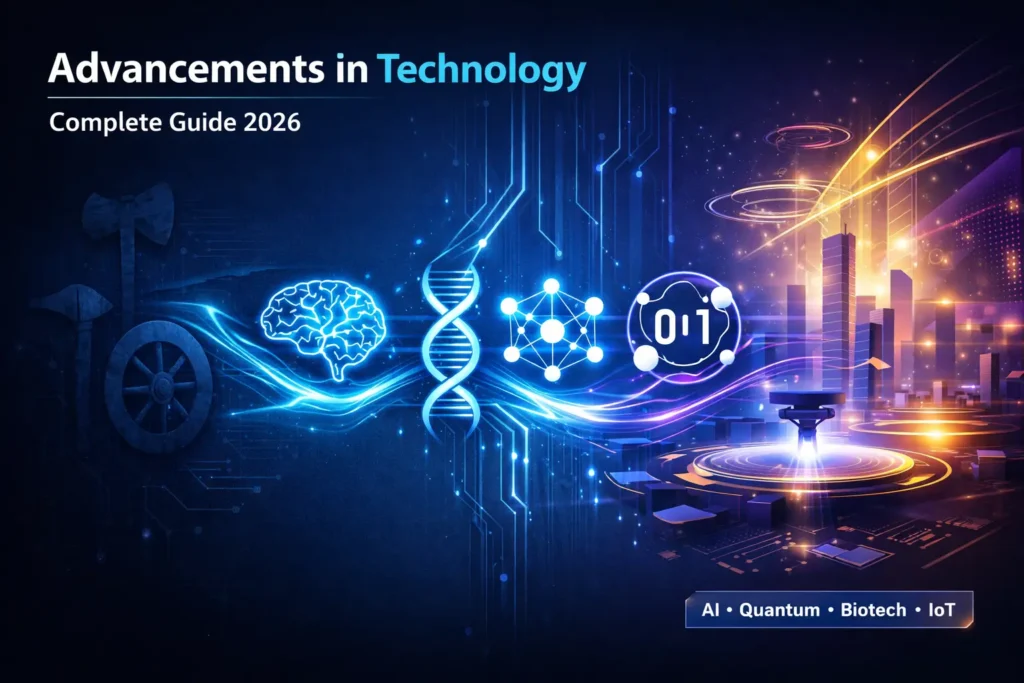
From the first stone tools shaped by human hands to artificial intelligence systems that can create art, compose music, and solve complex scientific problems, technology has been the defining force of human progress. But today’s pace of change is unlike anything our ancestors experienced. Technologies that once took decades to develop now emerge in years—or even months. Understanding these advancements isn’t just about keeping up with the latest gadgets; it’s about grasping the fundamental shifts reshaping how we work, live, heal, and connect.
This guide takes you beyond surface-level lists of innovations. We’ll explore not just what the key technological advancements are, but how they evolved, why they matter to your daily life, and where they’re taking humanity next.
The Engine of Progress: What Drives Advancements in Technology?
Before diving into specific technologies, it’s worth understanding what actually fuels innovation. Technological progress doesn’t happen in a vacuum—it’s the result of converging forces that amplify each other.
From Scientific Discovery to Real-World Application
The journey from laboratory breakthrough to everyday technology follows a predictable pipeline. It starts with basic scientific research—often publicly funded work at universities and institutions like MIT, CERN, or DARPA—where scientists probe fundamental questions about physics, chemistry, or biology without immediate commercial goals.
These discoveries then move into applied research, where engineers and companies figure out how to turn abstract principles into practical tools. GPS technology, for instance, began with Einstein’s theories of relativity, progressed through Cold War military satellite programs, and eventually became the navigation system in your smartphone. This pipeline can take decades, but when it succeeds, it transforms entire industries.
The Convergence Factor
Perhaps the most important principle driving modern innovation is convergence: breakthroughs accelerate when different technologies combine. Artificial intelligence alone is powerful, but AI combined with big data and cloud computing becomes transformative. Similarly, the Internet of Things only reaches its potential when paired with 5G connectivity and edge computing.
This convergence explains why progress feels exponential right now. Each new technology doesn’t just add to our capabilities—it multiplies the potential of everything that came before. Moore’s Law, which observed that computing power doubles roughly every two years, has been the engine beneath decades of this compounding innovation.
The Defining Advancements in Technology Shaping Our World
The Intelligence Revolution: AI and Machine Learning
From Narrow AI to Generative Breakthroughs
Artificial intelligence has evolved from systems that could only perform single, specific tasks to models that demonstrate remarkable versatility. Modern large language models like ChatGPT, Claude, and others in the generative AI family can write code, analyze documents, create images, and engage in nuanced conversations—tasks that require understanding context, creativity, and reasoning.
These systems are built on neural networks, computational architectures inspired by the human brain. They learn patterns from vast datasets rather than following explicitly programmed rules. The breakthrough of the 2020s has been generative AI’s ability to create original content, whether text, images, music, or even video, that’s often indistinguishable from human-created work.
Practical Applications Changing Industries
AI’s real power emerges in its applications. In healthcare, machine learning algorithms now detect cancers in medical imaging with accuracy matching or exceeding specialist radiologists. In business, predictive analytics help companies forecast demand, optimize supply chains, and personalize customer experiences at scale. Autonomous systems—from warehouse robots to self-driving vehicles—use AI to navigate complex, unpredictable environments.
The pattern is clear: wherever there’s data and pattern recognition involved, AI is transforming how work gets done, making processes faster, more accurate, and increasingly personalized.
Beyond Binary: The Promise of Quantum Computing
Qubits, Superposition, and Solving the Unsolvable
While classical computers process information as bits (either 0 or 1), quantum computers use qubits, which can exist in superposition—effectively being both 0 and 1 simultaneously. This isn’t just a incremental improvement; it’s a fundamentally different approach to computation.
Think of it this way: if a classical computer is like checking each path through a maze one at a time, a quantum computer can explore all paths simultaneously. For certain types of problems—those involving massive numbers of possible combinations—this represents a revolutionary leap in processing power.
Companies like IBM, Google, and specialized startups are building increasingly powerful quantum systems, though we’re still in the early stages. Current quantum computers are sensitive, require extreme cooling, and can only run for short periods before errors accumulate.
Future Impact: Cryptography, Drug Discovery, and Climate Modeling
The implications are staggering. Quantum computers could break current encryption systems (while also enabling new, quantum-based security). They could simulate molecular interactions to accelerate drug discovery, potentially designing new medicines in hours rather than years. Climate scientists could model Earth’s systems with unprecedented accuracy, improving predictions and solutions for environmental challenges.
The consensus among experts is that practical, large-scale quantum computing is still 5-15 years away, but the foundation is being laid now.
The Connected Planet: IoT, 5G/6G, and Hyperconnectivity
Building the Nervous System of Smart Cities
The Internet of Things refers to the billions of sensors, devices, and machines now connected to the internet, constantly collecting and sharing data. Your smart thermostat, fitness tracker, and voice assistant are simple examples, but the real transformation is happening at city and industrial scales.
Smart cities use IoT sensors to monitor everything from traffic flow to air quality to water systems. This real-time data allows cities to optimize resources, reduce energy waste, respond faster to emergencies, and improve quality of life. Manufacturing facilities use industrial IoT to predict equipment failures before they happen and fine-tune production processes for maximum efficiency.
How Advanced Connectivity Enables Everything Else
The explosion of connected devices only became viable with advances in wireless technology. 5G networks offer dramatically lower latency (the delay between sending and receiving data) and higher bandwidth than previous generations, making real-time applications possible. Autonomous vehicles need to communicate with each other and infrastructure in milliseconds—4G wasn’t fast enough, but 5G is. Remote surgery, where a specialist operates on a patient thousands of miles away using robotic instruments, requires the same ultra-low latency.
Looking ahead, 6G technology under development promises even more dramatic improvements, potentially enabling truly immersive augmented reality experiences and seamless human-AI collaboration.
The Physical-Digital Blend: Robotics, Automation, and XR
Cobots, Autonomous Agents, and the Future of Work
Modern robotics has evolved beyond the fixed, repetitive machines of traditional factories. Collaborative robots, or “cobots,” work safely alongside humans, learning from demonstrations and adapting to new tasks. Companies like Tesla and Boston Dynamics have showcased robots with remarkable agility and autonomy, able to navigate complex environments and manipulate objects with increasing dexterity.
The next frontier is autonomous agents—AI systems that can independently complete complex, multi-step tasks. These combine the physical capabilities of robots with the decision-making power of advanced AI, potentially revolutionizing industries from construction to healthcare to agriculture.
Immersive Worlds: How VR and AR Are Redefining Experience
Extended reality technologies—encompassing virtual reality, augmented reality, and mixed reality—are blurring the line between physical and digital worlds. Devices like Meta Quest headsets and Apple Vision Pro demonstrate how far immersive technology has come, offering experiences that feel genuinely three-dimensional and interactive.
Beyond gaming and entertainment, XR is proving valuable for training (allowing surgeons or pilots to practice in risk-free simulations), remote collaboration (meeting as avatars in virtual spaces), and design (visualizing architecture or products before building them). As hardware becomes lighter, more affordable, and more comfortable, expect these technologies to move from niche to mainstream.
Sustainable and Life-Saving Tech: Biotech and Green Tech
Editing the Code of Life: CRISPR and Personalized Medicine
CRISPR-Cas9 technology has given scientists a precise tool for editing DNA, essentially allowing us to rewrite genetic code with unprecedented accuracy. Researchers Jennifer Doudna and others pioneered this approach, which is now being used to develop treatments for previously incurable genetic diseases, create disease-resistant crops, and even potentially eliminate malaria-carrying mosquitoes.
Personalized medicine, enabled by genetic sequencing and AI analysis, tailors treatments to individual patients based on their unique genetic makeup. Cancer therapies can now be designed specifically for a patient’s tumor, dramatically improving outcomes. As sequencing becomes faster and cheaper, this personalized approach will likely become standard practice.
Innovations for a Healthy Planet: Renewables, Carbon Capture, and Circular Tech
The urgency of climate change has accelerated innovation in sustainable technologies. Solar and wind power have become cost-competitive with fossil fuels in many regions, while battery technology advances make renewable energy storage practical. Electric vehicles from companies like Tesla have moved from curiosity to mainstream, with traditional automakers racing to electrify their fleets.
Carbon capture technology aims to remove CO2 directly from the atmosphere or industrial exhaust, potentially reversing some greenhouse gas accumulation. Circular economy approaches redesign products and systems to eliminate waste, keeping materials in use through recycling, remanufacturing, and innovative business models like product-as-service.
Green technology isn’t just about environmental responsibility anymore—it’s becoming economically advantageous and strategically essential.
The Double-Edged Sword: Critical Impacts and Ethical Considerations
The Societal Balance: Productivity Versus Displacement
Every technological revolution disrupts labor markets. Automation and AI are no exception. While they create new job categories and increase productivity, they also displace workers in roles involving routine tasks—from manufacturing to data entry to even some creative and analytical work.
History suggests that technology creates more jobs than it destroys over the long term, but the transition periods can be painful, and the new jobs often require different skills. The challenge for society is ensuring workers can adapt through retraining programs, education reform, and social safety nets that support people during transitions.
Ethical Frontiers: Bias, Privacy, and Playing God
AI systems can perpetuate or amplify biases present in their training data, leading to discriminatory outcomes in hiring, lending, criminal justice, and other critical areas. Addressing algorithmic bias requires diverse development teams, careful dataset curation, and ongoing monitoring—work that’s as much social as technical.
Data privacy has become a central concern as our digital footprints expand. Every app, device, and online interaction generates data that companies collect and analyze. Finding the right balance between personalization benefits and privacy protection remains an active debate, with regulations like GDPR in Europe attempting to give individuals more control.
Biotechnology raises profound questions about human intervention in natural processes. Should we edit the genes of embryos to prevent disease? Where’s the line between therapy and enhancement? Who decides which genetic traits are desirable? These aren’t just technical questions—they’re ethical dilemmas that society must navigate collectively.
The Environmental Footprint of a Digital World
The irony of our digital age is that it has a substantial physical footprint. Data centers that power cloud computing and AI consume enormous amounts of energy—some estimates suggest AI training runs for large models use as much electricity as a small city over several weeks. The production of smartphones, computers, and other devices requires mining rare earth elements under often problematic conditions.
Electronic waste is the fastest-growing waste stream globally, as devices are replaced at accelerating rates. While sustainable technology is advancing, the tech industry itself must grapple with its environmental impact, pushing for renewable energy-powered infrastructure, longer device lifespans, and better recycling systems.
The Future of Advancement: What’s Next on the Horizon?
Short-Term Horizon (2026-2027): AI Agents and Autonomous Everything
The next few years will likely see AI evolve from assistive tools to autonomous agents that can complete complex tasks independently. Imagine AI that doesn’t just answer questions but can research topics, coordinate projects, make purchases, schedule appointments, and handle administrative work with minimal human oversight.
Autonomous vehicles will expand beyond test programs to commercial deployment in controlled environments—specific routes, delivery services, and dedicated zones within cities. The technology exists; the remaining challenges are regulatory approval, infrastructure adaptation, and public acceptance.
The Next Decade: Towards Artificial General Intelligence and Beyond
The possibility of artificial general intelligence—AI that can match or exceed human capabilities across all cognitive tasks—remains hotly debated. Some researchers believe AGI is 10-20 years away; others think it’s further or may never arrive. Regardless of timeline, the implications would be profound, potentially leading to rapid acceleration in scientific discovery, economic transformation, and fundamental questions about human purpose and identity.
Other developments likely within the next decade include practical quantum computers solving real-world problems, brain-computer interfaces allowing direct communication between minds and machines, and biotechnology advances that significantly extend healthy human lifespan.
As technology’s power grows, so does the importance of governance. Policymakers worldwide are grappling with how to regulate AI, protect privacy, ensure cybersecurity, manage autonomous systems, and address the geopolitical dimensions of technological competition—particularly around semiconductors, data, and advanced manufacturing.
The concept of “responsible innovation” emphasizes developing technology with ethical considerations built in from the start, not added as an afterthought. This includes diverse stakeholder input, transparency about capabilities and limitations, and proactive risk assessment. Standards bodies like IEEE and emerging frameworks for AI governance will shape how these powerful technologies are deployed.
FAQs
What has been the most significant technological advancement in human history?
While it’s tempting to point to recent innovations, a strong case can be made for information technologies that accelerated human knowledge sharing. Writing allowed ideas to persist beyond individual lifetimes. The printing press democratized knowledge, fueling the Renaissance and Reformation. The internet connected humanity’s collective intelligence instantaneously and globally. Each of these advancements didn’t just improve what we could do—they fundamentally changed how we think, organize, and evolve as a species.
What is the most important technology being developed right now?
Rather than a single technology, it’s the convergence of artificial intelligence, biotechnology, and sustainable energy systems that may prove most consequential. AI accelerates discovery across all fields. Biotechnology gives us tools to address disease and environmental challenges. Renewable energy and battery technology make sustainable civilization possible. These technologies reinforce each other—AI helps design better solar panels and drugs; biotech can create more efficient energy sources; clean energy powers the computing infrastructure AI requires.
How do technological advancements affect everyday life?
Technology has transformed daily existence in countless ways, many now invisible because they’re so integrated. Communication is instant and global—you can video call anyone, anywhere, for free. Healthcare access has expanded through telemedicine, wearable devices that monitor vital signs, and medical databases that help doctors make better decisions. Work has become more flexible, with remote collaboration tools enabling people to work from anywhere. Transportation is safer and more efficient, from GPS navigation to collision avoidance systems. Entertainment is personalized and on-demand. Even simple tasks like shopping, banking, and learning have been fundamentally reshaped by digital tools.
What are the biggest risks or dangers of new technologies?
Several categories of risk deserve attention. Misinformation spreads faster than ever through social media and can now be amplified by AI-generated content that’s increasingly difficult to distinguish from reality. Cybersecurity threats grow as more of our infrastructure becomes connected—a successful attack could disrupt power grids, financial systems, or healthcare networks. Autonomous weapons raise the specter of military conflict with reduced human judgment and control. Perhaps most concerning is the potential for technology to exacerbate inequality, creating a two-tier society where those with access to advanced tools pull further ahead while others are left behind. Socioeconomic disruption from rapid automation could destabilize communities and political systems if not managed thoughtfully.
How can I prepare for a future shaped by rapid technological change?
Cultivating adaptability is perhaps the most important skill. Commit to continuous learning—not just about specific technologies, but about how to learn new systems quickly. Digital literacy increasingly means understanding not just how to use tools, but how they work, their limitations, and their implications. Critical thinking becomes essential in an age of abundant but variable-quality information. Develop complementary skills that AI struggles with: emotional intelligence, creative problem-solving, ethical reasoning, and human connection. Stay informed about emerging technologies not to become an expert in everything, but to anticipate changes in your field and society. Finally, engage with the ethical and policy dimensions of technology—these decisions will shape everyone’s future, and democratic participation requires informed citizens.
Last updated: January 2026. Given the rapid pace of technological change, we review and update this guide regularly to ensure accuracy and relevance.

Adrian Cole is a technology researcher and AI content specialist with more than seven years of experience studying automation, machine learning models, and digital innovation. He has worked with multiple tech startups as a consultant, helping them adopt smarter tools and build data-driven systems. Adrian writes simple, clear, and practical explanations of complex tech topics so readers can easily understand the future of AI.




1