
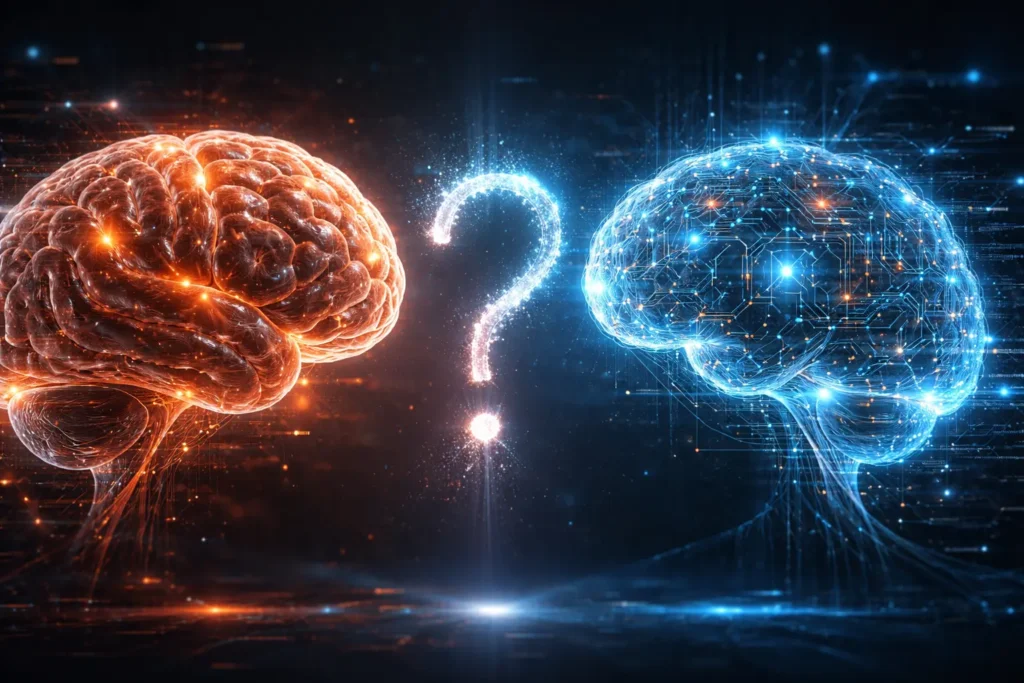
If you’ve ever watched an AI write a clean paragraph, debug code, diagnose a medical image, or hold a surprisingly natural conversation, you’ve probably asked yourself the same question millions of others are quietly Googling right now: is AI actually intelligent, or does it just look that way?
This question matters more today than it did even a year ago. AI systems are no longer hidden in research labs or buried inside enterprise software. They’re drafting emails, shaping hiring decisions, recommending medical treatments, driving cars, creating art, and influencing how information spreads. For business owners, creators, developers, students, and everyday users, understanding what AI really is—and what it is not—is no longer optional.
This article is for readers who want clarity without hype. You don’t need a computer science degree to follow it, but you also won’t find shallow explanations or marketing fluff. We’ll move carefully from first principles to expert-level insight, unpacking intelligence itself before asking whether machines genuinely possess it. Along the way, I’ll share practical observations from real-world deployments, highlight where AI delivers undeniable value, and explain where human judgment remains irreplaceable.
By the end, you’ll understand:
- Why AI feels intelligent even when it isn’t conscious
- What modern AI systems can do astonishingly well—and why
- Where today’s AI still fundamentally breaks down
- How to use AI confidently without overestimating or underestimating it
This isn’t about fear or blind optimism. It’s about accurate understanding—because the people who understand AI realistically are the ones who benefit from it the most.
What Do We Even Mean by “Intelligence” in the First Place?
Before answering whether AI is actually intelligent, we need to slow down and define intelligence itself. This is where most online debates quietly fall apart.
In everyday language, intelligence is a messy bundle of traits. We use it to describe problem-solving ability, learning from experience, adapting to new situations, reasoning abstractly, understanding context, and sometimes emotional awareness or creativity. Humans display all of these in different combinations, which is why intelligence isn’t a single measurable thing—even among people.
Psychologists, philosophers, and neuroscientists still don’t agree on one clean definition. Some focus on learning and adaptation. Others emphasize reasoning and goal-directed behavior. Still others argue that true intelligence requires consciousness or subjective experience.
This matters because AI excels at some components of intelligence while lacking others entirely.
A helpful analogy is a calculator. It performs arithmetic far better than any human, yet no one claims it “understands” math. Now scale that idea up dramatically. Modern AI systems can:
- Recognize patterns across billions of data points
- Predict outcomes with statistical accuracy
- Generate coherent language and images
- Optimize complex systems faster than humans
But these abilities arise from pattern processing, not awareness or understanding in the human sense.
So when people ask “is AI actually intelligent?”, they’re often mixing two different questions:
- Can AI perform intelligent-seeming tasks?
- Does AI possess intelligence as an internal mental state?
Keeping that distinction clear will make everything else click.
How Modern AI Works (Without the Jargon)
To understand why AI appears intelligent, it helps to understand how it works—at least conceptually.
Most modern AI systems are built on machine learning, particularly deep learning. Instead of following explicit rules written by programmers, these systems learn patterns from vast amounts of data. They don’t “know” facts the way humans do; they learn statistical relationships.
Imagine teaching a child to recognize dogs. You show them many dogs, correct mistakes, and eventually they generalize the concept. AI training works similarly—but at a scale no human could match. Millions or billions of examples are processed, and the system adjusts internal parameters to minimize errors.
Large language models, for example, learn how words relate to each other across enormous text corpora. They don’t understand meaning the way humans do. Instead, they become extremely good at predicting what comes next based on context.
That predictive power is what feels like intelligence.
In practice, this leads to impressive results:
- AI can summarize legal documents in seconds
- Detect cancer in medical scans with high accuracy
- Translate languages fluently
- Write functional code
But here’s the key insight: AI does not “know” what it is doing. It does not hold beliefs, intentions, or understanding. It maps inputs to outputs based on learned patterns.
That doesn’t make it useless. It makes it powerful—but different.
Why AI Feels Intelligent to Humans
AI feels intelligent because it mirrors the outputs of intelligence without sharing its internal experience.
Humans are social pattern-detectors. When something responds coherently, adapts to our input, and produces relevant information, we instinctively attribute intelligence. This is the same reason people name their cars or feel frustrated with software as if it had intentions.
There’s also history at play. Decades ago, conversational programs were crude. Today’s systems generate nuanced responses, remember context within sessions, and handle ambiguity gracefully. That leap tricks our intuition.
Another factor is specialization. Humans are generalists by necessity. AI systems, on the other hand, can become superhuman within narrow domains. A chess engine feels intelligent because it consistently outperforms grandmasters. But outside chess, it’s useless.
This mismatch between narrow excellence and broad understanding is where confusion arises.
When AI succeeds, it succeeds spectacularly. When it fails, it fails in ways no human would—confidently wrong, context-blind, or logically inconsistent.
Where AI Is Genuinely Powerful in the Real World

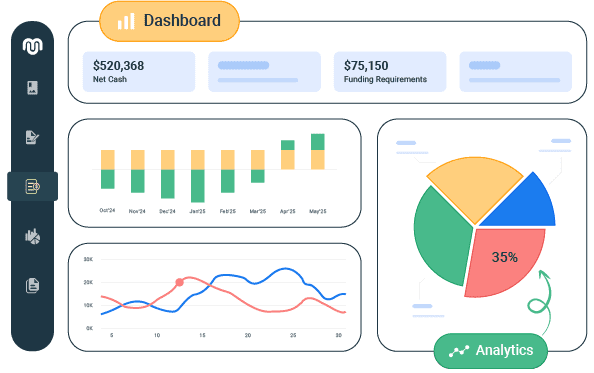

To ground this discussion, let’s talk about where AI delivers undeniable, practical intelligence-like value today.
In healthcare, AI systems analyze imaging data to detect early signs of disease. Radiologists using AI assistance often catch conditions faster and with fewer errors. In finance, AI models process market signals at speeds impossible for humans, supporting risk assessment and fraud detection.
In marketing and content strategy—areas you may already be working in—AI excels at pattern recognition across user behavior. It can identify what headlines convert, what content retains attention, and how audiences segment, saving teams enormous time.
In software development, AI reduces cognitive load. Developers use it to autocomplete code, explain legacy systems, and debug faster. The intelligence here isn’t creativity—it’s acceleration.
The common thread is this: AI amplifies human capability when the task is pattern-heavy, data-rich, and feedback-driven.
Before AI, these tasks were slow or expensive. After AI, they’re scalable.
The Limits: Where AI Quietly Falls Apart
This is where hype often collapses.
AI struggles with:
- True reasoning across unfamiliar domains
- Understanding cause and effect beyond correlation
- Common-sense judgment
- Moral or ethical reasoning
- Self-directed goal formation
Ask an AI to explain something slightly outside its training distribution, and you may get a confident but incorrect answer. This is not malice or deception—it’s a structural limitation.
AI does not “realize” it is wrong. It has no internal alarm for truth. It optimizes for plausibility, not accuracy.
This is why experienced professionals treat AI as an assistant, not an authority.
Is AI Actually Intelligent in the Philosophical Sense?
Short answer: No—not in the way humans are.
AI does not possess consciousness, self-awareness, or subjective experience. It does not understand meaning. It does not have desires or intentions. Even the most advanced systems today are tools executing learned statistical behaviors.
This doesn’t diminish their usefulness. It clarifies it.
Some researchers believe future systems may cross this line. Others argue intelligence without consciousness is fundamentally different. Influential thinkers like Alan Turing framed intelligence behaviorally, while modern AI labs such as OpenAI and DeepMind focus on capability scaling, not consciousness.
For now, intelligence in AI is functional, not experiential.
A Practical Step-by-Step Framework for Using AI Wisely
Understanding AI conceptually is useful, but applying it intelligently matters more.
First, define the task clearly. AI works best when success can be measured. Vague goals produce vague outputs.
Second, choose the right tool. General models like GPT-4 excel at language tasks, while specialized systems outperform them in narrow domains.
Third, keep humans in the loop. Review outputs critically. Treat AI suggestions as drafts, not decisions.
Fourth, iterate. The best results come from refining prompts, workflows, and feedback loops.
Finally, know when not to use AI. Tasks requiring empathy, accountability, or novel judgment still belong to humans.
Common Mistakes People Make With AI—and How to Avoid Them
The most common mistake is over-trusting AI outputs. People assume coherence equals correctness. It doesn’t.
Another mistake is under-utilization. Some dismiss AI entirely after one poor experience. In reality, AI performance depends heavily on context, prompting, and integration.
A third mistake is using AI to replace thinking rather than support it. The most successful users treat AI like a sharp intern: fast, capable, but in need of guidance.
So… Is AI Actually Intelligent?
AI is not intelligent in the human sense—but it is functionally powerful in ways that matter.
It doesn’t think. It doesn’t understand. It doesn’t know. But it predicts, recognizes, and generates with extraordinary effectiveness. When used appropriately, it becomes a force multiplier for human intelligence, not a replacement for it.
The future doesn’t belong to people who fear AI or worship it. It belongs to people who understand it accurately—and use it deliberately.
FAQs
Is AI conscious or self-aware?
No. Current AI systems have no consciousness or awareness.
Why does AI sound so confident even when wrong?
Because it optimizes for plausible responses, not truth verification.
Can AI think like a human?
No. It mimics outputs of thinking without internal understanding.
Will AI ever become truly intelligent?
That depends on future breakthroughs; there is no consensus.
Is AI smarter than humans?
In narrow tasks, yes. In general reasoning and judgment, no.

Adrian Cole is a technology researcher and AI content specialist with more than seven years of experience studying automation, machine learning models, and digital innovation. He has worked with multiple tech startups as a consultant, helping them adopt smarter tools and build data-driven systems. Adrian writes simple, clear, and practical explanations of complex tech topics so readers can easily understand the future of AI.