
Introduction
If you’ve ever found yourself staring at the Connections grid, convinced the words almost make sense together—but not quite—you’re not alone. Every morning, thousands of players search for connections hint today forbes, hoping for that gentle nudge that turns confusion into clarity. Not a spoiler. Not the full answer. Just enough insight to crack the puzzle yourself.
And that’s exactly why this topic matters.
Connections isn’t just another word game. It’s a daily mental workout that rewards lateral thinking, cultural awareness, and pattern recognition. Some days it feels effortless. Other days, it humbles even seasoned puzzle lovers. The right hint at the right time can make the difference between a satisfying “aha” moment and frustration-induced grid abandonment.
In this guide, I’ll walk you through what “Connections hint today Forbes” actually means, why so many players rely on it, and how to use hints strategically—without ruining the fun. We’ll cover benefits, real-world use cases, a step-by-step approach to solving the puzzle, tools and resources (including Forbes-style hints), common mistakes, and expert-level tips to sharpen your game long-term.
Whether you’re new to Connections or a daily streak defender, this is your complete, human-first roadmap.
Understanding Connections Hint Today Forbes
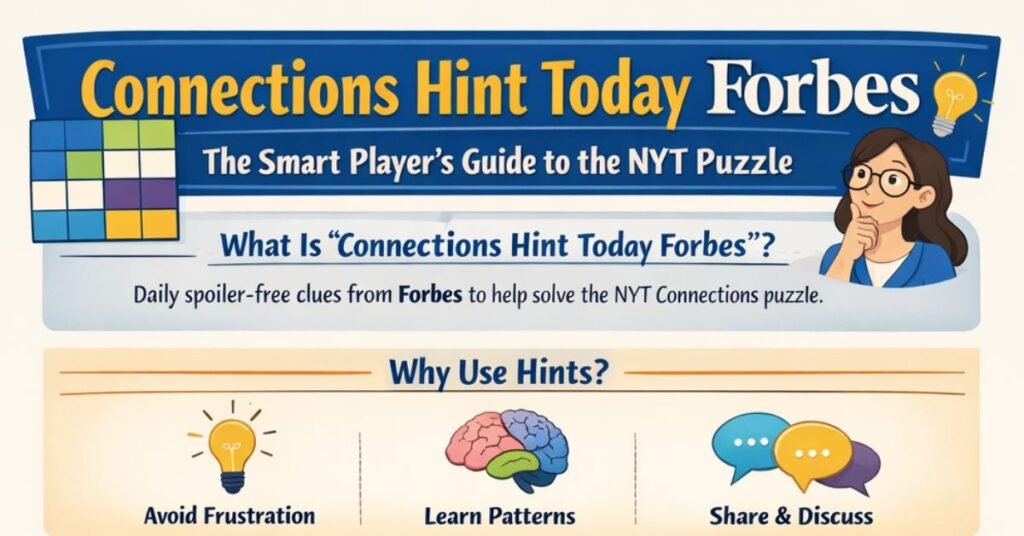
At its core, Connections hint today Forbes refers to the daily hints published or discussed in relation to the New York Times’ Connections puzzle, often curated or summarized by Forbes contributors. These hints are designed to guide players toward the correct groupings without outright revealing the answers.
Think of it like a friend tapping the table and saying, “You’re warm,” instead of blurting out the solution.
Connections presents 16 words that must be sorted into four groups of four, each group sharing a common theme. The catch? Many words seem like they belong in multiple categories. That overlap is intentional—and it’s what makes the puzzle addictive and tricky.
Forbes-style hints typically focus on:
- Broad category clues (e.g., “One group relates to finance”)
- Difficulty tier guidance (yellow is easiest, purple is hardest)
- Subtle nudges about word usage (literal vs. metaphorical meanings)
Unlike answer dumps, these hints preserve the challenge. They respect the puzzle-solving process while helping players avoid dead ends.
For beginners, this kind of hinting builds confidence. For experienced solvers, it sharpens strategic thinking. And for everyone else, it saves time without sacrificing satisfaction.
Why Players Use Connections Hints (Benefits & Use Cases)
The appeal of connections hint today forbes goes far beyond curiosity. There are practical, psychological, and even social reasons players seek hints instead of full solutions.
First, hints protect the joy of solving. When you get stuck, frustration can override fun. A small hint re-engages your brain and restores momentum without spoiling the payoff.
Second, hints help players learn patterns over time. Regular exposure to category logic—synonyms, homophones, pop culture references, wordplay—improves your future performance. You’re not just solving today’s puzzle; you’re training for tomorrow’s.
Common real-world use cases include:
- Morning routine players who want a quick win before work
- Casual players protecting a streak without cheating
- Educators and writers (yes, this includes content writers) using the puzzle as a creative warm-up
- Competitive solvers who analyze hint styles to predict difficulty
There’s also a social layer. Many people discuss hints with friends or online communities, comparing interpretations without sharing spoilers. That shared struggle creates connection—fitting, given the puzzle’s name.
In short, hints strike a balance between independence and assistance. They empower, rather than replace, your thinking.
How to Use Connections Hints Effectively (Step-by-Step Guide)
Using hints well is a skill in itself. Here’s a practical, repeatable process that seasoned solvers swear by.
Start by scanning the grid slowly. Read all 16 words out loud if possible. Hearing them often reveals associations your eyes miss. Before touching any hint, try forming at least one tentative group.
Next, identify obvious pairs. Two words that clearly relate—synonyms, shared contexts, or common phrases—can anchor a group. Don’t lock them in yet; just note the connection.
Only then should you consult a connections hint today forbes resource. Read the hint once. Resist the urge to overanalyze. Ask yourself: “Which of my assumptions does this confirm or challenge?”
Apply the hint strategically:
- If the hint mentions difficulty color, start with that tier
- If it references word function (verbs, nouns, slang), reclassify mentally
- If it hints at theme type (category vs. phrase), adjust your grouping logic
Lock in the group you feel most confident about first. This reduces noise and narrows options for the remaining words.
Finally, re-evaluate after each correct submission. The puzzle often becomes clearer once one group is removed.
Best practices include:
- Avoid stacking guesses without logic
- Don’t force cleverness where simplicity fits
- Step away for a minute if stuck—fresh eyes help
Hints are tools, not crutches. Use them to enhance, not replace, reasoning.
Tools, Comparisons, and Trusted Recommendations
Not all hint sources are created equal. Understanding your options helps you choose wisely.
Forbes-style hints are popular because they emphasize restraint. They’re usually written by experienced puzzle commentators who understand the value of discovery. The tone is informative, not clickbait-driven.
Free hint sources often include:
- Daily blogs summarizing puzzle themes
- Social media threads offering subtle nudges
- Community forums discussing categories without spoilers
Paid or premium options may offer:
- Early access hints
- Difficulty breakdowns with examples
- Historical analysis of puzzle patterns
Pros of Forbes-style hints:
- Clear, concise guidance
- SEO-friendly structure for quick scanning
- Respect for the puzzle-solving experience
Cons:
- Not always published early in the day
- May assume some prior puzzle familiarity
Alternatives include NYT-focused puzzle blogs or independent word game newsletters. The key is choosing sources that align with your play philosophy. If you value learning and satisfaction over speed, hint-based guidance is ideal.
Expert insight: rotate your hint sources occasionally. Different writers emphasize different angles, which broadens your pattern recognition.
Common Mistakes Players Make (and How to Fix Them)
Even experienced players fall into predictable traps. Recognizing these mistakes is half the battle.
One common error is overthinking simple categories. Not every group is clever or obscure. Sometimes “types of hats” really is just that. When hints suggest an easy tier, trust simplicity.
Another mistake is confirmation bias. You see three words that fit a theme and force a fourth that doesn’t quite belong. Hints often exist to break this mental tunnel vision.
Players also misuse hints by reading too many at once. This overloads your reasoning and turns the puzzle into a mechanical process.
How to fix these issues:
- Pause before locking in groups—ask what else a word could mean
- Use hints one at a time, not in bulk
- Revisit rejected groupings with fresh context
- Accept that some days are harder by design
Remember, struggling doesn’t mean you’re bad at the game. It means the puzzle is doing its job.
Long-Term Strategy: Getting Better Without Relying on Hints
If you find yourself searching connections hint today forbes every morning, that’s okay—but improvement comes from reflection.
After solving, review the final categories. Ask why they worked. Note unfamiliar references or word usages. Over time, you’ll spot recurring patterns: double meanings, cultural groupings, grammatical roles.
Keep a mental (or written) list of past themes. You’ll be surprised how often they resurface in new forms.
Also, play actively. Instead of guessing, articulate your reasoning—even if just in your head. This strengthens neural pathways associated with problem-solving.
Hints should gradually become optional. When that happens, you’re no longer just playing—you’re mastering the puzzle.
Conclusion
Searching for connections hint today forbes isn’t about shortcuts. It’s about smart support. The right hint preserves challenge, builds skill, and keeps the daily puzzle fun rather than frustrating.
By understanding how hints work, when to use them, and how to learn from them, you turn each puzzle into a growth opportunity. Over time, you’ll rely less on external nudges and more on your own sharpened instincts.
If you enjoyed this guide, try applying these strategies tomorrow—and see how differently the grid feels. And if you ever get stuck? A well-placed hint is waiting.
FAQS
What is Connections Hint Today Forbes?
It refers to daily, spoiler-light hints often published or summarized by Forbes contributors to help players solve the NYT Connections puzzle.
Are Forbes hints better than full answers?
Yes, if you want to preserve the challenge. Hints guide thinking without removing the satisfaction of solving.
Do hints affect my Connections streak?
No. Using hints doesn’t reset or invalidate your streak, since you’re still solving the puzzle yourself.
When should I use a hint?
After you’ve tried forming groups on your own and feel genuinely stuck, not immediately.
Are hints the same every day?
No. They change daily based on puzzle difficulty, themes, and wordplay style.

Michael Grant is a business writer with professional experience in small-business consulting and online entrepreneurship. Over the past decade, he has helped brands improve their digital strategy, customer engagement, and revenue planning. Michael simplifies business concepts and gives readers practical insights they can use immediately.





References:
Lollybet Casino Seriös toolbarqueries.google.li
References:
Lollybet Live Casino http://mimi28.ahlamontada.com/go/aHR0cHM6Ly9sb2xseWJldC5jb20uZGUv
References:
Neosurf Casino Auszahlung http://akmrko.ru/bitrix/redirect.php?event1=file&event2=download&event3=1015.doc&goto=https://s3.amazonaws.com/new-casino/Casino-Kingdom-App.html
References:
Löwen Play Casino Bewertung https://www.governmentcounty.org/modify-company-details?nid=50164&element=https://s3.amazonaws.com/new-casino/Sugar-Hill-Casino-Bonus-ohne-Einzahlung.html
References:
Mega Medusa Casino Bonus ohne Einzahlung https://www.infocar.ua/go/?s=612&u=https://s3.amazonaws.com/new-casino/Starda-Casino-App.html
References:
888 Casino Bonus ohne Einzahlung https://s3.amazonaws.com
References:
Vegas Casino Bonus ohne Einzahlung https://s3.amazonaws.com/new-casino/Bet365-Casino-Einzahlung.html
References:
High Roller Casino Einzahlung https://s3.amazonaws.com/
References:
%random_anchor_text% milegajob.com
References:
Casinia Casino Test code.a100-cn.com
References:
Lex Casino Einzahlung http://maps.google.mn/
References:
Candy 96 online casino australia https://theangel.fr/companies/top-online-pokies-site-in-australia
References:
Candy96 Casino referral jobszimbabwe.co.zw
References:
Candy96 play online https://cyprusjobs.com.cy/companies/free-chip-no-deposit-australia-best-risk-free-chips-2026-offers
References:
Billybets Casino Bonus ohne Einzahlung http://palm.muk.uni-hannover.de/trac/search?q=http://clients1.google.co.za/url?q=https://instantcasinodeutschland.de
References:
Gorilla Casino App forum.corvusbelli.com
References:
Monro Casino Einzahlung http://moldova.sports.md/extlivein.php?url=https://card.lifenlegacydigital.com/kennycroft9183
References:
Grand Casino Bonus ohne Einzahlung https://wasm.in/proxy.php?link=https://smartcard.phoenixopia.com/dorinearreguin
References:
Irwin Casino Auszahlung digitalcollections.clemson.edu
References:
Wettformat Casino Erfahrungen https://csszengarden.com
References:
Merkur Casino Erfahrungen https://gamma.astroempires.com/redirect.aspx?https://jobs.khtp.com.my/employer/91100/1go-casino-bonus-2026-50-freispiele-ohne-einzahlung/
References:
Vulkan Spiele Casino Auszahlung https://walijobs.com/
References:
Sugar Hill Casino Test https://alljobinpakistan.com
References:
Ice Casino Erfahrungen http://timetowin.clanweb.eu/index.php?site=profile&id=82887